Hispanic Heritage and the Colonial Category We Have Inherited
By Yenny Delgado
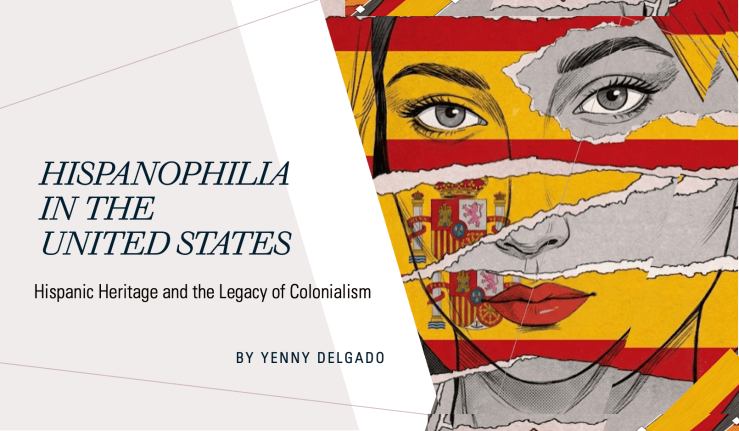
Every year, as the United States enters the month dedicated to Hispanic Heritage, celebrations, cultural events, and public observances gather around Hispanidad: a term that points to the cultural, historical, and linguistic heritage tied to Spain’s influence and colonial legacy on the continent. Although it can seem like a simple celebration of pride, it carries historical and political implications that deserve closer reflection.
Every year, as the United States enters the month dedicated to Hispanic Heritage, celebrations, cultural events, and public observances gather around Hispanidad: a term that points to the cultural, historical, and linguistic heritage tied to Spain’s influence and colonial legacy on the continent. Although it can seem like a simple celebration of pride, it carries historical and political implications that deserve closer reflection.
Originating in early twentieth-century Spain, particularly under Franco regimen, Hispanidad was promoted as an ideal of unity among Spanish-speaking peoples and as a celebration of Spanish civilization. It is often understood as a shared heritage built on language and culture, but its origins and uses are far from neutral.
As an immigrant in the United States, I have often wondered how deeply this conception of heritage has become institutionalized. People from profoundly different ethnic, ancestral, and cultural backgrounds, joined mainly by speaking Spanish, are grouped under the label “Hispanic” or “Latino.” That should prompt a critical question: what are we actually celebrating, what are we affirming, what are we remembering, and which identities and histories are left out?
The Historical Background
In the 1960s, during the Civil Rights Movement, rural and working-class communities were demanding recognition after suffering mistreatment, discrimination, and labor injustice. In 1968, President Lyndon B. Johnson, a Democrat, established National Hispanic Heritage Week, seeking to validate the presence of Cuban, Mexican, Puerto Rican and other migrant communities and to unify groups that were becoming publicly visible. Even then, Native descendants were generally folded into wider ethnic categories rather than recognized through their own ancestral histories.
Twenty years later, in 1988, Republican President Ronald Reagan expanded the observance from one week to a full month. That expansion marked a shift: from the struggles of civil rights toward an emphasis on “Spanish heritage,” patriotism, and traditional values, a decision that was as strategic as it was political. Many activists of the time read it as an attempt to “whiten,” or Europeanize, the identity of a community with far more diverse histories.
Reagan and the Republican Party also recognized the growing electoral weight of the Hispanic/Latino population. Reagan is widely reported to have said that Hispanics were Republicans who simply “don’t know it yet.” Whatever the exact wording, the sentiment captures the strategy: the government took an event born of civil resistance and community protest and turned it into a celebration that favored cultural assimilation, often at the expense of acknowledging the community’s multiethnic character.
The Legacy of Spanish Colonialism
The deeper question is the historical link between Hispanic identity and Spanish colonialism.
Spanish colonial rule, which began in 1492, reached much of what is now the United States, first as part of New Spain and later Mexico, and extended over all of Abya Yala.* Spanish colonizers forced Native peoples to erase their identities through genocide, exploitation, and oppression. Assimilation became a way to survive. Spanish language, names, Christianity, and cultural categories were imposed as tools of colonial control. Over generations, many Native descendants came to speak Spanish and later English, and migration and shifting borders made it harder still to determine how they would be identified in the United States. Speaking Spanish, carrying a Spanish surname, or coming from a country once colonized by Spain became more visible markers of identity than Native ancestry.
Hispanidad in the former Spanish colonies was born to reproduce that colonial structure. Its traditions, language, and religiosity were first celebrated by a white upper class descended from Spaniards and then reproduced downward among colonized peoples. These elements remain very present today, not only in the United States but across the continent. Celebrating this “heritage” without critical examination therefore risks reinforcing the same colonial worldview.
None of this means rejecting the Spanish language or traditions that have developed over centuries through interaction, resistance, migration, and exchange. The question is whether they can be honored without romanticizing, denying, or concealing the systems that imposed them.
The contradiction is especially clear when people who identify as Hispanic or Latino sharply criticize white supremacy, racism, and discrimination in Anglo-American society, while honoring Spanish colonial heritage without the same scrutiny. Spain colonized through discrimination, privilege, and the classism of white Spaniards. Why has that history been forgotten?
From Hispanic Identity to Hispanophilia
For many Spanish speakers in the United States, identifying as “Hispanic,” “Latino,” “Latinx,” or “Latine” has become a way to name a migrant background, one’s own or one’s family’s, and a bilingual condition in a society that has sought to homogenize itself around English. Speaking Spanish becomes a broader identity that goes beyond being Cuban, Mexican, Puerto Rican, or from any one country. In the United States, calling oneself Hispanic can foster belonging and increase political visibility. At the same time, the category creates considerable ambiguity.
In the broader American imagination, “Hispanic” or “Latino” people are typically racialized as brown-skinned, associated with Native ancestry, with low-wage labor, or, increasingly, with migrants affected by harsher border enforcement. Yet the most visible political voices who carry the label do not always live that experience. Take Marco Rubio and Ted Cruz, both with Cuban family roots, who have long championed strict immigration enforcement. The point is not their personal identity but how the migration story functions politically: the family’s journey of arrival becomes a credential and a source of authority, while the racial and class positions from which it is told go unexamined. This is one way the privileges of the colonial order keep reproducing themselves, rewarding those closest to its hierarchies while the Native and working-class people most affected by enforcement and exclusion remain the least represented.
The category “Hispanic” can therefore suggest a single, unified community when it actually includes people with profoundly different histories, racial identities, ancestral backgrounds, spiritual practices, social positions, and relationships to colonialism and migration.
Here the concept of Hispanophilia proves useful. Broadly, it means admiration or affection for Spain, including its culture, language, traditions, and historical legacy. It names a phenomenon that often goes unexamined: an emotional and cultural attachment to Spain that can conceal the genocide, the oppression, and the colonial structures that still sustain white supremacy in its former colonies. Some might even call this, in modern terms, a kind of Stockholm syndrome: an affective bond with the one who took power over you. So, we have to ask why the Spanish colonial legacy is remembered through pride, celebration, language, religion, and cultural achievement, while the violence inflicted on the very population that now celebrates it is pushed aside or made invisible.
The Colonial Category We Have Inherited
The trauma of the colonial past has also shaped how people are named. Millions of Native people and their descendants, including many Native people with Spanish surnames living in this country, have been forced to state their identity through categories like “Hispanic” or “Latino” on censuses, official records, birth certificates, and demographic surveys. They end up assimilated into a community recognized by the state rather than into their own ancestral nations.
Even those with Native ancestry often cannot fully claim that identity in the United States, especially in places like Texas, New Mexico, and California. Recognition as Native requires formal tribal enrollment, which is not based on ancestry alone but on an administrative process that can exclude more than it includes. This bureaucracy obscures the lived realities of many people who speak Spanish while keeping their ancestral languages alive.
The result is a paradox. A person may have Native ancestry, ancestral memory, cultural practices, and a bond with the peoples of Abya Yala, yet the most common public category remains “Hispanic,” and newer terms like Latino, Latine, or Latinx often circulate as synonyms or as other ways of living within the Spanish colonial legacy. That a colonial identity has become common, useful, or meaningful does not mean the history that produced it has disappeared.
The Contradictions of Decoloniality
The contradiction is especially visible in academic circles that consider themselves decolonial yet celebrate Hispanidad and admire Spain and its legacy.
Can we claim to be decolonial while paying homage to a colonial power, keeping alive the memory of its greatness, and hiding its genocides?
The same question applies to Anglo-American culture. Spain and the United States have different colonial histories, but both took part in the colonization of Abya Yala. Racism, white supremacy, and colonial systems remain in force. Coloniality does not vanish simply because we examine colonialism critically. It persists through the identities we adopt, the histories we honor, the institutions we remain in, and the kinds of knowledge we consider legitimate.
The contradiction deepens when people point to a parent or grandparent who arrived from Cuba, Mexico, or elsewhere as proof of their own disadvantage, without considering the ethnic, economic, and colonial differences within their communities of origin. Being a migrant does not automatically erase racial privilege, just as identifying as Hispanic does not automatically make someone a racial minority in every situation.
A decolonial approach requires more than asking who is marginalized in the United States. It also requires examining how privilege and hierarchy operate in the “Global South” countries people come from.
A Decolonial Academy, or a Trendy One?
This is where the problem sharpens. In recent years, “Global South” has become one of the most useful labels in the U.S. academy. It opens doors: invitations, publications, fellowships, hiring, credibility. But the label is often used without answering a basic question: who, exactly, is speaking from the Global South?
In Mexico, Brazil, or Argentine, many of the scholars who now present themselves this way belong to the white or European descendant elite. Their families, their ancestry, and their class position gave them a head start in countries built on the dispossession of Native and Afro-descendant peoples. They studied in the best schools, held social capital, and benefited from the very hierarchies that colonialism created and that still organize those societies. (Brazil’s colonizer was Portugal, not Spain, but the same logic of inherited colonial privilege applies.) Then they arrive in the United States, and “I am from the Global South” is treated as sufficient. It erases their position at home and turns a geographic origin into a claim to marginality. They then draw on the thought, struggles, and ancestral knowledge of Native peoples to build recognition, careers, and authority, benefiting a second time from the same system, now under the language of decoloniality.
Some academic discourses speak about marginalized communities while remaining structurally disconnected from them. In these settings, marginalized people become objects of reflection: their experiences and images enrich academic debate, while they remain excluded from shaping it. A truly decolonial methodology must go further. It must ask not only who speaks on behalf of marginalized groups, but also who is recognized as a subject, who holds authority, and which knowledge is considered legitimate.
Raising these questions carries significant personal and professional risk. Challenging coloniality in spaces that celebrate Hispanidad directly confronts narratives that glorify the Spanish imperial legacy instead of examining it. Identifying openly as a decolonial theologian can mean exclusion from Hispanic programs, scholarships, institutional networks, and publications. It means honoring ancestral memory in contexts that pressure people to erase it, or where that identity is perceived as a threat to institutional whiteness.
For those of us who honor and develop in community a decolonial theology we have named Abya Yala Theology, rooted in the spiritual practices and ancestral wisdom of the peoples of Abya Yala, the academic path is not easy. It is especially troubling to meet authors who treat decolonization as an academic trend, detached from the concrete, sustained commitments that many Abya Yala theologians have made in our communities. Decoloniality is not only a field of study or a category to be added to a research project. It is a responsibility to specific histories, peoples, territories, memories, and bodies.
Who Speaks?
That is why one of the first questions to ask of any work presented as decolonial is: who is speaking? Who is this person ancestry? What is their history? From where do they think? What is their relationship to the peoples, communities, and histories they write about? Whom do they represent, and to whom do they answer?
The absence of self-identification, ancestral memory, and an explicit historical and social location is not a minor matter. When someone writes about decolonization without situating themselves within the history they analyze, they risk turning other people’s experience into an academic object. And from that absence we must also ask about appropriation.
Can a descendant of Spanish colonizers, whose own family took part, directly or indirectly, in structures of domination and dispossession, speak about Native peoples? Can that person take on a decolonial voice without first acknowledging their place in this history and in the present? Or do they instead reach for broad categories like “migrant family from the Global South” to erase historical differences and camouflage their position, appropriating decolonial work that emerged from specific communities and that has bodies, memories, and trajectories behind it?
These questions are not meant to decide who has or does not have the right to think critically about coloniality. They ask us to distinguish between accompanying a decolonial process, studying it, and appropriating it. A truly decolonial reflection should begin by acknowledging where one speaks from and which power relations run through that position.
Perhaps these differences are not immediately obvious. But over time, once decolonial work stops being an academic novelty and becomes a sustained commitment, the differences begin to show. The absence of lived memory, embodied history, and community ties tends to reveal itself in work that reproduces the language of decoloniality as an academic exercise without sharing in the responsibilities that language carries.
What Are We Ready to Remember?
This is why decolonial theology must embrace discomfort and question established norms. My own relationship to this history shapes my perspective: I am formed by both the legacies of colonization and the ongoing work of reclaiming ancestral memory and tradition. Decoloniality requires dismantling colonial logic within ourselves, our communities, and the institutions we inhabit. Without that commitment, decolonial language risks becoming empty academic jargon laid over structures that remain intact.
Ultimately, the central question is not simply whether Hispanic Heritage Month should exist, but which histories we are willing to share, acknowledge, and confront through its observance.
*Abya Yala comes from the Guna language and means “land in full maturity” and “land of vital blood.” The Guna people live at the meeting points of the continent’s north and south, representing the motherland’s connectivity. In the 1970s, the term was adopted by many Native activists, historians, politicians, and theologians as a unified name in place of “the Americas,” “Latin America,” or “Hispanic America,” names that perpetuate colonial divisions. (Yenny Delgado and Claudio Ramírez, 2022)


Published by