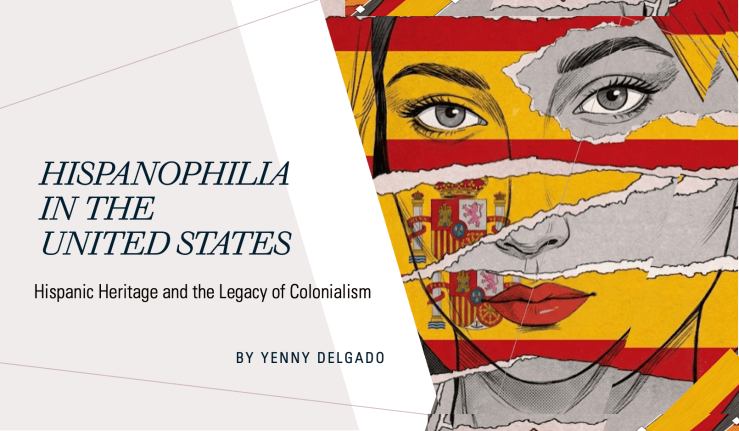
Hispanophilia in the United States

Hispanic Month and the legacy of colonialism

By Yenny Delgado

As the United States enters the month devoted to Hispanic Heritage, various celebrations, cultural events, and public observances are being organized around Hispanidad, which refers to the shared cultural, historical, and linguistic heritage connected to Spanish influence and legacy, particularly among Spanish-speakers and their descendants. Although the term might seem familiar and even harmless, it has significant historical and political implications that should be examined more thorough.

As an immigrant in the United States, I have often wondered how deeply rooted heritage has become institutionalized in this country. The manner in which individuals from diverse ethnic and cultural backgrounds are grouped together under the banner of Hispanic Heritage is perplexing and should prompt critical reflection on what is being celebrated, affirmed, and remembered, as well as which identities and histories are excluded. For this reason, I return to the historical context. During the Civil Rights Movement of the 1960s, a period characterized by increasing efforts to recognize the significant contributions of minority populations who struggle for rights, justice and opportunities. In 1968 under President Lyndon Johnson (D) proclaim the National Hispanic Heritage Week, twenty years later, in 1988 President Ronald Reagan (R) expanded into a 30-day observance. This expansion marked a shift from a focus on civil rights struggles to an emphasis on Spanish heritage, patriotism, and traditional values, which was a deliberate political and strategic decision. Many activists at the time viewed this shift as an attempt to “whiten” or Europeanize the community’s identity.

During his presidency Ronald Reagan and the Republican Party recognized the significant electoral influence of the expanding Latino population. Reagan famously stated, “Latinos are Republicans, they just don’t know it yet.” In this context, the U.S. government transformed an event rooted in civil resistance and community protest into a celebration that emphasized cultural assimilation, often at the expense of recognizing the community as multiethnic.

The presence of the Spanish colonialism spread all over Abya Yala* since they arrival in 1492. Spanish colonizers forced Native peoples to erase their identity in order to survive. Indeed Hispanidad in the former Spanish colonies was born to reproduce colonial structure, traditions, language and religiosity, that are still strongly present in today’s societies. However, there is a risk of reinforcing the same colonial views that decolonial thought aims to challenge if that heritage is celebrated without a critical examination of Spanish colonialism.

The contradiction is particularly clear when people who identify as Hispanic or Latino strongly criticize white supremacy, racism, and discrimination in Anglo-American society while at the same time honoring the Spanish colonial heritage; without subjecting that aspect to the same level of critical examination. The issue at stake is not whether we should reject the Spanish language, culture, or tradition; it is whether we can celebrate them without romanticizing the colonial systems that gave rise to them.

From Hispanic Identity to Hispanophilia

For many Spanish-speaking individuals who migrate to the United States or are born in the United States into Spanish-speaking families, the term “Hispanic” may become a broader identity that goes beyond being Cuban, Mexican, Puerto Rican, or any other specific country. In the United States, describing oneself as Hispanic can foster a sense of belonging and increase political visibility. At the same time, the category can generate significant ambiguity. In the broader cultural imagination, “Hispanic” or “Latino” people are often racialized as brown, associated with Native ancestry, low-wage labor, or, increasingly, with the experiences of migrants affected by intensified border enforcement. Yet many of the most visible political leaders who identify as Hispanic or Latino, including figures such as Marco Rubio and Ted Cruz, have predominantly Spanish ancestry.

The category “Hispanic,” therefore, can suggest the existence of a single, unified community when, in reality, it encompasses people with profoundly different histories, racial identities, ancestral backgrounds, social positions, and relationships to colonialism and migration.

Here, the concept of Hispanophilia proves useful. If it is broadly understood as meaning admiration or affection for Spain, including its culture, language, traditions, and historical legacy. Hispanophilia enables us to look at a phenomenon which is frequently left unnamed—that is, the emotional and cultural attachment to Spain which at the same time involves covering up the Spanish genocide, oppression, and colonialism that perpetuate white supremacy in their former colonies. 

When I was growing up in Peru, October 12th was remembered as the day Columbus arrived and the legacy of Spaniards as triumphalist, and it was until Native peoples rose up to criticize that celebration as painful and colonial that the government finally in 2009, as part of a decolonial move, changed it to the “Day of the Indigenous Peoples and Intercultural Dialogue.” Because of that, living in the United States now, I often ask myself where this deep appreciation for Spanish speakers and others does who don’t even speak Spanish but glorify their Spanish ancestors comes from.

Why is the Spanish colonial heritage remembered in terms of pride, celebration, language, religion, and cultural achievements while the violence of colonization is buried in the background?

The Colonial Category We Have Inherited

The word “Hispanic” has long been connected with Hispania and Spain and is now used to refer to people associated with the Spanish language and Spanish-speaking cultures. Over more than five centuries, Abya Yala has been subjected to Hispanicization to “civilize the native” and to keep proud Spanish and other European descendants from assimilating into the Spanish culture because of privilege and benefits.

This colonial past has also shaped how people are named. Millions of Native people and their descendants—among them many brown-skinned individuals with Spanish surnames living in the country—have been obliged to specify their identity using categories such as “Hispanic” or “Latino” on censuses, official records, birth certificates, and demographic surveys. 

It is important to mention that even those with Native ancestry cannot fully claim Native identity in the United States, especially in territories such as Texas, New Mexico, or California. Recognition as a Native person in these areas often requires formal tribal acknowledgment, which is not based on ancestry alone but on official documentation. This bureaucratic process complicates and sometimes obscures the lived realities and complex identities of many individuals. We still have the imprint of the colonial era in our identities, even if we do not recognize it. Just because a colonial identity has become commonplace, useful, or even significant does not mean that the history which created it is gone.

The Contradictions 

The contradiction is especially noticeable in academic circles that see themselves as decolonial yet also celebrate Hispanidad and admire Spain and Spanish heritage. 

Can we claim to be decolonial when we pay tribute to the cultural heritage of a colonial power without critically examining the colonial systems that created that heritage?

This is no objection to the Spanish language or to the cultural traditions that have developed over centuries through complex interactions, resistance, migration, and cultural exchange. The real issue is this: what does it mean to adopt decoloniality while also taking Hispanidad as a source of pride and, in some cases, showing a strong affection for Spain— Hispanophilia—if that identity’s colonial history is not addressed?

Is it possible to see the same in Anglo culture as in Spanish culture, as both were colonizers in Abya Yala? Racism, white supremacy, and colonial systems continue, stronger than ever.

This contradiction merits theological consideration because coloniality doesn’t vanish merely because we critically examine colonialism; it can persist through the identities we adopt, the histories we honor, the institutions we stay in, and the kinds of knowledge we regard as legitimate.

Certain theological communities celebrate their Hispanic identity, refer to Spain, and are proud of their Spanish heritage without looking at the way racial and social privilege still functions within these organizations. Although people may strongly oppose discrimination in Anglo-American society and say that they are disadvantaged because of their accents or because they are not always seen as white in the United States, they neglect the racial privileges they might possess in their countries of origin.

The fact is that being a migrant doesn’t automatically remove racial privilege, any more than identifying as Hispanic automatically makes someone a member of a racial minority in all situations.

The contradiction becomes even more evident when people refer to a parent or grandparent who came from Cuba, Mexico, or somewhere else as proof of their own disadvantaged position, without looking at the various ethnic, economic, and colonial situations existing within the communities of origin.

A decolonial approach demands that we not only consider who is marginalized in the United States but also examine how privilege and hierarchy function within the communities people come from.

Who Gets to Speak?

Some academic and theological discourses articulate the realities of marginalized communities while remaining structurally disconnected from them. In these contexts, marginalized individuals are often reduced to objects of reflection; their experiences and images are used to enrich academic debate, yet they remain excluded from shaping the discourse.

A genuinely decolonial methodology must go further. It should interrogate not only those who speak for marginalized groups, but also who is recognized as a subject, who holds authority, and whose knowledge is considered legitimate within theological discourse.

Addressing these questions entails significant personal and professional risk. Critiquing coloniality in spaces that celebrate Hispanidad directly challenges narratives that glorify Spanish imperial heritage rather than critically examine it. Openly identifying as a decolonial theologian can result in exclusion from Hispanic programs, scholarships, organizational networks, and publications. It involves honoring ancestral memory in contexts that pressure individuals to erase it or where such identity is perceived as a threat to institutional whiteness.

For scholars developing theology grounded in Natives and ancestral traditions, the journey is seldom straightforward. Furthermore, the work of decolonization is often appropriated by individuals who, lacking lived memory or embodied history, replicate this scholarship or reduce it to a transient academic trend.

This underscores the necessity for decolonial theology ( read more about Abya Yala Theology) to embrace discomfort and challenge established norms. Decoloniality demands the dismantling of colonial logic within us, our communities, and the theological institutions we occupy. Without such commitment, decolonial language risks devolving into empty academic jargon superimposed on unchanged colonial structures.

Ultimately, the central question is not simply whether Hispanic Heritage Month should exist, but rather what histories we are willing to share and confront through its observance.

*Abya Yala comes from the Guna language and means “land in full maturity and land of vital blood.” The Guna people geographically inhabit the meeting points of the north and south of the continent, representing the motherland’s connectivity. In the 1970s, the term Abya Yala was adopted by many native activists, historians, politicians, and theologians as a unified name instead of using “The Americas or Latin America” names which perpetuate colonial divisions.(Yenny Delgado and Claudio Ramirez, 2022)

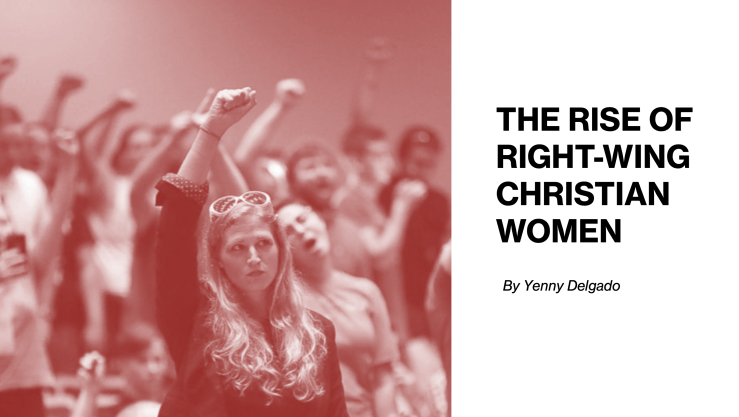
The Rise of Right-Wing Christian Women

More than a hundred years ago, the women’s movement achieved something we now take for granted: women’s entry into public and political life. It was a path of marches, hunger strikes, and mobilization that advanced country by country until women’s suffrage was won across the continent. But this achievement should not be idealized; in the United States, Eurodescendant white, upper-class women voted first, in 1920, and only after decades of further mobilization did the turn come for Indigenous women, Afro-descendant women, and women without property or education. In Peru, my grandmothers were able to vote for the first time in 1956. That was the moment when women began to take on rights in public life, slowly and with steady steps: choosing political leaders, presidents, and members of Congress; owning property; being educated; deciding whether to marry; controlling pregnancies; and deciding over their own bodies.

It is worth asking: how did women come to question whether the women’s rights won over a century ago are worth preserving? Did the women’s movement that won women’s rights abandon women who chose to marry and build families, have children, and who at the same time had to carry the responsibilities of household and domestic economies—all in the name of gender equality?

After decades of resistance, women carry a double burden: social expectations and actual responsibility. Women are expected to run the household, care for children, contribute economically, remain silent in the face of violence at home, and navigate both public and private life without questioning it. Many women had neither the time nor the space to learn what was happening in the realm of rights because we were already carrying the full weight of family responsibilities on our shoulders.

Meanwhile, a more liberal discourse about women’s bodies was developing in public life: the right to choose not to have children, to live out one’s sexuality freely, access to safe abortion, freedom from violence and harassment in the streets, and other demands often articulated by young, economically independent, single women without children. It was in this contrast that a gap began to emerge. And within that gap, a different message took hold—one tinged with resentment and dissatisfaction.

It was evident that women did not experience equality in the same manner; the obligation of becoming a mother started to involve a dual burden, since in the discussion equality was presented as justice without acknowledging that the term could ignore the women who had to bear family and work responsibilities which oppressed them doubly.

On the contrary, equity recognised that even though women have all the abilities and intellectual capabilities needed to be equal to men, there do exist biological, social and historical differences—and aimed at correcting the existing inequalities on that basis.

Women were therefore split into one category or another; those who decided to build families, have partners, marry and have children lacked spaces in which to engage in dialogue and to understand one another, while those who did not choose to do so created room for a different conception of what it means to be a woman.

In religious circles, churches kept on stressing that women should, first and foremost, look after their children; they talked about the consequences of women being away and described taking charge of children as a way of safeguarding the family. Yet at the same time men took on less and less responsibility at home and stayed on the periphery, exhibiting absent and/or violent fatherhood.

Studies show that a woman who has a partner ends up working 30% more than a man who has a partner since the daily household duties still remain her responsibility. There is one other worrying result: a woman who is educated in an mixed-gender environment does not reach the same educational achievements as a woman who is educated only among women, whereas this is not the case with men; men do not develop the same level of competitiveness when they attend all-male schools.

It seems that, in some way, women lose time, ground, resources, and opportunities whenever they share space with men. Aren’t men still being educated to compete with us?

What is the origin of the right?

In order to understand why support among women for the political right is increasing, we must start with the origins of the term. The designations “left” and “right” came about in the French National Assembly; the people who supported the old system and the monarchy sat to the right of the president and saw poverty as a natural thing, while those who sat on the left believed that poverty resulted from social inequality and that the state should take action to remedy it.

To this day we have continued to base ourselves on that original political imagination. The most radical defenders of the traditional hierarchy are the originators of what we now refer to as the far right: ultranationalism, rejection of democracy, and the cult of strong leadership.

It should be pointed out that new right-wing populism directs public resentment at socialist governments, which its critics say do not promote economic growth; this causes left-wing voters to move to the right, since the right provides jobs, free markets, and wealth as solutions to social problems. The right-wing movement has strengthened its position through its alliances with conservative groups, particularly with evangelical groups, even though the political right still maintains the existing hierarchies.

In this situation on the continent a similar pattern is seen: conservative messages which limit women’s rights still enjoy the support of women. The conservative party bases its arguments on public safety and takes a strict stance on crime. For many women who have suffered domestic violence, this leads them to the view that stricter security measures in the streets will protect them in the home.

The “Tradwife” and the Idealization of Motherhood

The stereotype of the ‘tradwife’, that is to say the traditional wife, is also an example of economic privilege which increases the disparities between women. The idea of a woman who looks after the home, looks after the children, cooks and maintains an impeccable image of well-being is one that is linked with upper-class women.

At the same time, women from working-class and low-income communities work full-time and look after the home. Many of them are, in fact, the caregivers, nannies, and cleaners that affluent women employ to look after their children, while the affluent women look immaculate on social media.

The same thing occurs in politics: women who attain power are generally portrayed as “mothers of the nation”. Instead of talking about their technical training, they refer to bringing up their children, handling the family budget, and dealing with everyday life. They associate public safety with peace in the home. This is part of a wider trend in which voting is structured around the family, the man being its head.

For many years many churches have supported this view in order that women may remain in a subordinate position, and consequently women end up voting in accordance with their economic interests, their religion, and their privileges rather than supporting those people who would promote greater social well-being.

Women feel that these messages are speaking directly to them since feminist views on free choice and the right to abortion do not provide a sense of security. They wish to protect their families, and that is one of the main reasons why so many vote for conservative far-right candidates. Motherhood is seen as the key point in society, and looking after the home and the family is regarded as honorable.

However, this perspective is still something only a few women can enjoy since the majority of women also have to work in order to support their families. Meanwhile, the conservative discourse holds that liberal ideas ignore the role of mothers and wives—and this seems to be the case.

From a Theological and Political Perspective

A great deal of the content I have given above is based on theology; specifically it stems from a view known as complementarianism, which holds that men and women were created to have different roles and to complement each other. Under this approach, men are expected to take on leadership positions at home, in the church, and also in government, while women are expected to provide support, show care, and take a following role.

The teaching is based upon a group of biblical passages which many conservative churches interpret as direct commands rather than as texts which belong to their own historical backgrounds. Wives are told to submit to their husbands ‘just as the church submits to Christ’ (Ephesians 5:22–24). The husband is referred to as the ‘head’ of the wife, just as Christ is the head of the church (1 Corinthians 11:3).

Women are told to act as ‘keepers of the home’ and to be devoted to their husbands, children, and their household (Titus 2:5); motherhood is regarded as their main purpose, this being supported by the instruction to ‘be fruitful and multiply’ (Genesis 1:28) and by the belief that children are a reward and a blessing (Psalm 127:3–5).

Some churches go even that far by teaching that Christian couples should reject the use of contraception and have as many children as God gives them, a stance which is known as the “Quiverfull” movement.

This is not a set of private beliefs limited to the decisions of couples and families; rather, it is taught from pulpits, spread on social media and in parenting books, and presented to children as the normal and divinely ordained way of life.

As time goes on, women’s own understanding of authority is influenced in this way: a man in a position of leadership is seen as ordinary, safe, and biblical; a woman who is in a position of leadership is only accepted, first and foremost, if she displays the same firm and decisive manner that is linked with male leadership.

This makes it possible to understand a situation which at first sight appears contradictory in that women who adhere to these values end up supporting male leaders; and when a woman does attain a position of power she expects herself—and expects others to expect her—to lead in a ‘masculine’, patriarchal way, that is to say, in a decisive, tough-minded approach to crime, an unemotional one, and a calculating one.

In the view of a conservative church, it is not just men who are preferred in positions of authority; a style of leadership seen as masculine is also preferred, and women who manage to stand out in that system usually adjust themselves to that style rather than oppose it.

This provides an explanation for the rise of the far right since it is not just men who are involved in these movements, but a whole system of values—which are taught by religious organisations, reinforced in the family, and reiterated in politics—and as a result many women come to support a male leader or a woman who leads in a masculine way.

Women’s participation, even though it is restricted within this system, remains hard to change, particularly since the political right has also sought to discredit and mock the women’s movement, feminist ideas, and their achievements. From the point of view of political theology, women’s role in the rise of the far right is thus essential to understanding how women’s position in society is once again being redefined.

To be continue (part 2 coming soon)


Yenny Delgado Peruvian theologian and psychologist. For over fifteen years, she has worked with faith communities, social movements, and local governments in order to promote decolonial education. She is a member of the Steering Committee responsible for the Status of Women and Gender in the American Academy of Religion. Yenny serves as director of PUBLICA, founded the Political Theology and Spiritualities Network, and is the convener of Women Doing Theology in Abya Yala.

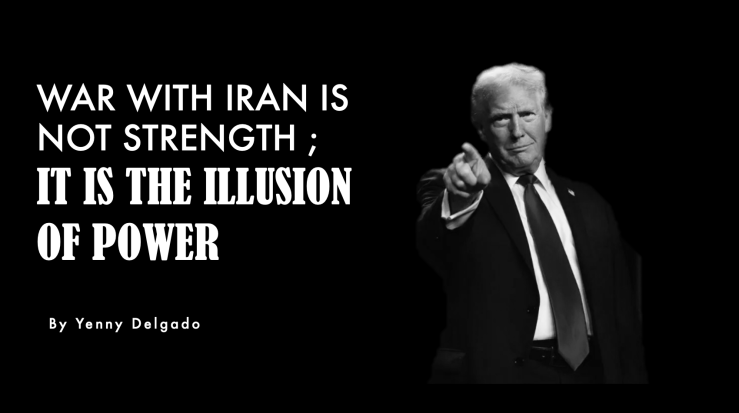
WAR WITH IRAN IS NOT STRENGTH ;  IT IS THE ILLUSION OF POWER

36 days ago Donald Trump decided to bomb Iran in support of Israel, furthering a pattern of expansion in the Middle East. By acting unilaterally and bypassing congressional approval, he has embroiled the nation in a conflict characterized by destruction and control. This approach neglects a fundamental truth: genuine leadership in a democracy is defined not by domination, but by service and the valuing of human life.

The ongoing escalation involving Iran, led by the United States and Israel, raises urgent moral, theological, and political questions. Beyond national security rhetoric, deeper concerns persist, including economic interests, political calculations, and the pursuit of regional influence. Military strength, regardless of its sophistication, does not confer moral legitimacy to endanger entire populations.

When bombs target schools and children, society must confront a painful reality: the erosion of what is sacred. Within the Christian tradition, protecting life, especially that of children, is a core value. When this principle is violated, the failure extends beyond policy; it constitutes a profound failure of conscience.

Each day, global headlines are saturated with fear, threats, and destructive rhetoric. Political figures openly discuss annihilation, treating such language as a strategic tool. However, threatening the eradication of entire nations does not demonstrate strength; it signifies moral collapse. No national interest can justify terror or mass death. Just hearing it should make us tremble!

Meanwhile, those in power remain largely insulated from the consequences of their decisions. Choices about war are made far from the lives they affect, while civilians, families, children, and entire communities bear the burden. In territories like Gaza, Lebanon, and Iran, millions endure uncertainty and struggle to survive. Will the victims get justice for what Israel and the United States are doing?

Simultaneously, unresolved corruption and abuse of power among elites continue to damage public trust. Epstein Files show the monstrous nature of man in power, sexual abuse of minors, among other atrocities, remains covered, and victims are waiting for justice. When truth is obscured and accountability is evaded, a larger moral crisis emerges, influencing foreign policy decisions. A government unable to address injustice domestically cannot credibly advocate for justice internationally.

This situation prompts a necessary question: Are calls to war distracting from deeper issues? If so, the problem is not just political; it is fundamentally ethical. Leadership driven by fear, ego, and deflection conflicts with the democratic values the United States claims to uphold. especially when pastors and evangelical religious leaders like Franklin Graham pray in daylight and on television to support Donald Trump instead of opposing him on his actions. 

Threatening the destruction of Iran and the deaths of millions does not constitute a strategy; it represents the rhetoric of catastrophe. No leader possesses the moral authority to determine the fate of entire populations. Such actions do not exemplify leadership; they reflect a dangerous distortion of power.

From a faith perspective, the message is unequivocal: God does not endorse unjust violence. War cannot be justified as an instrument of control. The destruction of human life is never acceptable.

This perspective also challenges communities within the United States that have supported violence under the guise of religious justification. No sincere interpretation of sacred texts supports terror, suffering, or the elimination of others. Invoking God to defend violence is not an act of faith; it is hypocrisy.

It must be acknowledged that bombing does not bring liberation; it is an exercise of control. When power is used at the expense of human life, it loses legitimacy.

It is time to reject leadership motivated by ego, corruption, and fear. Donald Trump must be scrutinized, questioned, and held accountable for his actions.

Across the country, voices are rising: “No Kings,” “No more endless wars,” and “Not in our name.” These statements do not indicate weakness; they represent expressions of democratic responsibility.

True strength is not measured by military force, but by the courage to protect life, uphold justice, and choose restraint over destruction.

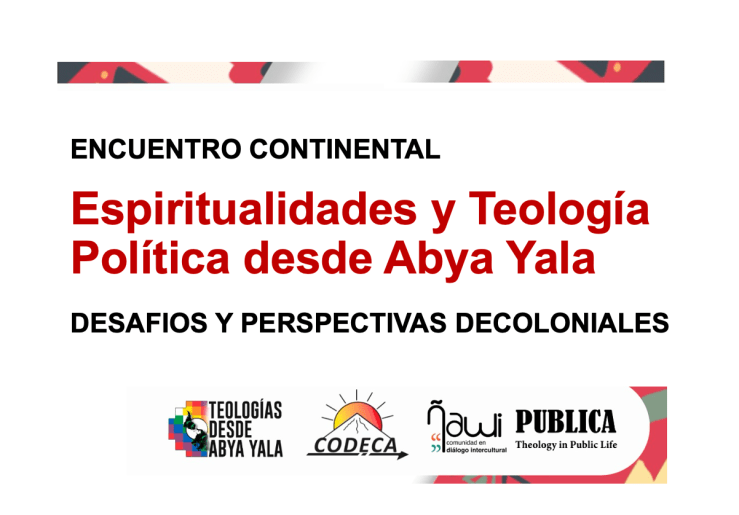
“Espiritualidades y Teologías Políticas desde Abya Yala: Desafíos y perspectivas descoloniales”

Encuentro Continental – Guatemala, 7-9 Noviembre,2025

Las comunidades organizadas en resistencias, articuladas en CODECA, el forum de teología política PUBLICA y la comunidad de diálogo intercultural, ÑAWI, invitamos a teólogos, teólogas, académicos, portavoces de comunidades en resistencias sociopolíticas, sabios y sabias de pueblos originarios, y actores comprometidos con la transformación socio-política, a participar en un espacio de diálogo y aprendizaje que explora las experiencias de resistencias de los movimientos sociales y eclesiales a través de las espiritualidades y esperanzas comunitarias en Abya Yala.

CONVOCATORIA DE PONENCIAS

Se invita a presentar ponencias que aborden, desde una perspectiva teológica política, los desafíos y oportunidades en las comunidades en resistencias, como promotoras del “Buen vivir” en los siguientes ejes temáticos:

  1. Acción eclesial en la política pública: Estrategias para la incidencia en políticas sociales y públicas en defensa de los derechos humanos.
  2. Educar para las resistencias transformadoras: Metodologías de educación popular para la formación en teología política.
  3. Salud y restauración de los equilibrios: Organización comunitaria para el acceso equitativo a la salud y justicia.
  4. Ecología integral desde Abya Yala: Cuidado de la madre tierra desde una perspectiva indígena y teológica.
  5. Teología política y migración: Reflexionar sobre los procesos migratorios en Abya Yala, y cómo estos exponen las políticas fronterizas, la exclusión y discriminación de los y las migrantes
  6. Identidades nativas y afro-descendencia: Reflexionar desde las perspectivas de la teología y espiritualidades nativas, indígenas, africana o teología negra, los desafíos actuales de las comunidades nativas y afro descendientes en Abya Yala.
  7. Mujer y derechos: Visibilizar las luchas de las mujeres en los diferentes contextos sociales y políticos desde una perspectiva mujerista y feminista comunitaria.

APOYO A LA PARTICIPACIÓN: Las y los seleccionados para presentar sus ponencias o talleres, se les ofrecerá: alojamiento, alimentación y traslado terrestre en el territorio de Guatemala.

Idiomas del Encuentro: Para garantizar la inclusión de voces diversas, contaremos con traducción durante las presentaciones en los siguientes idiomas:

●  Idiomas originarios de Abya Yala

●  Español

●  Portugués

●  Inglés

ENVÍO DE PROPUESTAS

Formato:
Resumen de máximo 300 palabras. Breve biografía del autor/a o autores/as. Institución. Nacionalidad. Identidad ancestral. Idioma de presentación.

Las propuestas deben enviarse con fecha extendida hasta el 15 de Julio al correo electrónico teologiaabyayala@publicatheology.org

Este encuentro es una invitación a construir colectivamente un pensamiento teológico-político desde la perspectiva de Abya Yala, capaz de responder de manera inclusiva, justa y sostenible a los desafíos contemporáneos.

¡Esperamos contar con tu participación!

Los cuerpos femeninos crucificados a causa del conflicto armado en Colombia

Por Claudia Chaurra

En el continente se viven realidades de pobreza, migración, violencia, desempleo corrupción, abusos, precariedad en ámbitos de salud, educación y en todo aquello que debe asegurar unas condiciones de vida digna. Los cuerpos en este contexto han sufrido las consecuencias de la injustica social en su mayor extensión, en especial los pueblos indígenas, campesinos y afro han vivido el mayor impacto de este mal encarnado.

En el caso particular de Colombia, en el año 2022, la comisión de la verdad presentó el informe final sobre el conflicto armado del País, en medio del discurso a cargo de Francisco de Roux se resaltó lo siguiente: “ Si hiciéramos un minuto de silencio por cada una de las víctimas del conflicto armado, el país tendría que estar en silencio durante 17 años”, es decir es una historia manchada de sangre, de impunidad e indiferencia, porque viendo lo que pasaba, se permitió que continuara la barbarie.

Más que cifras de las víctimas del conflicto, fueron rostros concretos, de campesinos, indígenas, de hombres, de mujeres, de niños, de jóvenes, que pagaron con su propia vida un precio muy alto. Una de las publicaciones entregadas por la comisión, tiene como protagonistas las experiencias de mujeres en el contexto del conflicto armado. Al pasar las páginas se leen los testimonios de mujeres que más allá del sufrimiento, hablan de sus esperanzas y sus anhelos de cambio para poder vivir en paz. La verbalización de estos hechos, tienen como función, romper el silencio, para redimirlos y luchar por su resurrección.

Estas mujeres fueron doblemente heridas: por el conflicto armado y por la sociedad que, aun viendo su dolor y sufrimiento, las condenó al olvido y a la impunidad, a esto se refiere el documento. Y… ¿Quiénes fueron estas mujeres? Como allí lo expresan: fueron mujeres de diferente edades, etnias, de distintas regiones del país, trabajadoras, amas de casa, lideresas, que experimentaron un profundo sufrimiento y enorme perdidas (cfr,. Comisión de Verdad y Memoria de Mujeres Colombianas, 2022,  p13), por ello, se habla de un doble circulo de confirmación de la violencia: La minusvalorización de las mujeres que permite la agresión con la que se ejerce el control sobre sus vidas y del funcionamiento social en que se da un normalización de la violencia y un silenciamiento de la misma ya sea porque no se visualiza o que se debe se teme a denunciarlo debido a que se estigmatiza y culpabiliza a las mujeres víctimas de la violencia. (cfr, p 20).

En el documento: “Guía para la pedagogía del volumen mi cuerpo es la verdad.” sección mujeres (2022), se exponen las siguientes cifras que reflejan este flagelo:  

  • Víctimas de desplazamiento forzado 7.760.771, 4.031.539 Mujeres.
  • Las mujeres indígenas que contaron su historia a la Comisión reportaron desplazamiento forzado en el 31,6 %  de los eventos de violencia; amenazas, en el 18,8%; violencias sexuales, en el 7,2%; y despojo, en el 3,21%.
  •  El 68,53% del total de mujeres víctimas que dieron su testimonio a la Comisión de la Verdad son campesinas.
  • De acuerdo con el Registro Único de Víctimas (RUV), en Colombia al menos 32.446 personas han sido víctimas de actos en contra de la libertad y la integridad sexual. Las mujeres y niñas son el 92 % del total de víctimas.
  • Las violencias sexuales y reproductivas se exacerbaron en el período de mayor degradación de la guerra entre 1996 y 2007. La mayor parte de las violencias reproductivas se cometieron al interior de los grupos armados. Las FARC en algunos de sus bloques impusieron la planificación y el aborto para las combatientes.
  • La Comisión identificó 173 violaciones de DDHH a mujeres que, en el momento de los hechos, ocupaban algún cargo político o eran funcionarias públicas. Fueron blanco de amenazas, persecuciones y homicidios.

Estos cuerpos en medio del conflicto, vivieron la inclemencia de la violencia, ya fuera física, sexual o psicológica, llevándolas a sentirse sin valor, sin rumbo y sin esperanzas; fueron  niñas, jóvenes, adultas y ancianas que sintieron que su cuerpo era un campo de guerra, sintieron cómo la muerte las rondaba, se sintieron señaladas, perseguidas, con miedo, pensaron quizá merecían esa realidad y que eran culpables de lo que les ocurría. Sufrieron en silencio, lloraron sin consuelo, enterraron sus muertos, perdieron sus tierras y dañaron sus sueños.

Algunas narrativas que permiten ampliar nuestra visión al respecto, son las siguientes:

  • “Había mucha corrupción, robos, infidelidades, estropeo de mujeres, robos de gallinas,  violaciones;  en ese tiempo una mujer no podía salir a hacer una diligencia,  mejor dicho  solo por fuerza mayor,  porque si alguien salía se reunían 10 o 20 hombres para abusar de ella. Nosotros le llamamos a esto “vaca muerta”. ¿A dónde se iba a quejar la pobre mujer? a ninguna parte, todo lo aguantaba” –Entrevista 140 VI-00095 mujer mestiza, ama de casa.
  • “Las mujeres tenían que estar en sus casas a cierta hora, ellos no querían ver mujeres en los billares, en discotecas. Una mujer infiel, podía ser asesinada en ese momento (…) todas bajo este tipo de regulación de la vida de las mujeres, eran castigadas” Entrevista 203 PR00198, mujer investigadora psicóloga.
  • “Yo quiero terminar con esta historia que me hace tanto daño. Primero que todo fui abusada a los seis años por un pariente de mi mamá. Era la más pequeña y siempre abusaban de mí. A los 15 años tomé la peor decisión de mi vida: Me fui de la casa y conocí al padre de mis hijos… A los 18 quedé en embarazo de mi primer hijo y todo ese tiempo fue maltrato, intentos de homicidio hacia mi y hacia mis hijos. Sufrí mucho.” – Entrevista 070- VI-00041 Mujer indígena nasa, empleada doméstica.

Esta dura realidad y otras narrativas que no se alcanzan a compartir en este escrito, representan las heridas de este mal encarnado en la historia, que muestra una vez más como los cuerpos femeninos han estado a merced de estructuras de poder, que oprimen y condenan a la soledad y muerte. Sin embargo, es muy significativo ver cómo la esperanza repunta, y cómo aquellas que se exiliaron de sí mismas y caminaron a oscuras sin tener a donde ir o a quién llamar, encontraron en otros cuerpos femeninos miradas y brazos sororos que las sostuvieron y animaron a continuar. El sufrimiento en común, hizo posible su encuentro, constituyéndose así, como portadoras y protectoras de vida, que acogen y defienden la misma, sea cual sea la circunstancia. En este sentido es muy coherente Margot Bremer, al afirmar que “un pueblo que sufre la pasión de muerte, despierta en la mujer la pasión por la vida”.

____________

Claudia Lorena Chaurra Romero. Teóloga colombiana. Vive y escribe desde  Cali- Colombia. Es licenciada en filosofía y ciencias religiosas, con maestría en teología latinoamericana por la Universidad Centroamericana ‘José Simeón Cañas’ (UCA) .