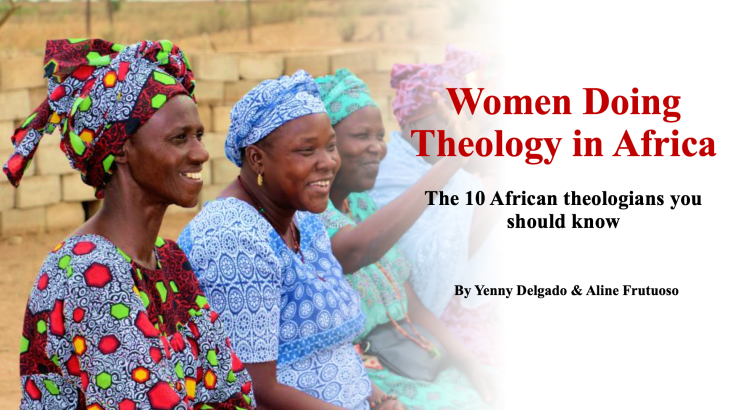
Women Doing Theology in Africa

The 10 African theologians you should know

By Yenny Delgado & Aline Frutuoso

In contemporary theological studies, the voice and impact of African women theologians have been instrumental in redefining religious and ethical paradigms around the world. Their contributions not only enrich theology with historically marginalized perspectives, but also challenge and transform power structures within faith communities.

The theological work of women makes illuminates the unseen and denounces practices and activities that run counter to the Gospel. The work of women investigates and teaches in favor of social justice to understand the intersections between spiritual practices, constructions of gender, sex, ethnicity and social justice, which are intertwined to deepen and enrich theological reflection Women’s.

Below, we present the 10 most inspiring African theologians. Each of them not only expands the theological canon, but also motivates and trains a new generation of scholars and believers to think critically about the theological work of women at the heart of the church and society.

  1. Mercy Amba Oduyoye (Ghana)

Mercy Amba Oduyoye, born in Ghana in 1933, is an academic, theologian and activist known as the “mother of African women’s theologies.” She was educated in Methodist schools and later studied at the Kumasi College of Technology. She earned her master’s degree in sacred theology from the University of Cambridge. Oduyoye was the first woman in Africa to obtain a university degree in Theology and with this training she taught at various universities in Africa, such as Cape Town and Nairobi. Additionally, she has been a visiting professor at the University of Ghana and at institutions in the Netherlands, South Africa and the United States.

She is the founder of the Circle of African Theologians and founding director of the Women’s Institute in Religion and Culture at Trinity Theological Seminary in Legon, Ghana and has made significant advances in contemporary theological and ethical discussions. Mercy is an influential theologian in the understanding of African spirituality and the defense of women’s rights.

Publications:

“Beads and Threads: An African Woman’s Reflections on Christianity in Africa.”

  1. Musa W. Dube (Botswana)

Musa W. Dube is a Botswana academic, theologian and activist. She earned her doctorate in New Testament from Vanderbilt University in Nashville, United States. Musa is a professor of New Testament at the University of Botswana and is widely recognized for her contributions to feminist and postcolonial theology. Her work on biblical interpretation from an African perspective has been influential in academic and practical settings. She is the general coordinator of the Circle of Concerned African Women Theologians. Her contributions to the decolonization of theology and her advocacy for gender justice have made significant advances in contemporary theological and ethical discussions. Winner of the Gutenberg Ensino Prize (2017) from Gutenberg University, Germany.

Musa works hard and consistently at the intersection of gender, race, ethnicity, and colonial ideology and their impact on the production and use of biblical texts in history. It explored ways of reading the Bible for an effective response in the context of HIV/AIDS, integrating gender and challenging theological institutions to revise their curriculum. She is an active member of the United Methodist Church and the Society of Biblical Literature.

Publications:

“Postcolonial Feminist Interpretation of the Bible.”

“The Bible on HIV and AIDS: Some Selected Essays.”

3. Isabel Apawo Phiri (Malawi)

Isabel Apawo Phiri is a Malawian academic, theologian and activist. She obtained her doctorate in Theology from the University of Cambridge, United Kingdom. Phiri is known for her work in African feminist theology, gender studies and social justice in the African context. She has worked in various academic institutions and is widely recognized for her contributions to theology and her defense of women’s rights.

She is Deputy General Secretary for Public Witness and Diakonia for the World Council of Churches. Professor of African Theology and Dean of the School of Religion, Philosophy and Classics at the University of KwaZulu-Natal. Isabel is a prominent figure in contemporary African theology, and her work has been instrumental in advancing discussions about gender and religion in Africa.

Publications:

“African women, religion and health: essays in honor of mercy”

  1. Musimbi Kanyoro (Kenya)

Musimbi Kanyoro is a Kenyan academic, theologian and activist. She obtained her doctorate in Feminist Theology from the San Francisco Theological Seminary, United States. Musimbi is recognized for her important contributions to African feminist theology and her tireless work advocating for women’s rights and social justice. She has held leadership positions in several international organizations and remains an influential voice in the field of theology and gender studies.

She was executive director of the Young Women’s World Christian Association (YWCA) and general secretary of the Lutheran World Federation for several years. She has been a key figure in promoting gender justice and women’s rights in both religious and secular contexts. Her work has addressed critical issues such as health, reproductive rights, and women’s empowerment.

Publications:

“Presenting Feminist Cultural Hermeneutics: An African Perspective.”

  1. Oluwatomisin Olayinka Oredein (Nigeria)

Oluwatomisin Olayinka Oredein is a Nigerian academic and theologian. She obtained her doctorate in Theology and Gender Studies from Duke University, United States. Oredein is recognized for her contributions to African feminist theology and for her work at the intersection of gender, race, and religion in African and diasporic contexts. She has taught at several academic institutions and is a respected voice in contemporary theological studies.

Inaugural winner of the Notre Dame Press Prize for her book: “The Theology of Mercy Amba Oduyoye: Ecumenism, Feminism and Communal practice.” She received the Louise Clark Brittan Endowed Teaching Excellence Award in Teaching. She has critically addressed theology from womanist and postcolonial perspectives Her work has influenced the understanding of how gender and racial identities affect religious and theological practices.

Publications:

The Theology of Mercy Amba Oduyoye: Ecumenism, Feminism, and Communal Practice

Theopoetics in color: approaches incorporated into theological discourse

6. Léocadie Lushombo (Congo)

Léocadie Lushombo is a consecrated theologian, member of the Teresian Institution. she obtained her Doctorate in Theological Ethics from Boston College, United States, and has several master’s degrees in theological ethics, sustainable development, and economics and development. Her primary area of research is Christian ethics, with a focus on political theology, decolonial and liberation theology, Catholic economics and social thought, African theological ethics and inculturation, nonviolence, and just peace ethics. She is a consultant and trainer on justice, peace and gender issues in Central Africa and Abya Yala.

Publications:

A Christian and African Ethics of Women’s Political Participation: Living as Resurrected Beings”

“African Women’s Theologies”

7. Kate Coleman (Ghana)

Kate Coleman is a theologian and minister. She was born in Ghana and moved to England, where she became the first African woman to be an accredited Baptist minister and ordained. Later, she became the first African woman president of the Baptist Union (2006-2007).

She founded Next Leadership, an organization dedicated to developing leadership in various areas and especially in the church. In 2017 she was recognized as one of the 20 most influential black Christian women leaders in the UK.

Publications:

“7 deadly sins of women in leadership”

8. Elizabeth W. Mburu (Kenya)

Elizabeth W. Mburu is a Kenyan theologian who teaches New Testament and Greek at the International Leadership University, Africa International University and Pan Africa Christian University in Nairobi. She earned a Master of Divinity from the Nairobi International School of Theology and a Master of Sacred Theology from Northwest Baptist Seminary. Elizabeth completed her doctorate in New Testament at Southeastern Baptist Theological Seminary in the United States. She is currently a professor of New Testament and Greek at several universities in Nairobi.

Publications:

“African Hermeneutics”

“Qumran and the origins of Johannine language and symbolism”

9. Loreen Maseno (Kenya)

Loreen Maseno earned her PhD from the University of Oslo, Norway, in an interdisciplinary academic program covering kinship, theology, and gender studies. Her postgraduate research focused on ethnographic studies among the Abanyole people of rural western Kenya.

Upon her return to Kenya, she faced limited access to online databases, but the HRAF Global Scholars program gave her access to an extensive repository of ethnographic and archaeological information, which she uses for citations in research publications and for teaching postgraduate courses. She is a senior lecturer at the Department of Religion, Theology and Philosophy at Maseno University.

Publications:

“Women Within Religions: Patriarchy, Feminism, and the Role of Women in Selected World Religions”

10. Teresa Okure (Nigeria)

Teresa Okure is a Nigerian Catholic nun and the first African to become a member of the Company of the Holy Child Jesus. She is a resident professor in the Department of Biblical Theology at the Catholic Institute of West Africa in Port Harcourt, Nigeria, where she has taught New Testament and Gender Hermeneutics since 1999. She earned her doctorate from Fordham University and was mentioned as a possible candidate for the appointment of cardinal by Pope Francis in 2013.

Academic Dean and Dean of Student Affairs at the Catholic Institute of West Africa. Member of several national and international theological and biblical associations. Founding President of the Catholic Biblical Association of Nigeria. Recognized biblical scholar with numerous conferences given.

Publications:

She is Co-Editor of the Bible Commentary Series Texts @ Contexts and Global Bible Commentary.

_______________

About the authors:

Aline Frutuoso

Brazilian economist and theologian. Doctoral student in Religious Sciences at the Pontifical Catholic University of São Paulo. Member of the Black Evangelical Movement and the Teomulher Network. She writes about black feminist theology, womanism, and decolonization.

Yenny Delgado

Peruvian psychologist and theologian. She is a doctoral candidate in Psychology of Religion at the University of Lausanne. She is the convener of Women Doing Theology in Abya Yala and director of Publica Theology. Yenny plays a critical role in fostering dialogues that amplify women’s voices and promote theological reflection from womanist and feminist decolonial perspectives.

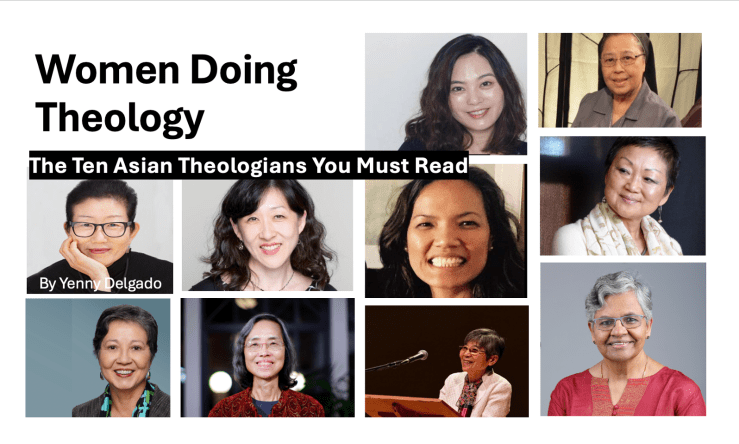
Women Doing Theology in Asia

The Ten Asian Theologians You Must Read

With their unwavering courage and resilience, women theologians have long recognized the need to highlight women’s experiences and ensure their voices are heard. They expose the inconsistencies between societal and ecclesiastical teachings about women’s roles and the realities of women’s everyday lives, confronting issues such as abuse, violence, and colonization. Their bravery in challenging these issues is not only inspiring but also empowers us to advocate for justice and inclusivity.

Through womanist and feminist approaches, these theologians challenge oppressive systems and advocate for justice. Asian theologians, in particular, have contributed significantly to these reflections, offering theological and biblical perspectives on liberation and decolonization.

If you are ready to embark on a transformative exploration of theology that confronts and dismantles patriarchal, colonial, and racist structures, these Asian theologians are essential reading. Their groundbreaking work, which is instrumental in shaping a more just and inclusive theology, will not only provoke and challenge you but also inspire you to rethink traditional theological boundaries and embrace a more inclusive vision of faith.

Here are the ten Asian theologians whose work you must read:

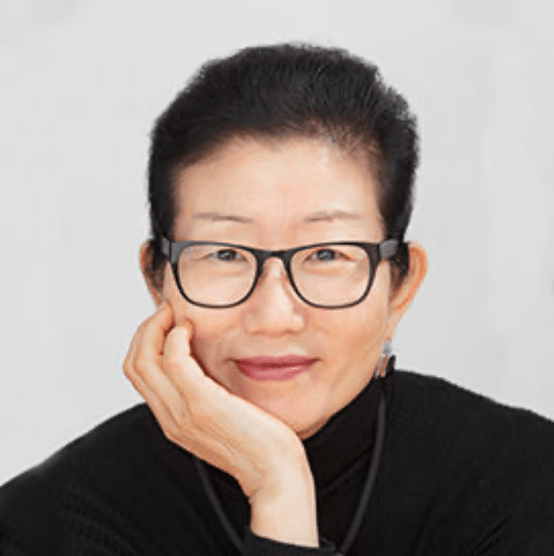
1. Kwok Pui-Lan ( Hong Kong)

Kwok Pui-Lan, a prominent figure in Asian feminist and postcolonial theology, is a Professor of Systematic Theology at Candler School of Theology. She holds a Ph.D. from Harvard Divinity School and has previously taught at institutions such as Yale Divinity School and the Chinese University of Hong Kong.

Kwok’s scholarly output significantly advances the discourse in feminist and postcolonial theology, providing critical perspectives that challenge traditional Western-centric theological frameworks. Her work underscores the importance of contextual theology and the role of Asian women in reshaping theological studies, thereby influencing the direction of theology and promoting inclusivity in society.

Book: Introducing Asian Feminist Theology by Kwok Pui-Lan

In this book, she introduces the principles and methodologies of Asian feminist theology. Her other notable works include Postcolonial Imagination and Feminist Theology and The Hong Kong Protests and Political Theology. Her research spans feminist theology, postcolonial theology, and biblical hermeneutics.

2. Aruna Gnanadason (India)

Aruna Gnanadason holds a doctorate in feminist theologies and a Master’s in English literature. From 1991 to 2009, she directed the global program on Women in Church and Society for the World Council of Churches in Geneva and coordinated its Justice, Peace, and Creation program. She is active in the Indian Christian Women’s Movement and is the National Convener.

Gnanadason’s work highlights the intersections of patriarchy, caste, and global capitalism. She advocates for systemic change within church structures and society. Her leadership and scholarly contributions foster a more inclusive and just theological discourse.

Book:With Courage and Compassion: Women and the Ecumenical Movement celebrates women’s contributions to various spheres, including the church and ecumenical movements. It addresses women’s persistent challenges and violence, calling for a transformative theological vision and political imagination to combat injustice within the ecumenical movement.


3. Chung Hyun Kyung (Korean)

Chung Hyun Kyung is a South Korean Christian theologian and a lay theologian of the Presbyterian Church of Korea. She is an Associate Professor of Ecumenical Theology at Union Theological Seminary in the United States. Her interests include feminist and ecofeminist theologies, interfaith dialogue, and the intersection of disease and healing with spirituality.

Chung’s work is distinguished by her innovative integration of diverse spiritual and social traditions. She is known for her groundbreaking speech at the World Council of Churches in 1991, where she introduced the concept of “salim” (making things alive) as a foundation for her ecofeminist theology. Her interdisciplinary approach fosters a dynamic dialogue between Christianity and other religious traditions, particularly Buddhism.

Book: Struggle to be the Sun Again: Introducing Asian Women’s Theology

This a pivotal text on Asian women’s theology. It reflects Chung’s synthesis of global people’s movements, Asian spiritual traditions, and academic analysis.

4. Mary John Mananzan (Philippines)

Sr. Mary John Mananzan is a Missionary Benedictine nun from the Philippines, a theologian, author, and activist. She has held various leadership roles, including president of St. Scholastica’s College and national chairperson of the Association of Major Religious Superiors of the Philippines. She co-founded GABRIELA, a federation of women’s organizations in the Philippines.

Mananzan has been a formidable advocate for women’s rights and social justice, integrating her theological insights with grassroots activism. Her leadership in movements against tyranny and women’s liberation has significantly impacted the Church and society. Mananzan’s work includes developing an Asian feminist theology of liberation, focusing on the intersections of religion, gender, and social justice.

Book: Women Resisting Violence: Spirituality for Life

Mananzan is one of the six editors of this collection of essays, which comprises the voice of women theologians writing on issues that impact the lives of women in society and well in the Church, advocating and demanding justice for women suffering different forms of violence: economic, military, cultural, ecological, psychological, and physical violence.

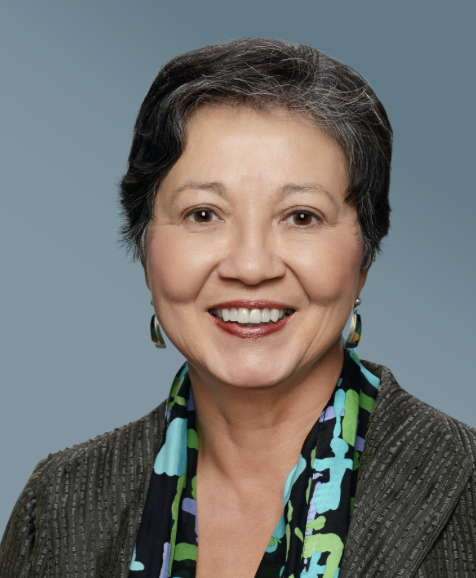
5. Grace Ji-Sun Kim (South Korea)

Grace Ji-Sun Kim was born in Korea and educated in Canada, where she earned her Ph.D. from the University of Toronto. She is an ordained minister in the Presbyterian Church (USA) and teaches theology at Earlham School of Religion.

Kim hosts the Madang podcast, which features conversations on Christianity, religion, and culture. The Christian Century hosts the podcast. Additionally, she is a co-editor for the Palgrave Macmillan Series, “Asian Christianity in the Diaspora.”

Book: When God Became White: Dismantling Whiteness for a More Just Christianity

Examines the historical and theological implications of depicting Jesus and God as white males. Christianity, which originated in the ancient Near East among people of darker skin, was reimagined by European Christians who depicted Jesus with fair skin, akin to imperial rulers. Kim explores how this portrayal facilitated a colonialist posture within Christianity and its harmful global impacts. She advocates for recovering the biblical reality of a nonwhite, nongendered God, asserting that rediscovering God as Spirit leads to a more just faith, Church, and world.

6. Rita Nakashima Brock (Japan)

Rita Nakashima Brock is a Japanese and USA scholar, theologian, and activist. She obtained her Ph.D. in Philosophy of Religion and Theology from the Claremont Graduate University in California. Brock is the Senior Vice President at Volunteers of America and a Commissioned Minister in Disciples of Christ. Her work on moral injury and feminist theology has been influential in academic and practical settings. Her contributions to understanding the impact of war on soldiers’ mental health and her advocacy for gender justice have made significant strides in contemporary theological and ethical discussions.

Book:Casting Stones: Prostitution and Liberation in Asia and the United States, which won the Catholic Press Award in Gender Studies. It was the first work in feminist theology to address the topic of sex work and justice. Co-author with Susan Brooks.

7.Keun-Joo Christine Pae (Korea)

Christine is a distinguished Korean theologian who serves as Professor of Religion/Ethics and Women’s and Gender Studies at Denison University in Granville, Ohio, where she also chairs the Department of Religion. She holds a Ph.D. in Christian Social Ethics from Union Theological Seminary in New York. Christine scholarly work centers on social ethics, particularly in the areas of transnational feminist ethics, ethics of peace and war, Asian and Asian American feminist theology and ethics, spiritual activism, and U.S.–Asia relationships through war, prostitution, immigration, and religion.

Book: Embodying Antiracist Christianity: Asian American Theological Resources for Just Racial Relations

This comprehensive work addresses the imperative of antiracist practices within Christian theology from an Asian American perspective. The book brings together contributions from various scholars who explore how Asian American theological resources can be harnessed to promote justice and equality in racial relations. It examines the intersections of race, religion, and social justice, providing critical insights into how Asian American experiences and theological reflections can contribute to the broader discourse on antiracism.

8. Cristina Lledo Gomez (Philippines)

Cristina Lledo Gomez is Filipino and Australian theologian. She earned her Ph.D. in Theology from Charles Sturt University and her Master and bachelor from Catholic Institute of Sydney. Her academic and research work is geared towards promoting women’s spiritualities, feminist theologies, and ecotheologies. In recognition of her impactful scholarship, she received the 2020 Catherine Mowry Lacugna Award from the Catholic Theological Society of America for her essay “Mother Language, Mother Church, Mother Earth.” Her extensive research portfolio covers ecclesiology, feminist-maternal theology, domestic violence, clerical abuse, integral ecology, migration, and colonialism. Gomez serves as Co-Chair of the Women’s Consultation for Constructive Theology at the CTSA and is a Board Member of the College Theology Society and Ecclesiological Investigations Network.

Book: The Church as Woman and Mother 

This book explores the metaphorical and theological understandings of the Church as a nurturing maternal figure. Drawing from historical and theological foundations, Lledo Gomez examines how the Church’s maternal identity has been constructed and perceived over time, addressing both its empowering and problematic aspects. The book delves into feminist and maternal theological perspectives, challenging traditional patriarchal views and advocating for a more inclusive and nurturing vision of the Church that embraces and elevates the experiences and contributions of women within the Christian community.

9. Namsoon Kang (Korea)

Namsoon Kang is a Professor of Theology and Religion in Brite Divinity School having previously taught at the Faculty of Divinity, Cambridge University in the United Kingdom, and Methodist Theological University in Seoul, South Korea. She obtained her doctorate from Drew University, USA. Writing both in English and Korean make a great contribution on her theological reflections, teaching, researching in transdisciplinary spaces. Her particular theoretical interests are in discourses of cosmopolitanism, apophatic theology/philosophy, postmodernism, postcolonialism, feminism, and diaspora.

Book: The Handbook of Theological Education in World Christianity, co-edited by Namsoon Kang, explores various dimensions of theological education within the  global context of Christianity. This comprehensive volume delves into how theological education is structured, taught, and practiced across diverse cultural and geographical settings. It addresses key issues such as curriculum development, pedagogical methods, theological perspectives, and the challenges and opportunities faced by theological institutions worldwide.

10. Hisako Kinukawa (Japan)

Hisako Kinukawa is a Japanese theologian with a Doctor of Ministry from San Francisco Theological Seminary. She teaches at International Christian University, Lutheran Seminary, and St. Paul Graduate School. Kinukawa co-directs the Center for Feminist Theology and Ministry in Japan.

Kinukawa provides a unique perspective that combines biblical scholarship with contemporary feminist thought, offering fresh insights into the role and representation of women in biblical texts. Her work is significant in bridging cultural and historical gaps, enriching the understanding of scripture from a non-Western feminist viewpoint.

Book :Women and Jesus in Mark: A Japanese Feminist Perspective explores the encounters between women and Jesus in the Gospel of Mark, examining these interactions through the lens of contemporary Japanese Christianity. This work highlights the significant risks taken by women who approached Jesus in a patriarchal society and delves into how Jesus’ responses to these women reflect the liberating essence of the gospel.

Conclusion

Asian women theologians have profoundly influenced a postcolonial theology. Their work challenges traditional theological frameworks and advocates for justice, inclusivity, and the recognition of diverse cultural perspectives. By addressing issues such as patriarchy, colonialism, and racism, these theologians aim to dismantle oppressive structures within religious institutions and society at large.

The collective contributions of these theologians continue to inspire and shape not only Asian theological work but all work. They offer critical perspectives that challenge the status quo and pave the way for a more inclusive and just theology. Their legacy is evident in the ongoing dialogues and transformative practices within academic, ecclesial, and social contexts, fostering a theology deeply attuned to marginalized communities’ voices and experiences. Through their groundbreaking work, these theologians enrich the field of theology and contribute significantly to the broader struggles for justice and equality in the world.

__________

Yenny Delgado is a psychologist and theologian. She is a Ph.D. candidate in Psychology of Religion at the University of Lausanne. She is also the Convener of Women Doing Theology in Abya Yala and Director of Publica Theology. Yenny plays a pivotal role in fostering dialogues that amplify women’s voices and promote theological discourse rooted womanist and feminist decolonial perspectives.

The Embrace of the Spirit in Abya Yala

By Yenny Delgado & Claudio Ramírez

The Spirit has been with us from the beginning of times, accompanying us from all around, providing hope and freedom that is neither static nor exclusive. As we witness in the journeys of the original peoples of Abya Yala who keep their spiritualities alive, there is a profound embodiment of the vital cosmic force that dances alongside in harmony, pulsating within their traditions with the Spirit.

The Spirit’s influence extends throughout the lives of the people of Abya Yala, fostering a consciousness deeply rooted in their cultural identity and fostering free and respectful relations. In traditional and spiritual practices in Abya Yala, we can learn from the Guaraní people who believe and understand the land without evil, an ideological process that fills all life with meaning. The path to the land without evil is not a utopia but a strenuous and accessible walk without hunger and oppression. The land without the evil of the Guarani would be nothing more and nothing less than land that lives in the movement and embraces the Spirit of God, the creator; for the Guarani, this consciousness embodies a dual nature: “oréva,” representing their unique individuality tied to their land, language, beliefs, and customs, and “ñandeva,” embracing inclusivity and acknowledging the existence of other cosmologies and rationalities. 

Central to understanding native spirituality is the recognition that it is experiential, narrative, and symbolic, drawing nourishment from a rich tapestry of myths, ceremonies, communal gatherings, dreams, and artistic expressions. The movement of the Spirit evokes a profound spirituality, where every practice becomes sacramental, infused with the diverse cultures, languages, and spiritualities that thrive across the expanse of Abya Yala. This sentiment echoes the sentiments expressed in the “Holy Spirit and Native Peoples” document by the Episcopate Conference of Mexico, which celebrates the beauty of unity within diversity, recognizing that various theological perspectives are not contradictory but complementary, enriching the understanding of the divine mystery.

In embracing the Spirit, the people of Abya Yala find strength in their interconnectedness, forging pathways towards a future where diversity is celebrated, and all are united in their pursuit of land without evil, where the Spirit of God moves freely.

The history of domination and colonization in Abya Yala unfolded within the framework of a patriarchal system, where women endured violation, abuse, and subsequent silencing of their transformative power. However, despite these oppressions, the flame of resistance flickered in the Women, the cornerstone of vitality and life within native communities, embracing the power and the holy of the Spirit. The Spirit, akin to breath, light, and movement, guides original peoples in confronting the challenges wrought by colonization. It is paramount to acknowledge that spiritual practices harmonize with ancestral.

Following centuries of colonization’s oppressive grip, the original peoples of Abya Yala strive to reclaim their existence, affording freedom and hope in spiritual expression. The Spirit propels resistance against the veiled neo-colonialism perpetuated by modern states, which marginalizes and disregards the knowledge, wisdom, and spirituality of original peoples. Across Abya Yala, many communities embark on a journey of decolonization, invoking the Spirit of their ancestors to heal and reconnect with ancestral inheritance memories, fostering new pathways of existence amidst the pervasive messages of colonialism, anthropocentrism, and hegemony.

The assertion that the Spirit of God permeates Abya Yala carries political and decolonial implications. It envisions a realm of goodness where encounters with roots, masculinity and femininity, and fluidity transpire because the Spirit is both and embraces all. The Spirit, acting as both agent and repository of historical memory, shapes perceptions of time and instills hope amidst present turmoil, reminding humanity of the enduring struggle for justice and the persistence of dedication and faith through the ages.

The embrace of the Spirit is not only resistance but also a spirit of liberation to truly live in the lifeblood of ancestral promise and spiritual practices. The Spirit sustains ancestral memories, transforming the pain into a healing force— anamnesis— that transcends personal, social, and historical wounds. We believe the Spirit engenders solidarity, community, organization, and hope of resurrection in Abya Yala.

Read more about Abya Yala’s Theology

About the authors

Yenny Delgado is a psychologist and theologian. She is a Ph.D. candidate in Psychology of Religion at the University of Lausanne. She is also the Convener of Women Doing Theology in Abya Yala and Director of Publica Theology. Yenny plays a pivotal role in fostering dialogues that amplify women’s voices and promote theological discourse rooted in native perspectives in Abya Yala.

Claudio Ramírez is a theologian and Ph.D. student at the Jujuy National University of Argentina. He is a founding member of the ÑAWI intercultural dialogue community, underscoring his commitment to fostering mutual understanding and collaboration across diverse cultural and spiritual practices, enriching academic discourse and community engagement.