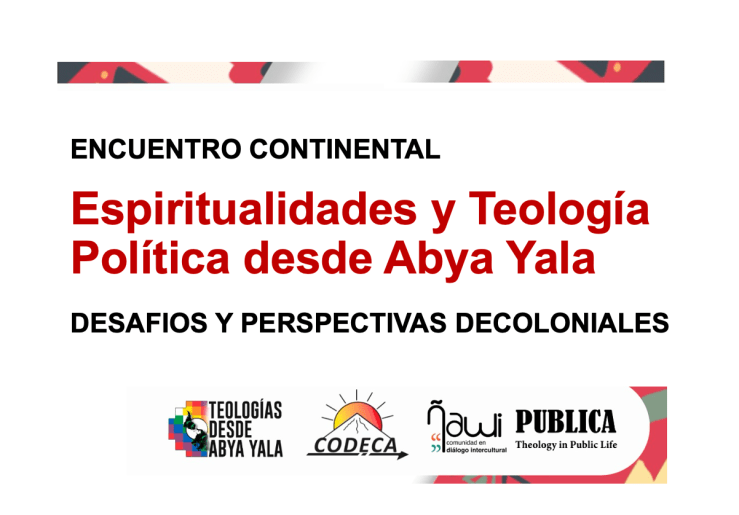
“Espiritualidades y Teologías Políticas desde Abya Yala: Desafíos y perspectivas descoloniales”

Encuentro Continental – Guatemala, 7-9 Noviembre,2025

Las comunidades organizadas en resistencias, articuladas en CODECA, el forum de teología política PUBLICA y la comunidad de diálogo intercultural, ÑAWI, invitamos a teólogos, teólogas, académicos, portavoces de comunidades en resistencias sociopolíticas, sabios y sabias de pueblos originarios, y actores comprometidos con la transformación socio-política, a participar en un espacio de diálogo y aprendizaje que explora las experiencias de resistencias de los movimientos sociales y eclesiales a través de las espiritualidades y esperanzas comunitarias en Abya Yala.

CONVOCATORIA DE PONENCIAS

Se invita a presentar ponencias que aborden, desde una perspectiva teológica política, los desafíos y oportunidades en las comunidades en resistencias, como promotoras del “Buen vivir” en los siguientes ejes temáticos:

  1. Acción eclesial en la política pública: Estrategias para la incidencia en políticas sociales y públicas en defensa de los derechos humanos.
  2. Educar para las resistencias transformadoras: Metodologías de educación popular para la formación en teología política.
  3. Salud y restauración de los equilibrios: Organización comunitaria para el acceso equitativo a la salud y justicia.
  4. Ecología integral desde Abya Yala: Cuidado de la madre tierra desde una perspectiva indígena y teológica.
  5. Teología política y migración: Reflexionar sobre los procesos migratorios en Abya Yala, y cómo estos exponen las políticas fronterizas, la exclusión y discriminación de los y las migrantes
  6. Identidades nativas y afro-descendencia: Reflexionar desde las perspectivas de la teología y espiritualidades nativas, indígenas, africana o teología negra, los desafíos actuales de las comunidades nativas y afro descendientes en Abya Yala.
  7. Mujer y derechos: Visibilizar las luchas de las mujeres en los diferentes contextos sociales y políticos desde una perspectiva mujerista y feminista comunitaria.

APOYO A LA PARTICIPACIÓN: Las y los seleccionados para presentar sus ponencias o talleres, se les ofrecerá: alojamiento, alimentación y traslado terrestre en el territorio de Guatemala.

Idiomas del Encuentro: Para garantizar la inclusión de voces diversas, contaremos con traducción durante las presentaciones en los siguientes idiomas:

●  Idiomas originarios de Abya Yala

●  Español

●  Portugués

●  Inglés

ENVÍO DE PROPUESTAS

Formato:
Resumen de máximo 300 palabras. Breve biografía del autor/a o autores/as. Institución. Nacionalidad. Identidad ancestral. Idioma de presentación.

Las propuestas deben enviarse con fecha extendida hasta el 15 de Julio al correo electrónico teologiaabyayala@publicatheology.org

Este encuentro es una invitación a construir colectivamente un pensamiento teológico-político desde la perspectiva de Abya Yala, capaz de responder de manera inclusiva, justa y sostenible a los desafíos contemporáneos.

¡Esperamos contar con tu participación!

The Embrace of the Spirit in Abya Yala

By Yenny Delgado & Claudio Ramírez

The Spirit has been with us from the beginning of times, accompanying us from all around, providing hope and freedom that is neither static nor exclusive. As we witness in the journeys of the original peoples of Abya Yala who keep their spiritualities alive, there is a profound embodiment of the vital cosmic force that dances alongside in harmony, pulsating within their traditions with the Spirit.

The Spirit’s influence extends throughout the lives of the people of Abya Yala, fostering a consciousness deeply rooted in their cultural identity and fostering free and respectful relations. In traditional and spiritual practices in Abya Yala, we can learn from the Guaraní people who believe and understand the land without evil, an ideological process that fills all life with meaning. The path to the land without evil is not a utopia but a strenuous and accessible walk without hunger and oppression. The land without the evil of the Guarani would be nothing more and nothing less than land that lives in the movement and embraces the Spirit of God, the creator; for the Guarani, this consciousness embodies a dual nature: “oréva,” representing their unique individuality tied to their land, language, beliefs, and customs, and “ñandeva,” embracing inclusivity and acknowledging the existence of other cosmologies and rationalities. 

Central to understanding native spirituality is the recognition that it is experiential, narrative, and symbolic, drawing nourishment from a rich tapestry of myths, ceremonies, communal gatherings, dreams, and artistic expressions. The movement of the Spirit evokes a profound spirituality, where every practice becomes sacramental, infused with the diverse cultures, languages, and spiritualities that thrive across the expanse of Abya Yala. This sentiment echoes the sentiments expressed in the “Holy Spirit and Native Peoples” document by the Episcopate Conference of Mexico, which celebrates the beauty of unity within diversity, recognizing that various theological perspectives are not contradictory but complementary, enriching the understanding of the divine mystery.

In embracing the Spirit, the people of Abya Yala find strength in their interconnectedness, forging pathways towards a future where diversity is celebrated, and all are united in their pursuit of land without evil, where the Spirit of God moves freely.

The history of domination and colonization in Abya Yala unfolded within the framework of a patriarchal system, where women endured violation, abuse, and subsequent silencing of their transformative power. However, despite these oppressions, the flame of resistance flickered in the Women, the cornerstone of vitality and life within native communities, embracing the power and the holy of the Spirit. The Spirit, akin to breath, light, and movement, guides original peoples in confronting the challenges wrought by colonization. It is paramount to acknowledge that spiritual practices harmonize with ancestral.

Following centuries of colonization’s oppressive grip, the original peoples of Abya Yala strive to reclaim their existence, affording freedom and hope in spiritual expression. The Spirit propels resistance against the veiled neo-colonialism perpetuated by modern states, which marginalizes and disregards the knowledge, wisdom, and spirituality of original peoples. Across Abya Yala, many communities embark on a journey of decolonization, invoking the Spirit of their ancestors to heal and reconnect with ancestral inheritance memories, fostering new pathways of existence amidst the pervasive messages of colonialism, anthropocentrism, and hegemony.

The assertion that the Spirit of God permeates Abya Yala carries political and decolonial implications. It envisions a realm of goodness where encounters with roots, masculinity and femininity, and fluidity transpire because the Spirit is both and embraces all. The Spirit, acting as both agent and repository of historical memory, shapes perceptions of time and instills hope amidst present turmoil, reminding humanity of the enduring struggle for justice and the persistence of dedication and faith through the ages.

The embrace of the Spirit is not only resistance but also a spirit of liberation to truly live in the lifeblood of ancestral promise and spiritual practices. The Spirit sustains ancestral memories, transforming the pain into a healing force— anamnesis— that transcends personal, social, and historical wounds. We believe the Spirit engenders solidarity, community, organization, and hope of resurrection in Abya Yala.

Read more about Abya Yala’s Theology

About the authors

Yenny Delgado is a psychologist and theologian. She is a Ph.D. candidate in Psychology of Religion at the University of Lausanne. She is also the Convener of Women Doing Theology in Abya Yala and Director of Publica Theology. Yenny plays a pivotal role in fostering dialogues that amplify women’s voices and promote theological discourse rooted in native perspectives in Abya Yala.

Claudio Ramírez is a theologian and Ph.D. student at the Jujuy National University of Argentina. He is a founding member of the ÑAWI intercultural dialogue community, underscoring his commitment to fostering mutual understanding and collaboration across diverse cultural and spiritual practices, enriching academic discourse and community engagement.