By Eliezer Burgos-Rosado
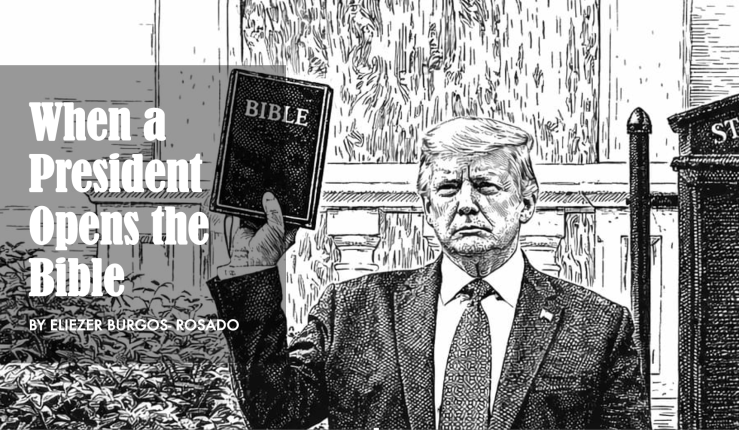
On April 21, 2026, it has been announced that Donald Trump, from the Oval Office, plans to read a passage from 2 Chronicles before his nation and the world. The scene is striking: the presidential desk, the flag, the seal of the United States in the background, and the president with an open Bible, speaking in a solemn tone. For many Christians, that image stirs hope: “at last a leader who acknowledges God.” But the decisive question is not which text Donald Trump will read, but whether we are willing to let that text judge him… and judge us.
The passage he has chosen, 2 Chronicles 7:11–22, was not written to adorn presidential speeches but to examine the relationship between the house of God, the people of God, and political power. The passage begins by establishing that Solomon finished two houses: the house of the Lord and the king’s house. Temple and palace. God’s presence and royal power, side by side but not confused. From the very first verse, an uncomfortable question rises: who serves whom? Will the king be submissive to the God of the temple, or will he try to use the temple to legitimize his own power?
That is the mirror in which we must look when we see Donald Trump seated in the Oval Office reading a portion of 2 Chronicles. It is not enough to get excited because “a president is quoting Scripture.” The king’s house is never above God’s house, and the God of the Bible is not institutional scenery for any national project. The risk is that the Word will lose its prophetic edge and end up reduced to religious props for an act of power.
God’s response to Solomon is both comfort and confrontation: “I have heard your prayer… I have chosen this house… my eyes and my heart will always be there.” God comes near, listens, watches, feels. Today as well, God sees our institutions, our borders, our prisons, our economic systems, and our public rhetoric. But that presence is not an automatic seal of approval. “My eyes and my heart will be there” means that God scrutinizes what takes place: how people govern, how they treat foreigners, the poor, and opponents; what they do with truth, with justice, and with the lives of the vulnerable.
Trump reading a verse from the Oval Office does not mean that God endorses his style of leadership. The God of 2 Chronicles is not available for hire to deliver a national agenda. God is not impressed by a televised appearance with a Bible on hand. God looks at the fruit behind the appearance. God looks at immigration policies that separate families and criminalize refugees. God looks at language that demeans women, minorities, and political opponents. God looks at the declared love of weapons, the normalization of lying, and the nostalgia for brute force as a solution.
In that context, the famous verse 14—“If my people humble themselves, pray, seek my face, and turn from their wicked ways… I will heal their land”—runs the risk of becoming a sort of empty “national prayer.” Read from behind the presidential desk, it can sound like this: “if the nation listens to me while I read this, God will heal the country.” But the text does not say that. It does not mention a “strong leader,” or the right party, or victory at the polls. It speaks of the people of God, not of the state. It speaks of conversion, not protocol.
The order is revealing. First: “my people humble themselves.” They do not exalt themselves, do not consider themselves superior, do not raise their flag above all others, but acknowledge their sin and their complicity in injustice. Then: “pray and seek my face.” They do not merely seek “our side” winning, but the will of God, even if that calls their political alliances into question. Finally: “turn from their wicked ways.” Those ways include racism, contempt for migrants, verbal violence, abuse of power, and the excessive love of money and weapons, even when all of this is dressed in “Christian” language.
This is where the issue of violence and war also comes in. God does not say: “if my people arm themselves to the teeth, if they wage preemptive wars, if they crush their enemies, then I will heal their land.” The land is not healed with “blessed” bombs. It is healed when God’s people stop blessing violence and turn away from those evil paths. A Christianity that asks for “national healing” while applauding aggressive policies, unjust military interventions, or hate-filled speech is asking God to sign off on exactly what this text denounces.
Later, God places the throne under conditions: “if you walk in my ways, I will establish your kingdom.” The king is on probation. The same holds true for Trump and for any president or ruler. The question is not simply whether he “defends Christians,” but whether his decisions resemble the justice, truth, and mercy of the biblical God. If a government lies systematically, despises foreigners, stirs up resentment, normalizes cruelty, and glorifies force, no verse read on television can turn it into “the Lord’s anointed.”
The passage ends with a severe warning. It warns that if the people go after other gods, the house will be uprooted and become a mockery. Today, those “other gods” have very clear names: the nation turned into an absolute (“our country first, no matter the cost”), the leader elevated to messiah (“only Trump can save the faith”), money and economic success sacralized, war presented as a path to salvation. The greatest danger is not that the world has idols, but that the church turns a president into an idol and grants him an obedience that belongs only to Christ.
When we see Donald Trump open 2 Chronicles 7 from the Oval Office, we can listen to the text with respect. But biblical faithfulness does not allow us to turn off discernment. This is not about hating a man, but about refusing to call “gospel” what contradicts the character of Jesus Christ. This is not about despising politics, but about remembering that no human throne deserves our primary loyalty.
Perhaps the most honest question this passage leaves us with is not “Is Donald Trump on God’s side?” but “Are we on the side of the God who speaks in 2 Chronicles 7?” If we answer seriously, we will discover that the true healing of the land does not come through a solemn message from the Oval Office, but through a church that humbles itself, prays, seeks the Lord’s face, and turns away from the ways of lies, hatred, violence, and nationalism that it has blessed in God’s name for far too long.


Published by