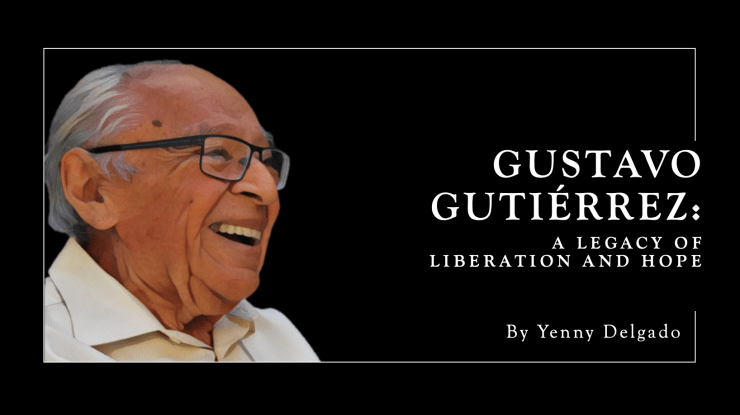
The Peruvian, Quechua-descendant theologian, psychologist, philosopher, and priest Gustavo Gutierrez is widely recognized as the founder of Liberation Theology and the Bartolomé de las Casas Institute. Gutiérrez, born in Lima on June 8, 1928, was a profound thinker and passionate advocate for the rights and dignity of the impoverished. His work, which continues to inspire generations of Christians, is a powerful catalyst for social justice and Liberation, igniting a flame of hope and determination in the hearts of those who strive for a more just world. His legacy is a testament to the transformative power of theological justice and solidarity.
Gustavo Gutierrez’s solid academic and theological education, including philosophy, psychology, and theology studies at renowned European institutions, provided him with a comprehensive understanding of the human condition and the Christian faith. This diverse education was instrumental in shaping his unique perspective on Liberation Theology.
Initially, Gutierrez began his career as a university student studying Medicine at the National University of San Marcos and Letters at the Pontifical Catholic University of Peru, but his religious vocation led him to abandon those studies and dedicate himself to the entire priesthood. This decision motivated him to seek a training theological broad and deep, which later allowed him to develop and articulate their vision of Liberation Theology.
His educational journey extended across Europe, taking him to Belgium, France, and eventually Rome. At just 23 years old, in 1951, he earned a bachelor’s degree in philosophy from the Catholic University of Louvain in Belgium. Driven by a deepening curiosity in the human mind and spirituality, he continued his studies and, at 27, received a bachelor’s degree in psychology from the Catholic University of Lyon, France, in 1955. A year later, in 1959, at 31, he completed a bachelor’s degree in theology. Shortly afterward, he was ordained as a priest, beginning a lifelong pastoral vocation.
In 1959 and 1960, Gutiérrez deepened his theological studies at Gregorian University, Rome. Later, he moved to the Catholic Institute of Paris, France, where, in 1962 and 1963, where he began to develop the foundations of his future reflection, theological and social.
Later in life, in 1985, at 57, he obtained his PhD in Theology, also from the Catholic University of Lyon, France, marking significant progress in his investigation of theology and its contributions to Liberation Theology.
Origins of Liberation Theology
The 1960s and 1970s social and ecclesial context of Abya Yala was crucial in forming Liberation Theology. In 1968, Dr. Martin Luther King Jr. advanced a theology against the discrimination and segregation faced by African Americans in the United States. Father of Black Theology, James Cone, continued this effort in 1971 to confront systemic oppression. Meanwhile, Paulo Freire published Pedagogy of the Oppressed in 1970, emphasizing education as a path to social justice and empowerment, particularly for marginalized communities.
In this context, Gutierrez’s theology presented a powerful vision of God as the liberator of the impoverished, with a central message of Christ’s resurrection embodying hope and Liberation. His work, however, was not without controversy. His focus on the poor and marginalized redefined theological discourse, emphasizing the Church’s role in challenging injustices and inspiring movements for social justice. Gustavo Gutierrez laid the foundation for what would become Liberation Theology, rooted in a commitment to the oppressed. His work ignited an international dialogue, with theologians worldwide seeking his insights on Liberation and social commitment, eager to understand the controversies and complexities surrounding his revolutionary ideas.
He participated in the Second Vatican Council and the Latin American Episcopate General Conferences in Medellín (1968) and Puebla (1979). These events were pivotal in shaping Gutierrez’s theology, providing a platform for him to offer a theology committed to the oppressed and responding to poverty, structural inequality, and social consciousness. This theological reflections influenced the development of social pastoral care in Abya Yala and provided a global platform for Gutiérrez’s transformative vision.
The publication of Liberation Theology: Perspectives (1971) marked a significant milestone in the revolution of Liberation Theology. Since his first writings, Gutierrez defended that faith should be radically Committed to the poor, an ‘option’ or ‘preferential’ that placed the marginalized and excluded at the center of the action of Christianity. Through his ‘see, judge and act’ approach, Gutierrez proposed a theological reflection that starts from concrete reality, illuminated by the Word of God, to reach an active and liberating transformation. This approach was a call to action, urging Christians to engage with the world’s injustices and work towards a more just society.
The Impact of Liberation
Liberation Theology fostered a profound ecumenical dialogue that welcomed people of all Christian traditions. This dialogue was about theological discussions and, importantly, the church’s pivotal role in ending injustice and standing with the communities in need. It often manifested in grassroots Christian communities that sought to act on the gospel’s teachings, guided by inspiring voices like Pedro Casaldáliga, Leonardo Boff, Elsa Tamez, Ivone Gebara, Eleazar López, Juan Luis Segundo, among others.
It is important to remember that amidst this theological momentum, Gutierrez, like many committed priests and theologians, faced persecution for his dedication to the oppressed. The murder of priests, such as Oscar Romero en El Salvador and now priest Marcelo Pérez , just days ago in Chiapas, Mexico, underscores that embracing a theology of liberation continues to be a path that demands one’s life. These ongoing challenges faced by theologians should serve as a reminder of the urgency and commitment required in the pursuit of social justice.
Today, Gutierrez’s legacy lives on in the evolving expressions of Liberation Theologies, including Ecofeminist, Womanist theology, Indigenous theology, Abya Yala theology, and other justice-focused theologies. These perspectives continue to address global injustices and advocate for inter-religious dialogue, emphasizing that Gutiérrez’s foundational work still offers a powerful and inclusive vision for social transformation.
On October 22, Gustavo Gutierrez, the Peruvian priest and father of Liberation Theology, passed away. His message has already taken root and will continue to flourish.
*The name Abya Yala comes from the Guna language (native peoples inhabited between Panama and Colombia) and means land in full maturity and land of vital blood. This name focuses on reflections on the land and its native people as a community connected to the whole continent. In the 1970s, native activists, historians, politicians, and theologians adopted Abya Yala as the unified name instead of Latin American (Spanish and Portuguese speakers) and North American (English speakers) names that perpetuated Eurocentric and colonial divisions.
___________________
Yenny Delgado
Peruvian psychologist and theologian Yenny is a doctoral candidate in Psychology of Religion at the University of Lausanne, Switzerland. She is also the founder and director of Publica Theology. Yenny is also the convener for Women Doing Theology in Abya Yala, an ecumenical, intergenerational activist space dedicated to amplifying women’s voices in theological education.

 PUBLICA
Published by