By Yenny Delgado
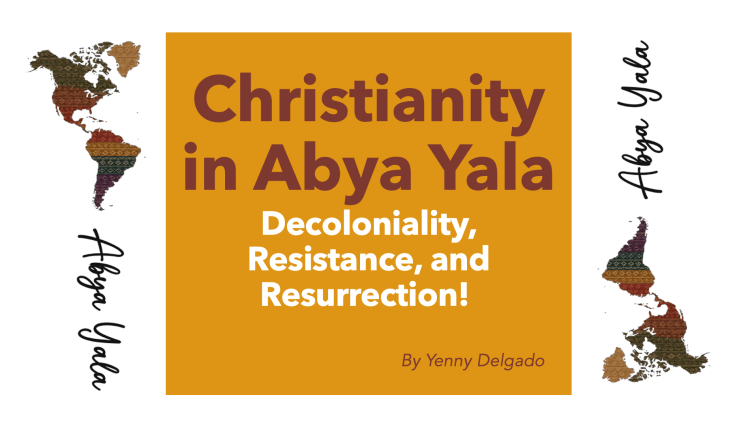
To speak about Christianity from Abya Yala is to begin from a distinct epistemological and experiential standpoint. This approach centers territory, memory, ancestry, and the lived experiences of Abya Yala peoples. The term Abya Yala comes from the Guna language and means “land in full maturity” and “land of vital blood.” It is a place where we are all connected; Native peoples are relatives, and we share a historical past, present, and future. Abya Yala is preferred over the colonial name ‘Latin America’ or “the Americas.”
My work on Christianity in Abya Yala began more than a decade ago with this question: What happens when Christianity is interpreted not from the center of European theological traditions, but from the territories, memories, spiritualities, and struggles of the peoples who received, resisted, transformed, and reinterpreted it?
For centuries, Christianity in Abya Yala was closely intertwined with colonial expansion. The Christian message was frequently presented alongside political power, territorial dispossession, forced conversion, cultural assimilation, and the suppression of Native identities and spiritual practices. My earlier work, published in 2023, “Colonization and the European Christian Message in Abya Yala,” examined how colonial powers tried to erase Native peoples’ ancestral memories. Still, as a seed must dry to flourish, we are here to rise again. This brings new generations of Native theologians who reflect on this Christianization process from all sides, producing a decolonial approach to help decolonize Christianity on our continent.
What Do We Mean by Decoloniality?
Decoloniality is not merely the antithesis of colonialism, nor is it limited to critiquing the colonial past. Instead, it interrogates how colonial forms of power continue to shape knowledge, identity, institutions, relationships, and how we understand and experience God, humanity, and the world. Still today, many churches and seminaries privilege European theological frameworks as the standard against which all theological knowledge is measured, often overlooking or dismissing Native spiritual understandings and practices as non-theological or inferior. This privileging can result in the exclusion of Native voices from theological education and church leadership, and in the marginalization of community rituals that have provided spiritual meaning for generations. These realities show that colonial ways of knowing still determine what counts as legitimate theology today.
This is why decolonial theological work demands more than academic and empathetic writing on paper; it calls for Native scholars to take the lead and produce our own scholarship, rooted in a critical interrogation of inherited frameworks. This means asking who has been granted authority to speak about God, whose experiences are valued as sources of theological knowledge, whose memories are preserved, and whose have been erased. Theologians such as Sofia Chipana (Bolivia), Eleazar Lopez (Mexico), Herbert Alvarez (Guatemala), Claudio Ramirez (Argentina), and myself from Peru are among those whose work must be read, studied, and cited.
Decoloniality, therefore, involves reclaiming the capacity to name, remember, interpret, create, and exist otherwise. It is a process of recovering what coloniality sought to silence, while simultaneously generating new approaches to theology in the present.
Christianization, Territory, and Power
The history of Christianization in Abya Yala shows how theology became entangled with territorial power development, from Quijano’s colonization of power to the acknowledgment of being. European Christians interpreted the land through biblical narratives and often imagined themselves as a new people entering a promised land. The Doctrine of Discovery in the 15th century provided an ecclesiastical and legal framework through which Christian kingdoms claimed authority over lands inhabited by Native peoples and justified their dispossession.
Missions, reductions, schools, and other institutions functioned as mechanisms of evangelization and cultural assimilation. Native peoples were forced to adopt European languages, clothing, social structures, and religious practices. In various contexts, children were separated from their families and communities under the pretext of Christian or “civilized” education. These processes impacted not only political and economic life but also disrupted the transmission of language, memory, spirituality, and identity.
From Erasure to Resistance
Yet the history of Christianity in Abya Yala is not only a history of domination. Native peoples were never simply passive recipients of Christianity. They interpreted, negotiated, resisted, transformed, and sometimes re-created Christian practices within their own to survive.
Resistance can take many forms. It can mean protecting a language, remembering an ancestor, defending territory, recovering a spiritual practice, refusing the shame attached to Native identity, or reading Scripture through a community’s experiences. Resistance can also mean asking whether the liberating dimensions of the Christian message can be recovered from the structures that historically distorted it.
This is where liberation theology became an important part of the history of theological reflection in Abya Yala. Yet the work of Native and Afro-descendant theologians also pushes the conversation further by questioning assumptions that can remain Eurocentric even within liberative traditions. Decolonial theology emerges in this ongoing movement: from critique to recovery, from silence to voice, and from imposed identity to self-determination.
Territory as a Theological Starting Point
Within decolonial Christianity in Abya Yala, territory is not simply a geographical space. Territory embodies memory, encompassing community histories, the presence of ancestors, and relationships with rivers, mountains, plants, animals, and the land itself. It serves as a locus where one finds spirituality and daily life converge.
Centering territory transforms theological practice. Scripture is no longer interpreted solely through inherited European categories; instead, it is read alongside community memory, ancestral knowledge, lived experience, and the realities of peoples defending life and land.
This approach does not romanticize Native communities or assume homogeneity of experience. Rather, it takes seriously the theological knowledge that comes from specific territories and histories and recognizes communities as sites of theological reflection.
From Resistance to Re-existence
I employ the concept of re-existence to describe a process that rises above mere survival. Peoples affected by colonialism not only resist destructive forces; they also continue to create life, relationships, memory, spirituality, and community.
Re-existence is evident when ancestral memory resurfaces after generations of silence, when Native descendants recover marginalized family stories, and when communities defend their territories while envisioning forms of life independent of extraction and domination. It is also present when women assert theological authority and establish spaces for their voices.
In this context, resurrection serves as a key theological understanding. Resurrection is not limited to a return to previous states; it also signifies the emergence of life following experiences of death, erasure, and rupture. A decolonial Christian imagination inquires into the forms of life, spirituality, community, and theological knowledge that are arising among peoples who persist and create despite colonial violence.
Decolonial theology is fundamentally a communal practice. Much of the theological work emerging from Abya Yala originates outside academic institutions. It develops through communities, dialogues, movements, women’s networks, spiritual practices, and relationships among individuals collectively interpreting their experiences.
This conviction is part of the work of Women Doing Theology in Abya Yala, an ecumenical space that brings women theologians and practitioners into conversation across territories and contexts. It is also part of the work of the Political Theology and Spiritualities from Abya Yala, which creates spaces for theological reflection connected to political realities, spiritual practices, community experience, and peoples’ struggles.
These spaces demonstrate that theological knowledge isn’t solely the product of individual scholars, but is also generated collectively. The contributions of women, community theologians, and grassroots practitioners must be recognized, cited, and rendered visible. Citation thus becomes not only an academic obligation, but also a practice of recognition and accountability.
Toward a Decolonial Christianity in Abya Yala
Decolonizing Christianity in Abya Yala does not entail rejecting Christianity solely due to its colonial history, nor does it involve disregarding that history to maintain a comfortable narrative of faith.
A decolonial Christianity must, therefore, adopt a different mode of listening. It must take seriously the memories of communities, the experiences of Native peoples, the theological contributions of women, and the spiritual knowledge transmitted throughout generations. It must acknowledge the wounds inflicted by colonization while also recognizing the resistance that have enabled peoples to persist.
The question is not only how Christianity participated in colonization. The question is also what Christianity can become when peoples reclaim the authority to interpret their own spiritual lives.