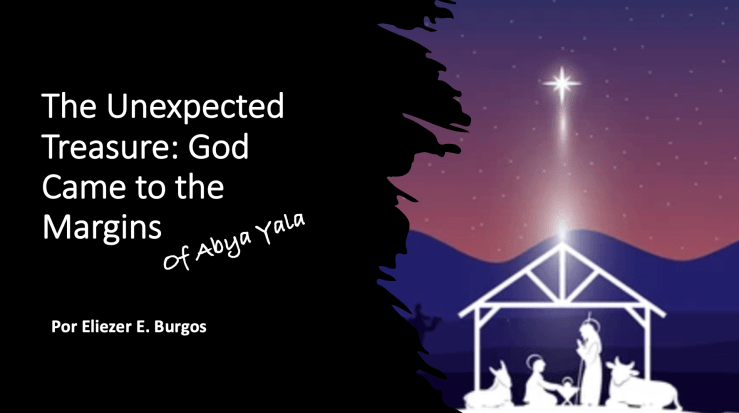
The Unexpected Treasure: God Came to the Margins of Abya Yala

Por Eliezer E. Burgos-Rosado 

The story of Nativity is part of our faith’s DNA. We have heard it so many times we risk domesticating it, rendering it inoffensive. Yet when it is viewed from the margins—from the impoverished, racialized, displaced, and forgotten peoples of Abya Yala*. Christmas ceases to be a gentle tale and is revealed for what it truly is: a dangerous disruption, because it destabilizes orders sustained by exclusion; subversive, because it overturns the logics of power and restores dignity to those who have been pushed aside; and profoundly hopeful, because it affirms that God does not abandon suffering peoples, but walks with them.

The Gospel of Luke does not narrate a neutral birth. It situates the event amid an imperial census, a policy of control that displaced bodies and fractured households. Mary and Joseph did not travel out of religious devotion, but under imperial compulsion. In that context of forced mobility and vulnerability, God chose to be born and insert himself into history, taking on its weight.

Here is where the prophetic denunciation begins. While the empire presented itself as the guarantor of the Pax Romana, the true peace of God arrived wrapped in fragility. Augustus called himself the “savior of the world,” yet the true Savior was not born in Rome or in a palace. He was born in Bethlehem, Palestine. Laid in a manger, surrounded by animals and impoverish. For the reason Christmas thus unmasks the lie of the powerful that promise order at the cost of the lives of the poor.

This contrast is no accident. Luke presents a social world in miniature—from the emperor at the top to the infant at the base. In that world, God chooses the most vulnerable body. In an era when infant mortality was extremely high and children possessed no social status, God chose to reveal himself as a baby—not as a strong adult, not as a warrior, nor as a triumphant king. God chooses fragility.

This choice unsettles our image of God and compels us to ask: what if God does not resemble our images of power, but rather those of our shared vulnerability? What if God is not on the side of those who control, but of those who struggle simply to survive?

It is no coincidence that the first to receive the news were shepherds. In their context they were people of low social status, suspect, rural, and despised by urban and imperial culture. They were not “respectable.” Yet to them was entrusted the greatest announcement in history. God not only is born in poverty; God announces his arrival to the poor.

Here the preferential option of God is revealed—not as a theory, but as an embodied praxis. God comes to those who “do not count,” to tell them that they do. God comes to those who have been displaced, to affirm that their stories matter. God comes to those labeled “surplus,” to proclaim that they are bearers of good news.

For this reason, Christmas remains profoundly relevant for Abya Yala. It is not merely a date on the Christian calendar nor an annual pious memory, but a lasting theological key for discerning where and how God continues to come into the world—especially where life is denied or discarded. In territories marked by colonialism, structural inequality, economic violence, racism, and dispossession, the manger still speaks volumes. God continues to come to us: in poverty that is not a choice but a wound; in the abused woman who endures another day; in children who live in hunger and should not bear the consequences of any system that has failed them; in exploited workers; in communities defending their land against voracious capitalists.

The Incarnation tells us something decisive: God claims us by becoming one of us. Not from above, but from within. God knows what pain is because God lived it. God knows what it means to have no place, to depend on others to survive, to be displaced, migrant, and vulnerable.

For this reason, Christian faith cannot be resignation. Christmas calls us to rise with hope. The salvation announced by the angels is not abstract nor merely future. It is concrete, communal, and begins now: where bread is shared, where solidarity is organized, where life is defended, where the lies of empire are exposed.

This is the prophetic call to our communities: you have not been forgotten. The God who was born in a manger continues to walk with you. And just as the shepherds left their routines to see what God was doing, we too are called to move from fear to action, from silence to voice, from a private faith to embodied hope.

Rise up in the name of the One who came before you!

For EMMANUEL is not merely a pious name; it is a spiritual and political proclamation. God is with us and no empire has the final word.

Abya Yala in the Guna language means “land in full maturity and land of vital blood.” In the 1970s, activists, historians, politicians, and theologians with a strong sense of ancestral identity adopted the term Abya Yala as a unified name for the continent, instead of referring to it as Latin America, among other names that perpetuate colonial divisions (Delgado & Ramírez, 2022).

Eliezer E. Burgos-Rosado 

Puerto Rican theologian. Doctoral student in Theology at the Interamerican University of Puerto Rico. Pastor and graduate of the Evangelical Seminary of Puerto Rico. Works on topics of ethics, ecclesiology, and social justice. Founder of Ediciones Didásko.

De comediante del evangelio a showman político “PresiDante”

Por Diego Ramos

Ha crecido con fuerza la espectacularidad en los líderes políticos. Los diferentes shows se van instalando como algo “útil” para cautivar la mayor porción de la sociedad, pero no son los únicos, también en el campo religioso hay “comediantes del evangelio”.

Dante Gebel es por hoy en América Latina un personaje mediático de alto alcance, de fuerte impacto en sus millares de seguidores que se encaminan hacia búsquedas, horizontes, brújulas, orientaciones para sus vidas emocionales, afectivas y de proyectos personales “un viaje al corazón y el alma”, tal como el mismo Gebel lo expresa en su gira PresiDante, la cual no se cuestiona, ni  se pone en tela de juicio. Entonces, ¿dónde comienza la preocupación? El predicador PresiDante ha expresado no descartar una candidatura presidencial, cuyo jefe de campaña podría ser Dios. Estas declaraciones nos coloca, sin duda, en un nuevo escenario riesgoso en tanto se está frente a un personaje de “dos caras de la misma moneda”: comediante del evangelio y showman político.

 ¿Qué sector lo promociona? Se habla de que la oposición intenta traccionarlo, algunos informan que lo quieren dentro de las líneas del oficialismo, otros confirman que es promovido por un sector del sindicalismo. Sea cual fuese el origen, las preguntas de fondo se hacen sentir: ¿por qué un predicador evangélico?, ¿no será acaso la comodidad de que, en vez de hacer lo que hay que hacer por parte de la dirigencia política, resulta más rentable y confortable recostarse sobre un predicador buscando legitimidad? No hago los cambios estructurales necesarios, no recreo los espacios o los democratizo, pero necesito una figura pura que me cubra; ésta sería la concepción general. La despolitización, en este caso, no es de un solo sector, sino de todos aquellos sectores políticos incapaces de proponer un nuevo sentido de la política y recrear, en nuevas generaciones, la importancia del ser sujetos políticos y democráticos.

 En 2023 Neflix lanzaba la segunda temporada de la serie argentina “El Reino”. En la ficción se mostraba que la crisis de representatividad había llegado a su fase final, momento ideal para que el pastor Emilio Vázquez Pena (Diego Peretti-actor) librase la guerra santa por medio de un nuevo e inédito contrato de tan solo una única cláusula entre Dios y las personas: tener fe. Esa única condición cumplida otorgaría al pueblo argentino seguridad y progreso. La serie pone a rodar la lógica de la teología de la prosperidad, que entiende que el éxito financiero, laboral o social se ve como evidencia del favor de Dios. A la inversa, la falta de éxito puede interpretarse como poca fe o desobediencia. No es casualidad que, en la ficción, el pastor- Presidente de la Nación- decidiera cerrar el Congreso. 

 ¿Se sigue profundizando el esquema de reemplazar el campo político por el religioso? Milei, el Moisés argentino y con las fuerzas del cielo asumió su presidencia a espalda del Congreso de la Nación, ahora PresiDante Gebel con la teoría de la teología de la prosperidad a cuestas entra al campo de la política.  Esta concepción teologal que reduce a Dios a un “medio” para obtener riqueza y que , al mismo tiempo, aparezca como un mecanismo de intercambio: “yo doy, Dios me da”, donde lo sagrado se  mercantiliza termina por culpar al pobre de su pobreza, mientras se propone una despolitización absoluta -sin conciencia social crítica-. Esta teología anula el campo de la política (anula las demandas por los derechos políticos, económicos, culturales y sociales), no señala las responsabilidades políticas y económicas, que atentan contra la dignidad de las personas, no hay, en la teología de la prosperidad, un responsable del modelo  de ajuste, se invisibiliza un capitalismo salvaje…La prosperidad depende de la fe, entonces: quien no prospera “tiene poca fe”. 

 Necesitamos seguir abiertos a los debates en torno a los verdaderos sentidos de la política, no podemos renunciar a la comunidad política, a la autocrítica y a reemplazar los viejos mapas de hacer política y poner parches con personajes mesiánicos. Hay una sociedad que demanda, exige un planteo ético político. Pero, no nos confundamos, siempre es desde la política, con la política y desde el Estado. La supuesta teología de la prosperidad ni es teología ni es de la prosperidad. Es religión de Estado camuflada de teología, que no busca la prosperidad de los pobres sino la aceptación de la pobreza por esto como aniquilamiento moral de lo político.    

Diego Ramos es educador popular argentino, militante político, licenciado en Ciencias Políticas, profesor de Filosofía y Ciencias Sagradas. Presidente del  Partido Nacional  “República Modelo”, dirige y coordina el Centro de Educación popular Antonio Gramcsi en Santiago del Estero.

We Are the Guardians of the Planet: A Spiritual and Moral Call to Care for Creation

COP30, the United Nations climate conference taking place in Belém, Brazil, has a promising agenda. On paper, such declarations lend the conference an air of promise. Yet in practice, global climate gatherings have long been shaped not by the communities most affected, but by nation-states and multinational corporations whose interests often overshadow the voices of those living at the frontlines of ecological collapse.

In response, sixty Native/Indigenous organizations from both the southern and northern of Abya Yala* embarked on an extraordinary journey known as the “Yaku Mama Flotilla.” Activist leaders from Ecuador, Peru, Brazil, Colombia, Panama, Guatemala, and Mexico set out from Ecuador, traveling over 1,800 miles down the Amazon River to Belém, Brazil. The name “Yaku Mama,” derived from Quechua language, translates to “Mother of the Waters.” This name reflects a worldview in which every river, forest, and creature is nurtured by a maternal presence. It embodies a vision of creation as not merely an object, but as an integral part of a shared existence with the cosmos.

Their voyage is at once a protest and a plea: an unequivocal call to end fossil-fuel extraction; a demand to safeguard uncontacted peoples; a push for direct, community-led climate financing; and a reaffirmation that any durable climate solution must be rooted in ancestral knowledge. It is not simply a political act—it is a spiritual procession, a living litany on behalf of the wounded Earth.

The disconnect between these frontline communities and international climate forums often reveals itself most acutely in language. For many Indigenous peoples, humanity exists within nature, not beyond it. Their urgency is not an abstract concern but the anguish of losing a loved one, the Amazon, the rivers, the mountains, the trees, the motherland, home.

Remembering the words of Pope Francis, in Laudato Si’ (2015), reminds the world that the Earth “is our common home,” a mother who “cries out because of the harm we have inflicted on her.” His words resonate profoundly with the spirit of the Yaku Mama Flotilla. Both speak of creation not as a commodity to be exploited, but as a sacred gift entrusted to our care. Francis warns that when humans, from an Eurocentric and anthropocentric point of view, imagine themselves as masters and owners, detached from the web of life, the result is the devastation of ecosystems, vulnerable peoples, and the moral fabric that binds us together.

In Laudate Deum (2023), he becomes even more urgent, insisting that the climate crisis is not merely political or scientific but deeply spiritual. In the face of this reality, Pope Francis speaks with prophetic clarity, denouncing both political inaction and the systematic obstruction of negotiations driven by economic interests that place profit above the common good. He calls for the creation of global structures capable of protecting our common home, and he lifts up the vital role of popular movements and local communities, who already bear the weight of environmental destruction. Francis urges a profound cultural revolution, one that frees us from selfishness and leads us to responsibility and care. He insists that science is an essential ally, not an enemy of faith. He invites us to embrace an active hope, a hope that is not naïve, but committed, courageous, and transformative.

The flotilla’s journey thus becomes a living homily. It proclaims what Pope Francis emphasizes repeatedly: that ecological conversion requires listening to those who live closest to the land, who understand creation as a communion of relationships. It is an invitation to repentance for the harms done, a call to defend the sacredness of all life, and a commitment to walk, like the “Yaku Mama Flotilla,” ourageous hope toward a future where humanity and creation may be healed together.

*Abya Yala in the Guna language means “land in full maturity and land of vital blood .” In the 1970s, Native activists, historians, politicians, and theologians with a strong sense of ancestral identity adopted the term Abya Yala as a unified name for the continent, instead of referring to it as Latin America, Hispanoamerica among other names that perpetuate colonial divisions (Delgado & Ramírez, 2022).

Abya Yala Theology: Prophetic, Communal, and Political

From November 7 to 9, 2025, the inaugural continental gathering was held in Mazatenango, Guatemala. Over the course of three days, delegations from ten countries and 375 participants—including leaders from diverse backgrounds such as farmers, educators, theologians, historians, anthropologists, sociologists, political scientists, elders, and spiritual guides from across the continent—came together to affirm the foundations of a communal, political, and prophetic theology that denounces colonial oppression and dictatorial political agendas.

This gathering marked a historical event in the emergence of Abya Yala theology. It served as a continental platform to defend life, harmony, Native spiritualities, ancestral knowledge, and the right to exist of the Native/Original Peoples of Abya Yala.

As Christendom has promoted since colonization, as a linear and singular understanding of history, it has increasingly marginalized alternative narratives, diverse spiritualities, and various paths to connect with the divine, wisdom for the native population. This perspective, influenced by government-imposed control, unilateral education programs, and structured religious practices, has perpetuated policies and systems that dictate behavior, belief, and imitation, aiming to mold individuals in its own image. However, this approach is no longer acceptable. Christianity and the teachings of Jesus illuminate a range of practices, as seen in Abya Yala theology, which moves beyond the image of the crucified man to embrace faith in the Resurrection.

In response to this, an embodied spirituality has emerged; the body of the resurrected manifests that another life is possible. A theology that is next to the everyday struggles, in maintaining the memories of those who dedicated their lives to achieving dignity, freedom, and the pursuit of a good living. For prophets of our time who believe in a cycle of times and preach against colonialism and superiority, that the time for native people

‘s Resurrection is now. In this context, we assert that Abya Yala Theology emerges from the heart of God, the resurrected messenger, rooted in faith, hope, and the proclamation of the Resurrection in the lives of those who suffer most since colonization: Indigenous, Natives, and Original peoples of Abya Yala.

Abya Yala’s theological perspective amplifies Quijano’s decolonial perspective on knowledge and power, emphasizing the need to deconstruct power and knowledge systems imposed by European paradigms, which often present themselves as superior and universal. Abya Yala theology is a decolonial theology with holistic ways of theological decoloniality, encompassing three vital dimensions for thinking and feeling God in Abya Yala: feeling, caring, and repairing.

To feel means to be touched, profoundly affected by the struggles of Native/original peoples who inhabit this “land of vital blood,” united through a shared ancestry. Caring embodies love and a commitment to the community, where feelings are genuine and mutual responsibilities foster a sense of cosmoexistence that brings us together. Finally, restoration signifies the movement towards actions that repair broken relationships, restore dignity, provide well-being, and create new conditions for life for all, within the framework of a cyclical and ancestral worldview.

For this reason, Abya Yala theology is inherently political, emphasizing the importance of engaging with spiritualities and ancestral knowledge that enable us to live in community amid the pluridiverse and pluricultural of Natives/Originals peoples. This approach is not the work of isolated theorists; rather, it underscores the urgent need for a theology arising from the peoples themselves as an affirmation of the living God in Abya Yala.

Abya Yala in the Guna language means “land in full maturity and land of vital blood .” In the 1970s, activists, historians, politicians, and theologians with a strong sense of ancestral identity adopted the term Abya Yala as a unified name for the continent, instead of referring to it as Latin America, among other names that perpetuate colonial divisions (Delgado & Ramírez, 2022).

Eva y María: Caída y Redención desde la Perspectiva Femenina

Por Rosaly Guzmán

Desde los albores de la creación hasta la plenitud de los tiempos, la figura femenina ha ocupado un lugar clave en la historia de la salvación. En este ensayo reflexionaremos sobre dos mujeres fundamentales: Eva, símbolo de la fragilidad humana y del inicio del drama del pecado; y María, la madre de Jesús, cuyo “sí” a Dios se convierte en el punto de inflexión redentora para toda la humanidad. A través de un análisis teológico y tipológico, examinaremos cómo estas dos figuras no son meramente contrastes, sino profundamente complementarias. Eva y María representan la tensión entre caída y redención, desobediencia y obediencia, oscuridad y luz. Ambas reflejan aspectos de la experiencia humana en su dimensión femenina, y nos invitan a contemplar el papel vital que la mujer desempeña en el plan divino. Este ensayo busca no solo profundizar en estas figuras bíblicas, sino también provocar una reflexión más amplia sobre la dignidad, vocación y misión de la mujer en la Iglesia y en el mundo.

La narrativa bíblica no es neutral en cuanto a género: está tejida con voces masculinas y femeninas que juntas revelan el corazón de Dios. En este contexto, Eva y María destacan como figuras clave dentro de una visión teológica de la humanidad. Aunque separadas por siglos de historia, estas dos mujeres representan polos teológicos entre los cuales se mueve el drama de la redención. La caída del ser humano, en la que Eva juega un papel activo, no es el final. En María, la nueva Eva, la historia encuentra su reverso redentor. Este ensayo propone una lectura tipológica y teológica de ambas figuras, no para confrontarlas como culpable y salvadora, sino para descubrir en ellas una pedagogía divina que exalta lo femenino como lugar de encuentro entre Dios y la humanidad.

Eva: La humanidad en caída

La primera mujer, Eva, aparece en el relato de Génesis como compañera del hombre y coimagen de Dios:“Y creó Dios al hombre a su imagen… varón y hembra los creó” (Génesis 1:27).

Eva, cuyo nombre significa “madre de todos los vivientes” (Génesis 3:20), se convierte en símbolo de la humanidad que busca el conocimiento fuera de la obediencia. Su acto de comer del fruto prohibido no debe interpretarse simplemente como un error individual, sino como la representación arquetípica del deseo humano de autonomía absoluta, sin Dios.

San Ireneo de Lyon, en su obra Contra las herejías, observa que Eva desata el nudo de la desobediencia que será anudado nuevamente por la obediencia de María. Él escribe:“Así como por la desobediencia de una mujer el hombre fue condenado, así también por la obediencia de una mujer el hombre fue salvado” (Ireneo, Adversus Haereses 3.22.4).

Eva no es condenada a ser una figura eternamente culpable, sino que representa a la humanidad en su búsqueda, caída y necesidad de redención. Su historia es la nuestra: una historia de fragilidad, deseo, error y, sin embargo, nunca fuera del alcance de la gracia divina.

María: La nueva Eva y el amanecer de la redención

En la plenitud de los tiempos, María aparece como la mujer por medio de la cual entra al mundo el Salvador. Su respuesta al anuncio del ángel Gabriel es un acto de fe radical:“He aquí la sierva del Señor; hágase conmigo conforme a tu palabra” (Lucas 1:38, RVR1960).

En este momento, María se convierte en el reverso redentor de Eva. Donde Eva escuchó a la serpiente, María escucha al mensajero de Dios. Donde Eva dudó del mandato divino, María confía plenamente. La tradición patrística vio en esta oposición una clave teológica para entender la redención.

Hans Urs von Balthasar expresa este paralelismo con claridad: “Eva se afirma en su voluntad sobre la de Dios, María se entrega. Donde Eva dijo ‘no’, María dice ‘sí’. Y ese sí es el canal por donde entra la gracia al mundo” (von Balthasar, María, Primera Iglesia, 1980).

La obediencia de María no es pasividad, sino un acto de libertad iluminada por la fe. Su maternidad es física, pero también espiritual: ella es madre de Jesús y, por extensión, madre de todos los redimidos (Juan 19:26–27).

Tipología: De la desobediencia al fiat

La lectura tipológica permite ver en Eva y María dos mujeres entrelazadas en la historia sagrada, no como rivales, sino como imágenes opuestas de la misma humanidad. Según San Justino Mártir:

“Cristo fue hecho hombre por medio de la Virgen para que la desobediencia provocada por la serpiente comenzara por medio de Eva y terminara por medio de María” (Diálogo con Trifón, 100).

En este sentido, María no borra a Eva, sino que la redime desde dentro. La tipología no anula el pasado, sino que lo resignifica. La historia de la salvación no avanza destruyendo lo antiguo, sino cumpliéndolo.

Ambas mujeres tienen una relación directa con el Árbol: Eva con el árbol del conocimiento, María con el madero de la cruz. Al pie de ese nuevo árbol, María se mantiene firme, convirtiéndose en testigo del nuevo pacto:“Mujer, he ahí tu hijo… He ahí tu madre” (Juan 19:26–27).

Implicaciones actuales: La mujer en la historia sagrada y en la Iglesia

La visión teológica de Eva y María tiene profundas implicaciones pastorales y eclesiales. Si la historia de la redención comienza con una mujer y culmina con otra, entonces la mujer ocupa un lugar indispensable en la economía de la salvación. Lejos de ser secundaria, la figura femenina es mediadora, portadora de vida y de fe.

El Papa Juan Pablo II, en su carta apostólica Mulieris Dignitatem (1988), escribió: “La mujer es introducida en la historia de la salvación de un modo insustituible: es la primera en recibir al Redentor y en cooperar con Él en el misterio de la redención.”

En una época en que la dignidad femenina sigue siendo amenazada por estructuras patriarcales, estereotipos culturales o incluso por silencios eclesiales, estas figuras bíblicas invitan a una recuperación profunda del valor de la mujer. La Iglesia necesita redescubrir la voz profética de María y aprender a mirar con nuevos ojos a Eva, no como culpable eterna, sino como parte de una humanidad redimida.

Conclusión

Eva y María, más que símbolos opuestos, representan las posibilidades y tensiones del corazón humano. Eva nos recuerda nuestra fragilidad, pero también nuestro anhelo de plenitud. María nos muestra que la redención no es una idea abstracta, sino una realidad encarnada en la fe y obediencia de una mujer común. En ambas, la historia sagrada nos invita a mirar la vida con esperanza: la caída no tiene la última palabra, la gracia sí. Y es en lo femenino donde esta gracia encuentra tierra fértil para dar fruto eterno.

Preguntas para la reflexión y aplicación pastoral:

  1. ¿Cómo podemos redescubrir a Eva como símbolo de la humanidad en búsqueda y no solo como figura de culpa?
  2. ¿Qué significa para ti que María haya dicho “sí” a Dios desde su condición de mujer joven, humilde y anónima?
  3. ¿De qué manera el ejemplo de María puede inspirar a las mujeres de hoy en su vida de fe, liderazgo y servicio?
  4. ¿Cómo puede la Iglesia valorar mejor la dimensión femenina en su misión pastoral y teológica?
  5. ¿Qué aspectos de tu vida personal podrían transformarse si pasas de un “no” temeroso a un “sí” confiado como el de María?

Sobre la autora:

Rosaly Guzmán Torres es puertorriqueña con una maestría en Divinidad y estudios doctorales en Consejería. Rosaly es profesora universitaria, maestra bíblica y líder activa en la iglesia Bautista del Sur. Además de sus múltiples roles profesionales, es madre y mentora, con un compromiso firme de guiar a otras mujeres hacia el crecimiento espiritual, emocional y personal.