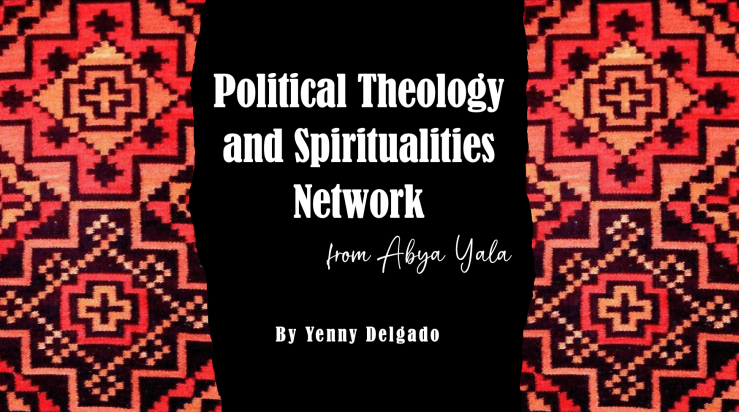
Decolonial. Comunal. Prophetic.
The Political Theology and Spiritualities Network was established at the beginning of 2025 with a commitment to fostering dialogue, critical reflection, and collective efforts. Its aim is to strengthen theological, political, and decolonial thought grounded in the territories, ancestral knowledge, and the resistance of Native peoples of Abya Yala.
Our network serves as a meeting space for theologians, wisdom people for communities, faith leaders, committed to critical reflection on the relationships among spirituality, politics, and community life. We seek to promote a theology that is not constructed from colonial logics or from perspectives imposed by Western centers of power, but rather one that grows from the memories, spiritualities, and resistances of Indigenous peoples and communities across the continent.
Political theology, understood in this context, explores the connections between religious ideas and political practices, recognizing that spirituality has historically been a source of inspiration, resistance, and organization for communities. From our perspective, this reflection develops in dialogue with diverse disciplines, including native philosophy, decolonial approach, ethics, cultural studies, and critical theories, while remaining firmly grounded in the lived realities of the peoples of Abya Yala.
The network aims to serve as a space that integrates thought, formation, and action, connecting academics, community leaders, activists, popular educators, and others interested in advancing social transformation rooted in liberating spirituality. We maintain that theology should not remain confined to academia; it must engage with the struggles, aspirations, and practices of communities.
Guided by this conviction, we promote a political theology that is decolonial, communal, and prophetic. This approach seeks to amplify voices silenced by colonial history and to recognize the spiritual wisdom embedded in ancestral worldviews, communal practices, and ongoing struggles for justice and dignity.
As part of this process, in 2025, we organized the First Gathering of Political Theology and Spiritualities from Abya Yala, a space for exchange and collective construction that brought together more than 400 participants, including farmer leaders, human rights activists, defenders of the land, theologians, political scientists, and diverse voices committed to a community-based political theology.
We are currently launching the First Popular Education Course in Political Theology and Spirituality, which begins on May 8 and runs over eight consecutive Fridays until June 26, 2026 ( Time, 6:00 pm Puerto Rico). This educational process aims to strengthen critical reflection and communal discernment through the following themes:
- Abya Yala: Territory, Memory, and Spirituality
- Popular Spiritualities: Political and Liberating Pedagogies
- Theology of Politics or Politics of Theology? A Continental Perspective
- Decolonial Methodologies of Feeling, Caring, and Repairing
- Spirituality and Political Struggle from Abya Yala
- Digital Networks, Communication, and Political Spirituality
- Ancestral Spiritualities and Cosmologies
- Communal Discernment and Political Action
We invite all those interested in learning, reflecting, and building knowledge in the community to register and participate in this formative process. Follow the registration link HERE.
Please note that the course will be offered entirely in Spanish.
It is important to emphasize that although the course is offered free of charge, this does not diminish its value. The course represents the collective effort of the Network as organizers, the facilitators responsible for the eight sessions, and all participants who will contribute to making this formation process a space for communal growth.
The program will be led by the Peruvian theologian Yenny Delgado, Argentine theologian Claudio Ramírez, and political scientist Diego Ramos, who, together with other collaborators and members of the Network, are promoting this continental space for dialogue, formation, and collective action.











 PUBLICA