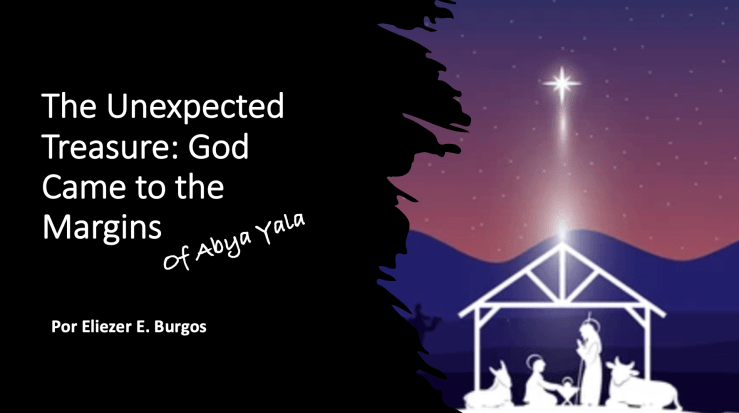
The Unexpected Treasure: God Came to the Margins of Abya Yala

Por Eliezer E. Burgos-Rosado 

The story of Nativity is part of our faith’s DNA. We have heard it so many times we risk domesticating it, rendering it inoffensive. Yet when it is viewed from the margins—from the impoverished, racialized, displaced, and forgotten peoples of Abya Yala*. Christmas ceases to be a gentle tale and is revealed for what it truly is: a dangerous disruption, because it destabilizes orders sustained by exclusion; subversive, because it overturns the logics of power and restores dignity to those who have been pushed aside; and profoundly hopeful, because it affirms that God does not abandon suffering peoples, but walks with them.

The Gospel of Luke does not narrate a neutral birth. It situates the event amid an imperial census, a policy of control that displaced bodies and fractured households. Mary and Joseph did not travel out of religious devotion, but under imperial compulsion. In that context of forced mobility and vulnerability, God chose to be born and insert himself into history, taking on its weight.

Here is where the prophetic denunciation begins. While the empire presented itself as the guarantor of the Pax Romana, the true peace of God arrived wrapped in fragility. Augustus called himself the “savior of the world,” yet the true Savior was not born in Rome or in a palace. He was born in Bethlehem, Palestine. Laid in a manger, surrounded by animals and impoverish. For the reason Christmas thus unmasks the lie of the powerful that promise order at the cost of the lives of the poor.

This contrast is no accident. Luke presents a social world in miniature—from the emperor at the top to the infant at the base. In that world, God chooses the most vulnerable body. In an era when infant mortality was extremely high and children possessed no social status, God chose to reveal himself as a baby—not as a strong adult, not as a warrior, nor as a triumphant king. God chooses fragility.

This choice unsettles our image of God and compels us to ask: what if God does not resemble our images of power, but rather those of our shared vulnerability? What if God is not on the side of those who control, but of those who struggle simply to survive?

It is no coincidence that the first to receive the news were shepherds. In their context they were people of low social status, suspect, rural, and despised by urban and imperial culture. They were not “respectable.” Yet to them was entrusted the greatest announcement in history. God not only is born in poverty; God announces his arrival to the poor.

Here the preferential option of God is revealed—not as a theory, but as an embodied praxis. God comes to those who “do not count,” to tell them that they do. God comes to those who have been displaced, to affirm that their stories matter. God comes to those labeled “surplus,” to proclaim that they are bearers of good news.

For this reason, Christmas remains profoundly relevant for Abya Yala. It is not merely a date on the Christian calendar nor an annual pious memory, but a lasting theological key for discerning where and how God continues to come into the world—especially where life is denied or discarded. In territories marked by colonialism, structural inequality, economic violence, racism, and dispossession, the manger still speaks volumes. God continues to come to us: in poverty that is not a choice but a wound; in the abused woman who endures another day; in children who live in hunger and should not bear the consequences of any system that has failed them; in exploited workers; in communities defending their land against voracious capitalists.

The Incarnation tells us something decisive: God claims us by becoming one of us. Not from above, but from within. God knows what pain is because God lived it. God knows what it means to have no place, to depend on others to survive, to be displaced, migrant, and vulnerable.

For this reason, Christian faith cannot be resignation. Christmas calls us to rise with hope. The salvation announced by the angels is not abstract nor merely future. It is concrete, communal, and begins now: where bread is shared, where solidarity is organized, where life is defended, where the lies of empire are exposed.

This is the prophetic call to our communities: you have not been forgotten. The God who was born in a manger continues to walk with you. And just as the shepherds left their routines to see what God was doing, we too are called to move from fear to action, from silence to voice, from a private faith to embodied hope.

Rise up in the name of the One who came before you!

For EMMANUEL is not merely a pious name; it is a spiritual and political proclamation. God is with us and no empire has the final word.

Abya Yala in the Guna language means “land in full maturity and land of vital blood.” In the 1970s, activists, historians, politicians, and theologians with a strong sense of ancestral identity adopted the term Abya Yala as a unified name for the continent, instead of referring to it as Latin America, among other names that perpetuate colonial divisions (Delgado & Ramírez, 2022).

Eliezer E. Burgos-Rosado 

Puerto Rican theologian. Doctoral student in Theology at the Interamerican University of Puerto Rico. Pastor and graduate of the Evangelical Seminary of Puerto Rico. Works on topics of ethics, ecclesiology, and social justice. Founder of Ediciones Didásko.

Ser Mamá y Teóloga en Abya Yala

La historia de mi maternidad no empieza con mi embarazo, ni únicamente con la transformación física y emocional que viví durante ese tiempo. Para mí, fue un proceso que tomó muchos años. Durante mucho tiempo pensé que la maternidad era una carga, una tarea que limitaría mi ser mujer y mi independencia. Pasó tiempo hasta que realmente lo deseé, y cuando quise, no fue tan fácil. Nuestro cuerpo, el cuerpo de las mujeres, tiene ciclos que influyen; mientras más años pasan, nuestra capacidad co-creadora cambia. Cada una tiene su propia historia de cómo llegó a la maternidad. Esta es la mía.

Llevar en mi vientre a mi hija fue una experiencia maravillosa que me multiplicó, cambió mis prioridades y revolucionó todos mis planes. Puedo decir que valió la pena cada una de esas cuarenta semanas que tuve a mi hija dentro de mí, los recuerdo como los más tiernos de mi vida. Pero convertirme en mamá no ocurrió solo durante la gestación; fue un proceso que se fue dando poco a poco, al sostener a mi bebé en brazos, al amamantarla, al acompañarla día y noche, en el cuidado diario. Así, entre ternura y cansancio, entre entrega y acogimiento, fui transformándome y aprendiendo a ser madre.

Ya inmersa en la tarea de la maternidad entiendo que mi experiencia no es solo personal, es comunal, espiritual, intelectual y política. Empecé a escribir mis reflexiones teológicas mucho antes que fuera madre, ahora como mamá y teóloga me acerco a lo más íntimo de senti-pensar a Dios.Mi propuesta teológica surge de una raíz profundamente ancestral y traigo a la memoria a mis abuelas, a mi madre, a todas las mujeres que corazonaron y siguen corazonando a Dios en medio de la crianza. Sentir a Dios desde el fogón de la cocina, preparar los alimentos, lavar ropa, cambiar pañales, amamantar. En ese tiempo circular que es cotidiano, que crea rutinas, intensifica fatigas se revela la poderosa tarea que asumimos las madres para crear familias. A la vez que criamos, administramos y organizamos la casa, a la vez que anidamos y seguimos buscando cumplir con nosotras, nuestros compromisos y sueños.

Así también yo en medio de mis responsabilidades maternas y comunitarias, corazono a Dios y continúo mi labor teológica que me apasiona, consciente de que mi maternidad es a la vez fuente, método y camino de mi pensamiento espiritual. Mi hija me acompaña mientras hago mis labores de la casa, mientras leo y escribo, mientras doy presentaciones en conferencias, en mi visita a comunidades rurales; en medio de este camino, y sobre la marcha de la vida me acompaña esa fuerza vital, que me recuerda que estos días son mi presente y mi pasado, lleno de ternura y de acompañamiento mutuo.

La sagrada continuidad de la vida

La maternidad no es solo una función biológica de reproducirnos; para mí, es una experiencia espiritual de co-creación. Traer un nuevo ser al mundo me introdujo en el misterio profundo de comprenderme como co-creadora. En esta experiencia, entendí que no solo parimos hijas e hijos, parimos mundos, parimos historias, parimos resistencia.

Desde que soy madre, he visto cómo transmitimos la memoria colectiva a través de relatos, ritos y creencias que practicamos en la vida cotidiana. Mi cuerpo recuerda, mis relatos se vuelven carne, y así entiendo que el cuerpo materno es un microcosmos de tierra fértil, nutriente, cíclico y generoso. Desde esta visión, siento que la maternidad sostiene la armonía de gestar humanidad. Esta comprensión me enfrenta a los dualismos occidentales que separan y dividen entre cuerpo y espíritu, lo humano y lo animal, lo sagrado y lo cotidiano. Para mí, el cuerpo de las mujeres es unidad, es territorio, un ser holístico donde lo divino se encarna y sostiene.

He aprendido de las mujeres de mi comunidad y de muchas comunidades originarias que la transmisión de la vida y de la memoria es un acto sagrado. Desde niñas, nos enseñan que nuestro cuerpo, nuestra voz y nuestra capacidad de gestar y sostener la vida son dones que debemos cuidar y honrar. Sin embargo, esta continuidad co-creadora enfrenta hoy amenazas muy concretas, violencia sexual en la infancia, abusos dentro la pareja, embarazos no deseados, abortos clandestinos, infertilidad y otras formas de violencia contra las mujeres. La maternidad, lejos de ser solo celebración de la vida, se vuelve frágil en contextos que vulneran la plenitud de la vida.

Ser mamá teóloga para mí significa hacer teología desde el cuerpo, desde la memoria de la celebración y de la resistencia, y también desde la herida colonial que violentó los cuerpos de las mujeres. Reconozco que, desde esta continuidad ancestral de resistencia, no puedo quedarme en el dolor que paraliza, nos condena, nos culpa, nos señala por denunciar las violencias que vivimos como mujeres, ni por asumir la maternidad crucificada que tantas de nosotras hemos enfrentado.

Al mirar el dolor ancestral inscrito en el cuerpo abusado que han sufrido las mujeres de mi familia, mi madre y abuelas, me vuelvo hacia la sanación. Necesito salir del cuerpo crucificado para centrarme en un cuerpo resucitado, que me libera del dolor sufrido por abusos generacionales, para así ser capaz de engendrar una nueva vida. Es desde este lugar de liberación que asumo mi maternidad: para crear una familia en la que mi hija pueda crecer libre de violencia.

Mi hija es la quinta generación de mujeres en ambas líneas familiares cuyos nombres, historias y lugares de origen conocemos. Entre ella y mis bisabuelas se extiende un hilo de 135 años de memoria femenina ininterrumpida, un tejido vivo donde maternidad, sabiduría y resistencia se entrelazan generación tras generación. Así como yo tuve el privilegio de conocer a mis dos abuelas (Candelaria y Juanita), mi hija ha tenido la bendición de conocer a las suyas. Esta continuidad no es casual, es herencia, es ancestralidad y es responsabilidad espiritual.

La Maternidad como espiritualidad y resistencia

Las tradiciones bíblicas también reconocen la maternidad como signo continuidad sagrada de vida. En Lucas 11:27 se proclama “Bienaventurado el vientre que te llevó y los pechos que te amamantaron.” Esta afirmación reconoce la maternidad como un acto sagrado, profundamente ligado a la gestación, al cuidado, al alimentar.

Sin embargo, por siglos hemos recibido una imagen de Dios casi exclusivamente masculina. La teología patriarcal silenció la dimensión femenina del “imago Dei”. Pero si Dios crea a la humanidad “varón y mujer”, entonces la imagen divina abarca también lo femenino. La experiencia cotidiana de las mujeres, su capacidad de gestar, amamantar, nutrir, resistir, es lugar teológico donde la presencia de Dios se revela. 

Reflexionar sobre esta dimensión femenina de lo divino exige atender todas las formas de acción y expresión de las mujeres, así como las diversas opresiones que enfrentamos. Como señala McFague, “los símbolos de Dios deben reflejar la totalidad de la experiencia humana, y no únicamente aquello que ha sido asociado históricamente al dominio masculino.”

Desde esta perspectiva, la maternidad divina se manifiesta en la tierra, en el agua, en el territorio y en los cuerpos femeninos que dan vida, haciendo visible la presencia de Dios en los procesos vitales y en las realidades concretas de las mujeres. Para los pueblos originarios, la madre tierra, es fuente de vida y destino “Nacemos de ella, nos alimenta, nos recibe en el descanso y volvemos a ella cuando morimos.”

La madre tierra, nuestra Abya Yala no es una metáfora ni un recurso simbólico, sino una realidad ontológica y espiritual, es cuerpo de mujer, matriz originaria y destino cíclico. Desde esta perspectiva, la maternidad no es solo un acto biológico, sino una categoría teológica que expresa la relación sagrada de interdependencia entre los seres humanos, los otros seres vivos y el territorio. La tierra es madre porque gesta, nutre, protege y regula la vida; por eso, el cuerpo femenino, también generador y cuidador de vida, es reconocido como extensión concreta de esa sacralidad.

Sin embargo, la colonización quebró este modo sagrado de co-creación. La invasión europea sobre Abya Yala no solo ocupó territorios, sino que desmanteló las cosmologías que reconocían la sacralidad materna del mundo. Así como la Madre Tierra fue violentada, dividida como propiedad privada y explotada, también lo fueron los cuerpos de las mujeres. La lógica colonial trasladó la idea de propiedad del territorio al cuerpo femenino: colonizadores, terratenientes y patrones convirtieron a las mujeres nativas en territorio conquistable, mano de obra forzada y objeto de abuso sexual sistemático. Como sostiene Segato, el cuerpo de las mujeres se transformó en el principal territorio político del colonialismo, un espacio donde se disputó poder, dominio y control. Su liberación, por tanto, no es un añadido, sino el corazón mismo de cualquier proyecto serio de descolonización.

La violencia sexual colonial funcionó como estrategia espiritual además de política, buscaba deshumanizar a las mujeres, fracturar la transmisión cultural y quebrar la resistencia comunitaria. El cuerpo materno, convertido en instrumento de explotación y reproducción forzada, sufrió un doble ataque, por ser cuerpo de mujer y por ser cuerpo indígena. Esta doble opresión dejó heridas profundas que se transmiten de generación en generación.

No obstante, incluso en medio de estas violencias, la maternidad en Abya Yala emergió como territorio espiritual de resistencia. Desde la memoria ancestral, parir, amamantar, criar y sostener la vida se han convertido en actos profundamente teológicos, gestos cotidianos mediante los cuales las mujeres rehacen el mundo, resguardan la cultura, regeneran la comunidad y desafían las lógicas patriarcales y coloniales. La maternidad, entendida como relación y no como imposición, es un acto político y espiritual que reconstituye la alianza entre cuerpo y territorio.

En esta cosmovisión, el cuerpo materno es espejo de la Madre Tierra, ambos gestan vida, ambos han sido violentados y ambos son hoy espacios sagrados de lucha y sanación. Una teología desde Abya Yala nos recuerda que defender la tierra es defender el cuerpo de las mujeres, y sanar el cuerpo de las mujeres es sanar también el territorio. Por eso, la maternidad como cuerpo–territorio se convierte en una categoría teológica fundamental para los procesos de resistencia y reconstrucción de los pueblos originarios, es el lugar donde se afirma la vida frente a la muerte, la memoria frente al olvido, y la dignidad frente al colonialismo aún persistente.

Volver a la maternidad como ciclo sagrado y relacional

Ser madre es una alegría profunda, pero también un camino de cansancio, desvelo y responsabilidad compartida, sin redes de apoyo ni condiciones dignas, las mujeres y nuestras hijas e hijos enfrentamos riesgos altísimos. Violencia física, sexual y psicológica; empobrecimiento estructural; falta de acceso a salud intercultural y respetuosa. Estas violencias fragmentan la experiencia materna y la separan de su dimensión espiritual y comunitaria.

Frente a ello, muchas comunidades de Abya Yala están retomando la sabiduría ancestral que comprende la maternidad como un ciclo sagrado. Reconocer los ritmos del cuerpo, honrar la fertilidad, acompañar los procesos de gestación con medicina ancestral, reconectar con los ritmos lunares y cuidar la gestación como prácticas que restauran el tejido de la vida. Como enseña la teóloga Aymara Sofía Chipana, en el Kuti, el tiempo del retorno y la transformación, las comunidades reconocen que cada ciclo requiere equilibrio, uywaña, el cuidado tierno y responsable de todos los seres. Desde esta perspectiva, la maternidad no es un acto individual sino un movimiento relacional, un diálogo constante entre cuerpo, territorio, cosmos y comunidad.

Ser madre hoy, en Abya Yala, es abrazar la continuidad, la resistencia y la espiritualidad de seguir existiendo en medio de un proceso colonial que, desde sus inicios, ha buscado desaparecer a la población nativa en su totalidad. Ser madre es cuidar la vida con ternura y fortaleza, incluso en estructuras que todavía reproducen violencia colonial. Es sanar las heridas de abuso y reconectar con nuestros cuerpos. Desde esta visión, nuestros vientres y nuestras tierras no son territorios de conquista, sino territorios de vida.

Asumir la maternidad implica reconocer que quienes optamos por ella encarnamos un legado y una responsabilidad ancestral. Es la continuidad de las memorias de nuestras abuelas, que resistieron la colonización, las migraciones y los exilios; de aquellas que mantuvieron la lengua ancestral, la ceremonia espiritual y la memoria viva incluso bajo la opresión.

Por eso, al escribir sobre mi maternidad y mi experiencia como madre y teóloga, afirmo que mi hija es memoria y resistencia de nuestras abuelas. Es por ella que soy madre, y con ella cultivo una teología viva, un ciclo sagrado que florece, que nos sostiene y nos promete la esperanza de la resurrección.

Abya Yala, el nombre proviene de la lengua Guna, pueblo originario que habita entre Panamá y Colombia. Abya Yala significa “tierra en plena madurez y tierra de sangre vital”. En la década de 1970, activistas, historiadores, políticos, sociólogas, teólogas con un fuerte sentido de identidad y trabajo decolonial adoptaron el término Abya Yala como nombre unificado para el continente, en lugar de referirse como América Latina, Latinoamérica, Las Américas entre otros nombres que perpetúan las divisiones coloniales (Delgado & Ramírez, 2022).

Nota: Este artículo es un pequeño entretejido de dos textos que escribí y fueron publicados entre el 2024 y 2025

Motherhood in Abya Yala: A womanist approach to ancestral memory of care and resistance. (2025). In Divine Interruptions: Maternal Theologies and Experiences (1st ed., pp. 64–78). Paulist Press.

The Sacredness of Motherhood in Abya Yala. La sacralità della maternità in Abya Yala. Anthropotes – Rivista ufficiale del Pontificio Istituto Teologico Giovanni Paolo II per le Scienze del Matrimonio e della Famiglia in Rome.


Spiritualities and Political Theology from Abya Yala

Statement at the Conclusion of the First Continental Gathering on “Spiritualities and Political Theology from Abya Yala.” (Over 400 participants, including women, men, and children.)

Mazatenango, Suchitepéquez, Guatemala November 10, 2025

​Gathered in Mazatenango, Guatemala, from November 7–9, 2025, representatives of faith communities, social movements, grassroots organizations, farmers, educators, academics, and theologians from across Abya Yala convened to share experiences and deepen our common search for meaning. This First Encounter of Spiritualities and Political Theology From Abya Yala* arose as a space of attentive listening and collective discernment, inviting us to reimagine faith, justice, and hope in light of our continental realities and the ancestral wisdom of the original peoples of Abya Yala.

​Over the course of three days of dialogue, a shared conviction emerged: our spiritualities, born in Abya Yala, cannot be separated from history, from our bodies, or from our motherland. They are embodied spiritualities, expressed in the daily struggles of our peoples, in the memory of those who gave their lives for justice, and in the care for life in all its forms. Confronted with the open wounds of colonialism, patriarchy, racism, and the new manifestations of global capitalism, we affirm the urgent need for a theology conceived and lived within communities—one that is political, liberating, and decolonial.

We understand that our spiritualities as christians and followers of Jesus of Nazareth is characterized by a commitment to the life and dignity of the oppressed, distinguishing it from the power dynamics that, throughout history, have shaped Christianity as a system of domination. In this sense, we affirm that Christian Native spiritualities cannot be separated from transformative action or from the horizon of the Kingdom of God, understood as justice, equity, and universal solidarity.

During this first encounter, the conviction emerged strongly that Abya Yala theology is ancestral, comunal and political theology and must begin with feeling, caring, and repairing. These three dimensions express a profoundly human and spiritual methodology. Feeling involves allowing oneself to be affected by the suffering and hope of people; caring implies assuming mutual responsibility among human beings and with creation; repairing, finally, refers to transformative action that seeks to restore dignity and build new conditions for life.

Furthermore, the importance of critically engaging with digital spaces was emphasized, recognizing that networks can be both sites of domination and territories of encounter and resistance. From the perspective of political theology, there is an urgent need to construct narratives that promote discernment, solidarity, and communion in a world fragmented by disinformation and indifference.

​These shared reflections also led us to recognize the value of ancestral memories as a source of wisdom for political action. Our ancestral identity is a symbol of spirituality and cultural heritage for the peoples of Abya Yala: a memory that resists oblivion, teaches us to walk with humility, and inspires us to build community in the face of adversity.

In this context, we express our appreciation for the support of CODECA, PUBLICA, ÑAWI, and the delegations from various countries who, through their commitment to human rights, land and territories, and the dignity of peoples, embody the Gospel as a life-giving force in the face of fascism, racism, impoverishment, supremacies, and the many forms of exclusion and genocide committed in Abya Yala. Their decolonial actions stand as a living testament to a spirituality that takes shape and becomes resistance.

These days together leaves us with the conviction that reflecting on spiritualities is not an isolated theoretical exercise but an urgent necessity for sustaining and guiding the political struggles of our peoples. A political theology without spirituality risks becoming meaningless, and a spirituality without political commitment becomes sterile in the face of the world’s suffering. Both dimensions must be intertwined so that faith becomes transformative praxis.

From Abya Yala, we invite faith communities, ecclesial and academic institutions, and social movements to continue forging common paths. We call for a spirituality rooted in decolonial history, one that looks with compassion and acts courageously in the face of injustice.

​We firmly believe that without spiritual practices there can be no lasting political transformation, and that without justice there can be no true spirituality. With this conviction, we reaffirm our commitment to life and to building a future of peace, equity, and dignity for all in our motherland.

With hope and determination,
We, the participants of the First Gathering on Spiritualities and Political Theology in Abya Yala.

​*Abya Yala in the Guna language means “land in full maturity and land of vital blood.” In the 1970s, activists, historians, politicians, and theologians with a strong sense of ancestral identity adopted the term Abya Yala as a unified name for the continent, instead of referring to it as Latin America, The Americas among other names that perpetuate colonial divisions (Delgado & Ramírez, 2022).

Las Mujeres y la Teología en Abya Yala

Desde una Perspectiva Mujerista.

Las mujeres han estado involucradas en el trabajo teológico desde el comienzo del cristianismo. Sin embargo, sus contribuciones han sido subestimadas o invisibilizadas en los espacios teológicos y académicos debido al estigma, la sospecha y los celos de un sistema patriarcal que ha dispuesto jerarquías en las cuales la mujer no es vista como igual. A pesar de la invisibilidad impuesta, las mujeres han guiado su labor teológica desde sus propios contextos, respondiendo a las necesidades de sus comunidades y encarnando una teología que es real, experiencial, accesible y profundamente mujerista. Su compromiso con desarrollar una teología de la encarnación y su profunda creencia en la resurrección del mensaje de esperanza de Jesús han sido esenciales para moldear una teología que interpreta la tradición y responde a la vida cotidiana.

Las mujeres teólogas se apoyan en sus experiencias diarias como abuelas,madres, tías, hermanas e hijas. Su teología trasciende los límites académicos, enraizándose en una profunda espiritualidad en comunidad. Las comunidades de base de fe, informadas por las reflexiones de estas mujeres, han integrado perspectivas teológicas en conversaciones alrededor de la mesa de la cocina, en los desafíos de la maternidad y la crianza, en la resistencia contra la pobreza y la violencia dentro de la familia como en la sociedad, en las luchas de la migración forzada en busca de un futuro mejor, en las prácticas espirituales ancestrales de esperanza y en la sabiduría que surge de las resistencias generacionales por vivir bien, vivir bonito. 

Nosotras las mujeres hemos establecido comunidades, colectivos y redes de esperanza y resiliencia, al tiempo que han ampliado su comprensión del Evangelio para incluir la interseccionalidad que acontece a la Mujer por su sexo, por su acceso educativo y económico, por su color de piel y su herencia ancestral que es base de su identidad la cual engendra un senti-pensar y corazonar profundo de la relación con Dios.

Para la generación venidera de mujeres, nos encontramos en un tiempo en el que nosotras hemos trazado un camino significativo en las reflexiones teológicas arraigadas en nuestras experiencias cotidianas y en las que las comunidades de fe, son las que promueven y fortalecen estas experiencias. 

Es importante reconocer que las contribuciones de las mujeres como teólogas han enriquecido nuestra comprensión de la fe y han transformado la Iglesia y las comunidades creyentes en entornos más inclusivos y diversos, dedicados a elevar a quienes han sido históricamente marginadas, por eso debemos de seguir abriendo camino desde dentro para irradiar el mensaje hacia fuera. De esta manera, el trabajo teológico de las mujeres es tanto nutritivo como generativo. encarnando los principios de la teología de la liberación que está estrechamente entrelazada con la vida, el compromiso y la esperanza en comunidad.

En la foto de portada aparecen Ana María Jara, Yenny Delgado, Luzmila Quezada e Irma Espinoza, amigas y teólogas peruanas.

Este texto fue publicado originalmente en AETH https://aeth.info/wp-content/uploads/2025/03/MUJER-TEOLOGIA-Eng-March-9.pdf (8 de marzo de 2025)

Yenny Delgado es psicóloga y teóloga peruana. Candidata doctoral en Psicología de la Religión en la Universidad de Lausana. Convocante de Mujeres Haciendo Teología en Abya Yala. Fundadora y directora de PUBLICA, una organización que facilita diálogos, encuentros y un espacio que amplifica las voces de las mujeres desde perspectivas decoloniales y de liberación.

Women and Theology: From a Womanist Perspective

Women have been involved in theological work since the beginning of Christianity. However, their contributions have been undervalued or rendered invisible in theological and academic spaces due to the stigma, suspicion, and jealousy of a patriarchal system that has arranged hierarchies in which women are not seen as equals. Despite the imposed invisibility, women have guided their theological work from their own contexts, responding to the needs of their communities and embodying a theology that is real, experiential, accessible, and deeply womanist. Their commitment to developing a theology of incarnation and their deep belief in the resurrection of Jesus’ message of hope has been essential in shaping a theology that interprets tradition and responds to everyday life.

Women theologians draw, color and reflect on their daily experiences as grandmothers, mothers, aunts, sisters, and daughters. Their theology transcends academic boundaries, rooted in a deep spirituality in community. Grassroots faith communities, informed by the reflections of these women, have integrated theological perspectives into conversations around the kitchen table, into the challenges of motherhood and parenting, into resistance against poverty and violence within the family and in society, into the struggles of forced migration in search of a better future, into ancestral spiritual practices of hope and into the wisdom that emerges from generational resistance to living well, living beautifully.

Women have established networks of hope and resilience while expanding their understanding of the Gospel to include the intersectionality that happens to women because of their sex, their educational and economic access, their skin color, and their ancestral heritage that is the basis of their identity and engenders a deep feeling-thinking of the relationship with God.

For the coming generation of women, we find ourselves in a time when we have forged a significant path in theological reflections rooted in our everyday experiences and in which communities of faith are those that promote and strengthen these experiences.

It is essential to recognize that the contributions of women as theologians have enriched our understanding of faith and have transformed the Church and believing communities into more inclusive and diverse environments, dedicated to uplifting those who have been historically marginalized, and so we must continue to blaze a trail from within to radiate the message outward. In this way, women’s theological work is both nourishing and generative, embodying liberation theology principles closely intertwined with community life, commitment, resistance, and hope.

In the cover photo features Ana Maria Jara, Yenny Delgado, Luzmila Quezada, and Irma Espinoza, peruvian theologians.

This text was originally published on AETH https://aeth.info/wp-content/uploads/2025/03/MUJER-TEOLOGIA-Eng-March-9.pdf (March 8, 2025)

Yenny Delgado is a psychologist and theologian. Doctoral candidate in Psychology of Religion at the University of Lausanne. Convener of Women Doing Theology in Abya Yala. Yenny is the founder and director of PUBLICA, an organization that facilitates dialogues, gatherings, and a space that amplifies women’s voices from decolonial and liberation perspectives.

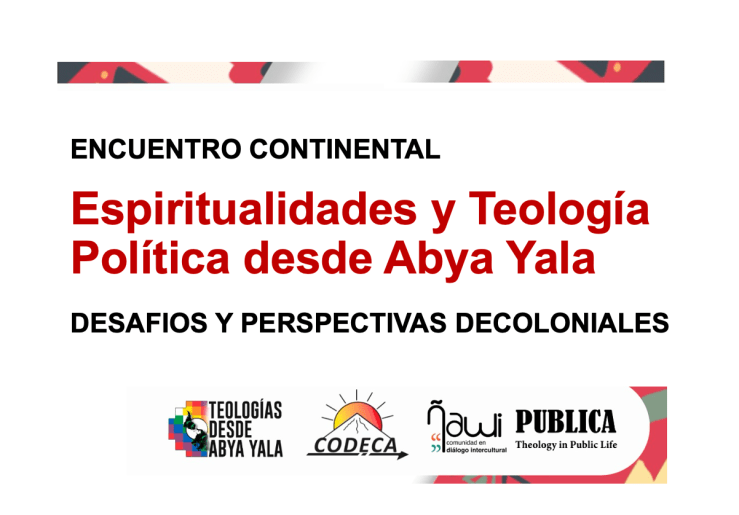
Spiritualities and Political Theologies from Abya Yala: Challenges and Decolonial Perspectives

CONTINENTAL CONFERENCEGuatemala , November 7-9, 2025

Introduction

Communities organized in resistance, International Land Coalition articulated in CODECA Guatemala, the forum of political theology PUBLICA and the community of intercultural dialogue, ÑAWI, invite theologians, academics, community leaders in sociopolitical resistance, wise men and women members of indigenous communities, and actors committed to socio-political transformation, to participate in a space for dialogue and learning that explores the experiences of resistance of social and ecclesial movements through Abya Yala.

This gathering seeks to reflect on the transcendental hopes of communities in sociopolitical resistance, ecclesial and communities of faith, Originals Peoples/ Natives leaders who promote processes of profound structural changes in and from different territories of the Continent of Abya Yala. Our Mission is to contribute from political theologies to restoration/construction of Good Living practices with a decolonial and plurinational perspective.

CALL FOR PAPERS

We invite theologians, academics, community representatives engaged in sociopolitical resistance, and knowledgeable elders from Native communities with indigenous practices and spiritualities, as well as activists committed to socio-political transformation. We encourage participation in a dialogue and learning space that examines the experiences of resistance within social and ecclesial movements.

We invite submissions that explore, from a political and theological standpoint, the challenges and opportunities faced by communities in resistance as advocates of “Good Living.” We welcome contributions addressing the following thematic areas:

1. Ecclesiastical Action in Public Policy: Strategies for influencing social and public policies to defend human rights.

2. Educating for Liberation and Transformative Resistance: Popular education, ancestral practices, and methodologies designed for training in political theology.

3. Health and Restoration of Balance: Community organization efforts to ensure equitable access to health justice.

4. Eco-Theology from Abya Yala: Theological and indigenous perspectives on the care of Motherland.

5. Political Theology and Migration: Analysis of migration processes in Abya Yala, highlighting border policies, exclusion, and discrimination against migrants.

6. Native and Afro-Descendant Identities: Insights from Native and descendants, Indigenous, African, and Black theology and spiritualities regarding the challenges faced by Native and Afro-descendant communities in Abya Yala.

7. Women Rights: Highlighting women’s struggles across various social and political contexts. Womanist approach to rights and liberation.

PROPOSAL
Proposal of a maximum of 300 words. Brief biography of the author(s)
Indicate the language of presentation. Country of Nationality.Ancestral Identity. Institution or/in membership of community.

Evaluation Criteria

– Thematic relevance.
– Practical and participatory approach.

SUPPORT FOR PARTICIPATION

Those selected to present their papers or workshops will be offered lodging, food, and ground transportation from the airport to the event’s location.

Languages of the conference

To ensure the inclusion of many diverse voices in Abya Yala, we will provide translations during presentations in the following languages:

· Native languages (to be coordinated) · Spanish . Portuguese . English

DEADLINE FOR SUBMITTING PROPOSALS
Proposals must be sent from February 15 to May 30 to the email teologiaabyayala@publicatheology.org

This meeting is an invitation to collectively build a theological-political thought from Abya Yala, capable of responding in an inclusive, fair, and sustainable way to decolonial challenges.

We look forward to your participation!

“Espiritualidades y Teologías Políticas desde Abya Yala: Desafíos y perspectivas descoloniales”

Encuentro Continental – Guatemala, 7-9 Noviembre,2025

Las comunidades organizadas en resistencias, articuladas en CODECA, el forum de teología política PUBLICA y la comunidad de diálogo intercultural, ÑAWI, invitamos a teólogos, teólogas, académicos, portavoces de comunidades en resistencias sociopolíticas, sabios y sabias de pueblos originarios, y actores comprometidos con la transformación socio-política, a participar en un espacio de diálogo y aprendizaje que explora las experiencias de resistencias de los movimientos sociales y eclesiales a través de las espiritualidades y esperanzas comunitarias en Abya Yala.

CONVOCATORIA DE PONENCIAS

Se invita a presentar ponencias que aborden, desde una perspectiva teológica política, los desafíos y oportunidades en las comunidades en resistencias, como promotoras del “Buen vivir” en los siguientes ejes temáticos:

  1. Acción eclesial en la política pública: Estrategias para la incidencia en políticas sociales y públicas en defensa de los derechos humanos.
  2. Educar para las resistencias transformadoras: Metodologías de educación popular para la formación en teología política.
  3. Salud y restauración de los equilibrios: Organización comunitaria para el acceso equitativo a la salud y justicia.
  4. Ecología integral desde Abya Yala: Cuidado de la madre tierra desde una perspectiva indígena y teológica.
  5. Teología política y migración: Reflexionar sobre los procesos migratorios en Abya Yala, y cómo estos exponen las políticas fronterizas, la exclusión y discriminación de los y las migrantes
  6. Identidades nativas y afro-descendencia: Reflexionar desde las perspectivas de la teología y espiritualidades nativas, indígenas, africana o teología negra, los desafíos actuales de las comunidades nativas y afro descendientes en Abya Yala.
  7. Mujer y derechos: Visibilizar las luchas de las mujeres en los diferentes contextos sociales y políticos desde una perspectiva mujerista y feminista comunitaria.

APOYO A LA PARTICIPACIÓN: Las y los seleccionados para presentar sus ponencias o talleres, se les ofrecerá: alojamiento, alimentación y traslado terrestre en el territorio de Guatemala.

Idiomas del Encuentro: Para garantizar la inclusión de voces diversas, contaremos con traducción durante las presentaciones en los siguientes idiomas:

●  Idiomas originarios de Abya Yala

●  Español

●  Portugués

●  Inglés

ENVÍO DE PROPUESTAS

Formato:
Resumen de máximo 300 palabras. Breve biografía del autor/a o autores/as. Institución. Nacionalidad. Identidad ancestral. Idioma de presentación.

Las propuestas deben enviarse con fecha extendida hasta el 15 de Julio al correo electrónico teologiaabyayala@publicatheology.org

Este encuentro es una invitación a construir colectivamente un pensamiento teológico-político desde la perspectiva de Abya Yala, capaz de responder de manera inclusiva, justa y sostenible a los desafíos contemporáneos.

¡Esperamos contar con tu participación!

The Embrace of the Spirit in Abya Yala

By Yenny Delgado & Claudio Ramírez

The Spirit has been with us from the beginning of times, accompanying us from all around, providing hope and freedom that is neither static nor exclusive. As we witness in the journeys of the original peoples of Abya Yala who keep their spiritualities alive, there is a profound embodiment of the vital cosmic force that dances alongside in harmony, pulsating within their traditions with the Spirit.

The Spirit’s influence extends throughout the lives of the people of Abya Yala, fostering a consciousness deeply rooted in their cultural identity and fostering free and respectful relations. In traditional and spiritual practices in Abya Yala, we can learn from the Guaraní people who believe and understand the land without evil, an ideological process that fills all life with meaning. The path to the land without evil is not a utopia but a strenuous and accessible walk without hunger and oppression. The land without the evil of the Guarani would be nothing more and nothing less than land that lives in the movement and embraces the Spirit of God, the creator; for the Guarani, this consciousness embodies a dual nature: “oréva,” representing their unique individuality tied to their land, language, beliefs, and customs, and “ñandeva,” embracing inclusivity and acknowledging the existence of other cosmologies and rationalities. 

Central to understanding native spirituality is the recognition that it is experiential, narrative, and symbolic, drawing nourishment from a rich tapestry of myths, ceremonies, communal gatherings, dreams, and artistic expressions. The movement of the Spirit evokes a profound spirituality, where every practice becomes sacramental, infused with the diverse cultures, languages, and spiritualities that thrive across the expanse of Abya Yala. This sentiment echoes the sentiments expressed in the “Holy Spirit and Native Peoples” document by the Episcopate Conference of Mexico, which celebrates the beauty of unity within diversity, recognizing that various theological perspectives are not contradictory but complementary, enriching the understanding of the divine mystery.

In embracing the Spirit, the people of Abya Yala find strength in their interconnectedness, forging pathways towards a future where diversity is celebrated, and all are united in their pursuit of land without evil, where the Spirit of God moves freely.

The history of domination and colonization in Abya Yala unfolded within the framework of a patriarchal system, where women endured violation, abuse, and subsequent silencing of their transformative power. However, despite these oppressions, the flame of resistance flickered in the Women, the cornerstone of vitality and life within native communities, embracing the power and the holy of the Spirit. The Spirit, akin to breath, light, and movement, guides original peoples in confronting the challenges wrought by colonization. It is paramount to acknowledge that spiritual practices harmonize with ancestral.

Following centuries of colonization’s oppressive grip, the original peoples of Abya Yala strive to reclaim their existence, affording freedom and hope in spiritual expression. The Spirit propels resistance against the veiled neo-colonialism perpetuated by modern states, which marginalizes and disregards the knowledge, wisdom, and spirituality of original peoples. Across Abya Yala, many communities embark on a journey of decolonization, invoking the Spirit of their ancestors to heal and reconnect with ancestral inheritance memories, fostering new pathways of existence amidst the pervasive messages of colonialism, anthropocentrism, and hegemony.

The assertion that the Spirit of God permeates Abya Yala carries political and decolonial implications. It envisions a realm of goodness where encounters with roots, masculinity and femininity, and fluidity transpire because the Spirit is both and embraces all. The Spirit, acting as both agent and repository of historical memory, shapes perceptions of time and instills hope amidst present turmoil, reminding humanity of the enduring struggle for justice and the persistence of dedication and faith through the ages.

The embrace of the Spirit is not only resistance but also a spirit of liberation to truly live in the lifeblood of ancestral promise and spiritual practices. The Spirit sustains ancestral memories, transforming the pain into a healing force— anamnesis— that transcends personal, social, and historical wounds. We believe the Spirit engenders solidarity, community, organization, and hope of resurrection in Abya Yala.

Read more about Abya Yala’s Theology

About the authors

Yenny Delgado is a psychologist and theologian. She is a Ph.D. candidate in Psychology of Religion at the University of Lausanne. She is also the Convener of Women Doing Theology in Abya Yala and Director of Publica Theology. Yenny plays a pivotal role in fostering dialogues that amplify women’s voices and promote theological discourse rooted in native perspectives in Abya Yala.

Claudio Ramírez is a theologian and Ph.D. student at the Jujuy National University of Argentina. He is a founding member of the ÑAWI intercultural dialogue community, underscoring his commitment to fostering mutual understanding and collaboration across diverse cultural and spiritual practices, enriching academic discourse and community engagement.