The US southern border: A symbol of unity or isolation?

By Yenny Delgado

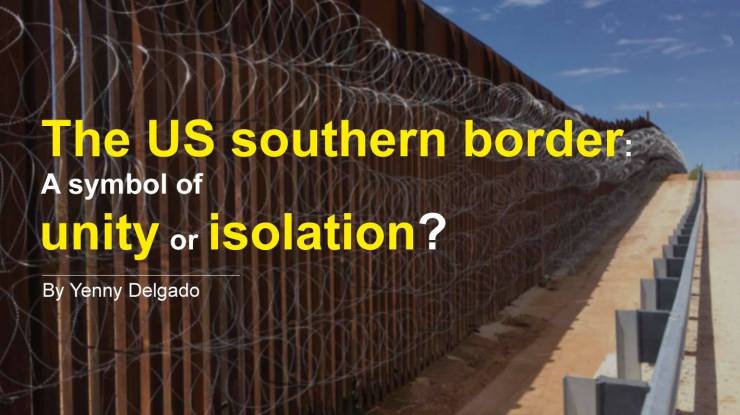
In light of the recent Supreme Court Decision that prevented the Trump administration from revoking the Deferred Action for Childhood Arrival (DACA) policy due to failure to provide adequate justification, immigration is back on the top of everyone’s mind.  Questions of the border and, more particular, the US Southern Border have come into sharper focus.  Moreover, as we enter another intense, it is clear that President Trump will aim to use immigration and the Southern Border as another wedge issue to encourage voters to support his re-election.  This paper reflects on the United States’ southern border a ponders its symbology and proposes a re-examination of how Christians should view the border in light of the gospel.

The border has unique symbolism and conjures thoughts of protection, filtration, separation, or insulation from danger. Borders are a critical part of the functional integrity of a country and allow for governments to track commerce, register individuals, and provide a line in the sand for defense. These edges offer a first boundary upon which the country is established and to which individuals are considered residents and citizens and receive inherent benefits. Throughout the history of the United States, the border has been in flux – enlarged through purchases, wars, and invasion.

Unfortunately, much of the debate around the border and immigration has been overly simplified, for far too long. From the four boundaries, the country has chosen its southern border as the primary threat. The US focuses on the 1,954-mile southern border with Mexico and not much attention to the 5,525-mile border to the north with Canada and minimal attention in the press or public regarding the Pacific Cost border or Atlantic Cost border. 

With the election of Donald Trump as President of the United States in 2016, there has been a renewed scrutiny of the Southern Border when he promised that he would “build a great wall on our southern border, and I’ll have Mexico pay for that wall.” In the intervening year, it is clear that Mexico is not paying for the construction of a wall on the southern border, and the building has been slow. 

Historical Context of the Border

The southern border has changed from the times of the colonies through expanding territory under the auspices of Manifest Destiny, with the contemporary edge established in 1853. Over the intervening years, the regulation to cross the border has changed. People living on the border in areas such as Texas often say, “we didn’t cross the border. The border crossed us.” Families who were never planning to be in the United States became part of the country because of the border change in the 19th century.  However, migration to the US has also been, in large part, motivated by the need for labor in the growing US economy, especially in the agricultural and low-skill sectors. 

At the start of the Second World War, the US started the “Braceros” program that provided legal migration for farmworkers up until the 1960s. This program allowed farmers to migrate to the US during the planting and harvest and then return home to live with their families.

Today, similar applications exist, such as the H-2A Temporary Agricultural Workers visa; however, there is a desire for jobs from people south of the border and the need for labor in the US. Thus, one of the significant drivers for migrants is for improved economic opportunity compared to stagnant growth and opportunity in one’s home country. Individuals risk their lives to cross the border without proper documentation in isolated desert locations to work at jobs for half the pay, no health coverage, and toxic chemicals and pesticide exposure in positions that most US citizens do not want. The national narrative does not focus on industrious migrants looking for improved opportunities at life, but primarily on the cases of violence or criminal activity perpetrated by immigrants and has given rise to a desire of greater border security.

Historically walls were built for protection and to signify to the inhabitants that they were protected. However, the US government is building a wall in an era when they are primarily being destroyed and torn down. In fact, during the 1980s the US President Reagan chided the Soviets to tear down the Berlin Wall as antiquated and for impinging upon freedoms. The argument currently used for the construction of the wall is based on the need to respect the current laws of the land and preservation of the already prevailing cultural norms. 

Theological Response

President Trump realizes their religiosity is crucial to his sustained political power, and through tweets and staged photos caters to this part of the electorate. Concerning the building of border walls, there is not one strict interpretation of Christian scripture or from Christian ethicists and scholars of the past.  

Jesus taught his disciples in Mark 12:31, “You shall love your neighbor as yourself. There is no other commandment greater than these.”

The emphasis that Jesus places on the importance of the right relationship with the neighbor is clear. In the parable of the Good Samaritan, Jesus helps provide further context to the call of neighborly love by confirming that the right neighbor is the one they showed mercy. How can we say we love our neighbor if we are building a dividing wall between ourselves and them? 

Which country can have confidence in the relationship with a country that aims to build the longest wall on the continent to prevent or select their neighbors from entering? If the border is the limit or filter, we are showing that not every human being is equal or has intrinsic value; and it is contradictory to a Christian view of creation in which all humans were made in God’s image. 

However, with the construction of borders and harsh regulations, individuals from other countries are dehumanized and are treated only as disposable parts of the economy, for harvesting crops. Though this may be an economic argument for such border protections, it does not square with a Christian understanding of our relationship with our neighbor as described above. Ethicist, Luke Bretherton of Duke Divinity propose viewing the border with countries as equivalent to a face. In his philosophical construction: 

“Borders are a means of framing and structuring this relationship and orientating a nation to  the rest of the world in a way that presents an enquiring, confident, hospitable face rather than either a closed, insular, hostile face turning away from the relationship with the poor and vulnerable or a hopeless…” 

If we embrace the construct of the face, it leads to the question of what face do we show our neighbors to the south through building a high-tech wall and militarizing the southern border.  

Building oppressive militarized borders would not be comprehensible with an understanding of Loving God of all creation and the sanctity of all life. Borders are already delimited, but building a physical wall is a step towards not only aggression but of separation and is contradictory to the message of the Gospels. 

The United States is known to many neighbors in the south, not for liberal democratic values but as an oppressive empire that protects corporate interests and dictators. The US has intervened in Latin American countries over 35 times, and unfortunately construction of a militarized border wall goes further to cement the concept of a nasty neighbor. 

We need to re-conceptualize our idea of borders in the country. Using the framework of Bretherton’s idea of borders as a face, I think that the United States can better serve its citizens and neighbors as a positive force. The southern border should be a symbol of unity with our neighbors.

___________________________________________________________________________________________________________

Yenny Delgado (she/her/ Ella)  

Social psychologist and contextual theologian. She writes about the intersections between politics, faith, and resistance. Follow me on twitter @yennydc

La opción por la hermandad

Por Marissa Galván

La historia de Sara y Agar ha sido descrita en algunas ocasiones como una simple pelea entre dos mujeres celosas. Es posible que hayas escuchado que Abraham y su esposa Sara recibieron una promesa de Dios: la pareja tendría un bebé. Sin embargo, pasó mucho tiempo para que la promesa se cumpliera y Sara se impaciento. Por eso, ella le ofrece a Abraham una solución. Le pide que se acueste con su esclava, Agar, para que esta le pueda dar el hijo que ella no puede darle. Suena a uno de esos casos que se presentan en Caso Cerrado. Y casi podemos imaginar que esto no va a tener un final feliz.

Sara y Agar fueron mujeres durante un momento histórico en que ambas están en peligro por ser mujeres. El ser mujer en esos tiempos era estar en una posición vulnerable en donde no se tenía control sobre su vida, su dinero o su destino. Sara sabía esto de primera mano. Ella era una mujer infértil, en un momento en donde la cosa más importante que podía hacer una mujer era preservar la herencia y el legado familiar por medio de tener hijos varones. Además de eso, la Biblia nos dice que es una mujer de suma belleza. Por eso, es utilizada por Abraham como una pieza de negociación para conseguir el favor de los jefes de tribu y hasta del faraón en un momento en que el grupo familiar pasa por Egipto. Sara es presentada a estos hombres para conseguir protección y riquezas para su familia, y es obligada a hacerlo sin tener ningún poder para remediar la embarazosa y peligrosa situación.

Por eso es irónico que una mujer que conoce el dolor, la fragilidad y la incertidumbre, escoja utilizar el poco poder que tiene para oprimir a otra mujer que tiene menos poder que ella.

Agar, la esclava egipcia, entra en la historia de Abraham y Sara en Génesis 16. Su presencia trata de explicar la relación familiar contenciosa entre el pueblo de Israel y los ismaelitas. Sin embargo, aunque Sara es la matriarca de su familia, Agar es una esclava. Aunque Sara pertenece a su familia, Agar es una extranjera. Aunque Sara disfruta de la prosperidad de su casa, Agar depende totalmente de Sara para poder vivir. Aunque Sara es infértil, tiene control sobre la fertilidad de Agar. La historia hace tanto énfasis en las diferencias entre estas dos mujeres que aún su nombre, «HaGar» nos demuestra cuán invisible e impotente es. Es un nombre de hombre que significa «forastero» o «desconocido». Y cuando la vemos mirando a su ama con desprecio, la tildamos de criada malcriada, en vez de darle la razón.

En Génesis 21, 8-10, vemos cómo Dios cumple su promesa. Isaac nace y el día en que fue destetado, Abraham hace una gran fiesta. De repente, Sara ve a Ismael. Aquí, es interesante como funcionan las traducciones bíblicas: En la Palabra de Dios para todos, dice que Ismael estaba jugando con Isaac. En otras versiones se dice que Ismael se burlaba, pero no dice de quién. En las únicas dos versiones que dice que Ismael se estaba burlando de Isaac son en la Reina Valera del 60 y en la Dios Habla Hoy. Sin embargo, aunque Ismael, un niño, estuviese haciendo niñerías… la reacción de Sara es sorprendente y desmedida. Ella, aprovechó la circunstancia para ejercer su poder e hizo algo totalmente inmerecido e incorrecto: «Echa a esta sierva y a su hijo, pues el hijo de esta sierva no ha de heredar junto con mi hijo, con Isaac».

Wilda C. Gafney, en su Womanist Midrash, nota que Sara tiene otra opción en ese momento. Ella dice que la historia de Sara es una advertencia, que da testimonio de la tentación de ejercitar cualquier privilegio que tengamos sobre otra persona, en vez de defenderla de un peligro compartido. Sara usa su privilegio para oprimir a Agar y a Ismael y para dejarles en el total desamparo. Aquí, le podemos dar gracias a Dios, porque tiene un plan y una promesa, no sólo para Abraham… sino también para Agar.

Gafney comparte esto, reflexionando sobre las palabras de Renita Weems sobre la historia de Sara y Agar en su libro Just a Sister Away. En él, ella nos desafía diciendo que todas somos hijas de Agar… todas necesitamos a una mujer, no para que abuse de nosotras y que nos oprima, sino para que sea nuestra hermana.

Ella lo dice mejor de lo que yo puedo decirlo… y esta es mi traducción de sus palabras. Hay momentos de la vida en que lo único que nos separa de la posibilidad de sufrir y que nos acerca a la sanidad es tener una hermana. Necesitamos a una mujer, a una hermana, que pueda ver en nuestra miseria una imagen escabrosa de lo que un día podría ser nuestra historia. Necesitamos una hermana que nos responda con misericordia. Necesitamos una hermana cuya misericordia genuina—que no debe confundirse con la lástima que es episódica, aleatoria, y de carácter cambiante—es firme, consistente y sin condiciones y dada a manos llenas.

Yo creo que como seres humanos tenemos una opción. Creo que como pueblo tenemos un opción. Creo que como naciones tenemos una opción. Quienes tenemos algún tipo de privilegio, sea mucho o sea poco tenemos una opción. Quienes tenemos educación, un techo… quienes sabemos más de un idioma, que tenemos un poquito de dinero, que vivimos con estabilidad, que tenemos acceso al Internet, a teléfonos inteligentes, que tenemos la posibilidad de poner comida en la mesa tres veces al día, tenemos una opción.

Esa opción es la hermandad. Cada vez que tengamos la oportunidad, necesitamos optar por el hermanamiento, por ver a la otra y al otro como la familia que Dios quiere que tengamos. Necesitamos apartarnos de la tentación de las nimiedades, de la naturaleza humana de oprimir porque sentimos que nos han oprimido o de reprimir porque pensamos que otras personas merecen ser oprimidas, o básicamente de agobiar a alguien porque nos cae mal o porque no piensa lo mismo y eso nos da miedo. Necesitamos poner un alto a esta locura de pensar que todos somos como Sara… personas sin conciencia que no se dan cuenta de que toda persona es parte de estos sistemas de opresión y racismo que afectan a todo el mundo y que toman cualquier oportunidad para agobiar, desamparar, abusar y reprimir con nuestro egoísmo, nuestro prejuicio y nuestro racismo. Como dice 1 Corintios: «De manera que si un miembro padece, todos los miembros se conduelen con él; y si un miembro recibe honra, todos los miembros se gozan con él».

Todas necesitamos hermanas en algún momento… y todas necesitamos ser hermanas en todo momento. Por eso debemos escoger siempre la hermandad y la solidaridad sobre toda opción posible. Creo firmemente en que esto es lo que Dios desea para la humanidad. Quiere que vivamos demostrando misericordia genuina y demandando misericordia genuina. Que vivamos haciendo justicia verdadera y demandando justicia verdadera ante toda acción cruel, vengativa, racista y funesta. Seamos hermanas. Seamos hermanos. Seamos hermanes… con fidelidad, consistencia y sin condiciones. Eso es lo que Dios promete y quiere.

Marissa Galván. Editora de recursos en español de la Corporación Presbiteriana de publicaciones y pastora de la Iglesia Presbiteriana Beechmont, una iglesia intercultural en Louisville.

La mentira de la “bendición blanca”

Por Yenny Delgado

Como resultado de las protestas pacíficas en todo el mundo, tras el violento asesinato de George Floyd, los líderes cristianos se ven obligados a abordar los problemas del racismo y la ideología de la supremacía blanca desde la iglesia. Para muchas congregaciones, la respuesta ha sido realizar una o todas de las siguientes acciones:

  1. Colocar una pancarta de “Black Lives Matter” frente al santuario;
  2. Promover la lectura de libros que revelen la historia del privilegio blanco y sus consecuencias en la sociedad, leyendo autores como Robin D’Angelo, Ibram X. Kendi y Michelle Alexander.
  3. Desarrollar espacios, aunque sea virtualmente, para discutir honestamente la historia, los eventos actuales y, con suerte, un futuro camino a seguir.

En una discusión, el pastor europeo-descendiente Louie Giglio de la mega iglesia Passion City de Atlanta tuvo una conversación con el rapero afroamericano Lecrae Moor y el director ejecutivo de Chick-fil-A, Dan Cathy. En esta discusión, dijo las siguientes palabras:  

“Pero quiero darle la vuelta porque creo que el otro lado es cierto con la historia de nuestra nación. Entendemos la maldición que fue la esclavitud, los blancos lo hacen, y decimos, ‘eso fue malo’, pero extrañamos la bendición de la esclavitud que construyó el marco para el mundo en el que viven los blancos”.

En esta frase, la teología del pastor es clara. Conectó la deshumanización de los demás a través de la esclavitud como una bendición. El pastor Giglio le recordó a su audiencia la verdadera atención de muchas iglesias y líderes cristianos cuando se trata de lidiar con los pecados del pasado. Además, su encuadre de la esclavitud como una “bendición” no es un concepto nuevo, sino que hace referencia a las opiniones originales de los europeos que llegaron a este continente. Al llegar, vieron la tierra como un nuevo comienzo y una oportunidad para vivir su fe y su pureza blanca. A principios de los años 1500, la mayoría de las personas que vivían en Europa eran agricultores pobres, sin educación, y que vivían bajo temor; para ellos las colonias en América representaban una oportunidad para reiniciarse en “tierra virgen”. En el libro “Destino manifiesto” Anders Stephanson dice:

“Cada actividad, personal y comunitaria, era irreductiblemente parte de la guerra santa contra Satanás y los infieles. La aristocracia de los santos tuvo que trabajar sin cesar en este momento crítico para hacer que el mundo actual fuera tan solemne y gloriosamente cristiano como podría ser. Un resultado era poner gran énfasis en la pureza de la comunidad, en determinar siempre quién estaba adentro y afuera, en eliminar la desviación “.  

Los cristianos habían construido una imagen de Dios, quien los bendijo para mantener la pureza y no mezclarse con los demás era obedecer. Después de eliminar a las poblaciones nativas a través de un genocidio orquestado, los europeos comenzaron a esclavizar a los africanos para trabajar la tierra. Los esclavos formaron principalmente la columna vertebral económica de la colonia y condujeron al desarrollo del capitalismo moderno y la riqueza en torno al comercio del algodón. Como explicó Sven Beckert: ¨este negocio aumentó la riqueza y los recursos. Debido al crecimiento económico, las iglesias comenzaron a florecer, y llegaron nuevas denominaciones y crecieron junto con el crecimiento de la esclavitud¨.

Las denominaciones eclesiales crecientes en todo el país estaban vinculadas con la objetivación de los africanos a través de la esclavitud. Como se informó en una auditoría del Seminario Teológico de Princeton y su interacción con la esclavitud en 2019: “varios de sus fundadores y líderes prominentes participaron en la esclavitud e incluso emplearon mano de obra esclavizada”. 

La esclavitud de personas con piel oscura era una regulación codificada por la ley y apoyada por un texto teológico de las maldiciones del Antiguo Testamento donde se practicaba la esclavitud. Después de la independencia, algunas denominaciones, como los cuáqueros, hablaron en contra de la esclavitud, pero la mayoría de las iglesias eligieron abordar solo “asuntos espirituales” y se concentraron en mantener el sistema. 

La Dra. Yolanda Pierce, decana de la Escuela de Divinidad de la Universidad de Howard, afirma: “Gran parte de la identidad cristiana estadounidense primitiva se basa en una teología de la esclavitud. Desde el nombramiento de los barcos de comercio de personas esclavizadas hasta quién patrocinó algunos de estos viajes, algunas de las iglesias están incluidas”. 

Ahora, en junio del 2020, un pastor “cristiano” una vez más propone formular esa idea de la esclavitud, como un beneficio general para la “gente blanca”. De hecho, tiene razón en que, mediante la deshumanización y el asesinato, uno puede llegar a ser extremadamente rico y construir una sociedad desigual. Esta es la historia de los descendientes europeos en los Estados Unidos. Sin embargo, como cristianos, no debemos jugar con palabras como bendición o privilegio. 

La forma en que la iglesia apoyó a construir un país supremacista blanco basado en el racismo anti-negro es el PECADO BLANCO. ¿Cuándo cambió y se arrepintió la iglesia cristiana en los Estados Unidos por este pecado? En la imaginación de la iglesia, todos son bienvenidos, pero en el papel, la teología está atrapada en el pasado. Tal como dice el pastor Giglio: “no es un privilegio blanco, sino una bendición blanca”.

Si las iglesias y congregaciones realmente esperan tener una conversación real sobre la protesta en curso en la calle, se necesitarán más que unos pocos libros, manifestaciones y el encuadre de la esclavitud como un beneficio blanco. Como primer paso, la iglesia necesita reprender verdaderamente las acciones pecaminosas de este país y los antepasados ​​en acciones que están en completa oposición al Evangelio.

Esto se hace a través de un arduo trabajo de leer la historia y luego buscar el diálogo y el arrepentimiento genuino para con aquellas comunidades que han sido afectadas negativamente por las políticas y leyes para beneficiar a los blancos. Para la iglesia y los cristianos, estas verdades duras deberían conducir a un cambio sistémico. Y, si no, entonces quizás estos lugares no sean iglesias realmente sino clubes sociales donde los blancos disfrutan reuniéndose el domingo por la mañana.

_________________________________________________________________________________________________


Yenny Delgado

Psicóloga social, teóloga y analista político. Ella escribe sobre la interseccionalidad entre política, fe y resistencia. Puedes seguirle en twitter @yennydc

It is not “White Blessing ,” it is a White Sin

By Yenny Delgado

As a result of the largely peaceful protest throughout the globe as a result of the murder of George Floyd, Christian leaders are being forced to address the issues of anti-black racism and white supremacy in the church. For many congregations, the response has done one or all of the following actions:

  1. Placing a Black Lives Matter banner in front of the sanctuary;
  2. Books Club from authors including Robin D’Angelo, Ibram X. Kendi, and Michelle Alexander 
  3. Develop spaces, albeit virtually, to honestly discuss history, current events, and hopefully a future way forward.  

In one discussion, European American Pastor Louie Giglio from the Atlanta Megachurch Passion City had a conversation with the African American rapper Lecrae Moor and the European American Chick-fil-A chief executive Dan Cathy. In this discussion, he said the following words:  

“But I want to flip that upside down because I think the other side of it is true with our nation’s history. We understand the curse that was slavery, white people do, and we say, ‘that was bad,’ but we miss the blessing of slavery that built up the framework for the world that white people live in.”

In this one phrase, the Pastor’s theology is made clear. He connected the dehumanization of others through chattel slavery as a blessing; Pastor Giglio reminded his audience of the real attention of many churches and Christian leaders when it comes to deal with the sins of the past. Moreover, his framing of slavery as a blessing is not a new concept but harkens to Europeans’ original views that arrived on this continent. Upon arrival, they viewed the land as a new start and an opportunity to live out their faith and truth. In the early 1500s, the majority of people living in Europe were poor farmers, uneducated, and living under fear as such America represented an opportunity to restart in “virgin land”.

“Every activity, personal and communal, was irreducibly part of the holy war against Satan and the infidels. The aristocracy of saints had to work ceaselessly at this critical moment to make the present world as solemnly and gloriously Christian as it could be. One result was to put great emphasis on the purity of the community, on always determining who was inside and outside, on eliminating deviance.”  

Christians had constructed an image of God who blessed them to maintain purity and not intermingle with others. After removing the native populations through an orchestrated genocide, Europeans began enslaving Africans to work the land. The enslaved primarily formed the nation’s economic backbone and led to the development of modern capitalism and wealth around the cotton trade. As explained by Sven Beckert, this business increased wealth and resources. Due to economic growth, churches began to flourish, and new denominations arrived and grew along with the growth of slavery.  

Growing denominations throughout the country were linked with the objectification of Africans through chattel slavery. As an audit of the Princeton Theological Seminary and its interaction with slavery reported in 2019, “several of its founders and prominent leaders were entangled with slavery and even employed slave labor themselves.” Enslavement of people with dark skin was a regulation encoded by the law and supported by theological text from some verses from the Old Testament where slavery was practiced.

After independence, some denominations, such as the Quakers, spoke out against slavery, but most churches chose to address only “spiritual matters” and concentrated on maintaining the system. Dr. Yolanda Pierce, Dean of Divinity School at Howard University, states, “So much of early American Christian identity is predicated on a proslavery theology. From the naming of the slave ships to who sponsored some of these journeys including some churches, to the fact that so much of these journeys including some churches.” 

Now in June 2020, a Christian Pastor once again proposes to formulate that idea of slavery as overall beneficial to “white people.” Indeed, he is right – through dehumanization and murder, one can become extremely wealthy and build an unequal society; this is the story of European descendants in the United States. 

However, as Christians, we need not mince words with blessing or privilege. The way the church helped to support and construct a white supremacist country based on anti-black racism is WHITE SIN. When did the Christian church in the United States change and repent for this sin? In the imagination of the church, everyone is welcomed, but on paper, the theology is trapped in the past. Just as Pastor Giglio is saying, it is not a white privilege but is a white blessing.

If churches and congregations genuinely hope to have a real conversation about the ongoing protest on the street, it will take more than a few books, rallies, and the framing of slavery as a white benefit. As a first step, the church needs to truly rebuke the sinful actions of this country and the forefathers in actions that are in complete opposition to the Gospel of Jesus Christ. This is done through the hard work of reading the history and then seeking dialog and repentance from those communities that have continually been negatively affected by policies and laws after the Civil War only to benefit white people. 

For the church and Christians, these hard truths should lead to change systemically, and if not, then perhaps these places are not churches but social clubs where white people enjoy gathering on Sunday morning. 

_____________________________________________________________________________________________________


Yenny Delgado (she/her/ Ella)  Social psychologist and contextual theologian. She writes about the intersections between politics, faith, and resistance.

 Follow me on twitter @yennydc

¿Se ha implementado la ideología de la supremacía blanca en América “Latina”?

Por: Yenny Delgado 

Comenzando con la llegada de Colón en 1492, los reinos europeos aterrorizaron al continente americano, reduciendo y controlando a la población original a través del asesinato y la propagación de enfermedades nuevas en el continente. América fue dividida por unos pocos reinos: España, Portugal, Francia e Inglaterra. Como si fuera un pastel.

El terror, la expropiación y la colonización de América se dieron en base a una ideología de supremacía blanca y deseos de tener no sólo tierra sino riqueza. A pesar de que la gran mayoría de los migrantes europeos escapaban de la pobreza y la opresión de un sistema feudal al llegar a América, asumieron un manto de superioridad y ejecutaron las peores maldades, las cuales Dios ha sido testigo a cabalidad a lo largo de la historia de la humanidad. 

Esta ideología de la supremacía blanca se construyó en base de que el robo, el genocidio y el esclavismo era totalmente justificado. Los individuos no blancos debían ser sujetados por un grupo superior, afectando drásticamente toda relación humana.

En todo el continente, los europeos secuestraron y esclavizaron no sólo a la población nativa americana, sino que también esclavizaron africanos que fueron transportados por el Atlántico de manera inhumana para luego ser vendidos en diferentes puertos del continente.

Durante siglos se saqueó una cantidad de riqueza sin precedentes que transformó a Europa en una de las regiones más avanzadas y prósperas del mundo, mientras que al mismo tiempo con la independencia de América se construyen nuevos gobiernos que decidieron mantenerse en el poder con la misma ideología de superioridad, así tenemos a Estados Unidos, Canadá, República Dominicana, Cuba, México, Brasil, Venezuela, Colombia, Argentina, Perú, entre otros países. La población nativa americana quedó despojada de su tierra y la población africana sin justicia tras cientos de años de trabajo forzado y sin remuneración. Otros fueron lo que se beneficiaron de su trabajo.

Durante los últimos años, los descendientes de la población africana han buscado mantener viva su historia, su lucha por la abolición de la esclavitud y por ser aceptados en las nuevas repúblicas ha sido constante. Por otro lado, la población nativa americana y sus descendientes en lugar de unir fuerzas y levantarse contra la opresión, muchos han aceptado el término “latino” y han decidido voltear la cara cuando ocurre la discriminación por el color de su piel, demostrando que el blanco tiene un lugar privilegiado en el país por ser los libertadores, forjadores de la republica y dejando sepultada la maldad con la que ejercieron su supremacía.

Debemos reconocer honestamente que nuestras comunidades han sido impactadas por la ideología supremacista blanca. En las formas en que nos han enseñado a buscar nuestras raíces europeas y sepultar las raíces de nuestros ancestros, con las cuales muchos hemos crecido, siempre prefiriendo tener una piel más clara y unos rasgos perfilados, anhelando siempre parecernos más al colonizador europeo.

En Estados Unidos, los blancos que hablan español o portugués aún reciben beneficios estructurales de la misma ideología supremacista blanca. Específicamente, reciben protección policial, mejores escuelas y mejores trabajos, al igual que los blancos que hablan inglés.

El hecho de que el primer idioma de alguien sea el español o el portugués, no significa que el individuo no practique ni se beneficie de la ideología supremacista blanca. Vivimos bajo el mismo sistema y tenemos un trabajo pendiente por hacer.Conocer nuestra historia nos debe ayudar a comprender que:

-La ideología de la supremacía blanca se impuso e implementó en todas las colonias europeas. A pesar de la independencia, las nuevas repúblicas continuaron regulando la vida basada en el color de piel.

-La lucha de la población afrodescendiente desde que fueron raptados en África y luego vendidos como una propiedad en las colonias americanas siguen clamando por justicia.

-La población originaria de América y sus descendientes aún luchan por ser tratados como ciudadanos, con los mismos derechos y oportunidades. La colonización todavía causa dolor.

-Los descendientes de europeos que emigraron al continente americano, sea que hablen español, portugués, francés o inglés siguen creyéndose superiores en comparación a la población nativa y afrodescendiente. La población considerada blanca en América tienen en común el mismo “pecado original” heredado de sus ancestros colonizadores por 527 años.

Es hora de quitar la estatua de la “conquista” y desmantelar la ideología supremacista blanca de raíz. A medida que el mundo se despierta de la época de la colonia, también debemos usar este momento de reflexión para completar nuestra liberación y reclamar la opresión sistémica y la discriminación basada en el color de la piel. Esta lucha debe ser continental.

Reconocer ésta dolorosa historia permitirá construir un futuro diferente, por lo cual los errores del pasado deben corregirse y permitir un cambio estructural de las leyes que la sostienen. El primer paso está ahora en las calles con miles de jóvenes pidiendo justicia.

“I Can’t Breathe – A Pentecost Reflection”

By Patrick Jackson

Do you have any idea how many times in a day that you breathe? According to one account, the average person takes 23,040 breaths a day.

Preacher Barbara Brown Taylor drew upon this daily life rhythm to portray the power of breath at Pentecost. “We breathe air that circulated in the rain forests of Kenya and in the air that turned yellow with sulfur over Mexico City. We breathe the same air that Plato breathed, and Mozart and Michelangelo . . . Every time we breathe, we take in what was once some baby’s first breath, or some dying person’s last.” And then she imagined the last breath of Christ, which was unleashed around the earth, and filled that upper room on Pentecost.


The breath of God, this Holy Spirit, has been loosed over the world ever since the first moments of creation when a “wind . . . swept over the face of the waters” (Gen. 1:1) and then “the Lord God formed man . . . and breathed into his nostrils the breath of life (Gen. 2:7). And so it is, and ever has been, that the breath of God is the source of life – the source of our individual lives, and the lifeblood of the church which we re-christened on Pentecost. And yet as we celebrate the inhaling and exhaling power of the Holy Spirit, we are haunted by those desperate, gasping words from George Floyd as he lay pinned on the concrete: “I can’t breathe. I can’t breathe.” Words spoken until George Floyd could speak no more.


Perhaps it’s a measure of God’s grace that shortly after George Floyd’s life was wrung from his lungs that congregations the world over gathered (virtually) to mark Pentecost. After the month we have had as a nation, we needed to be reminded that the church was not just born by the breath power of the Holy Spirit; the church was also unified by the power of the Holy Spirit. “All of them, the apostles, were filled with the Holy Spirit and began to speak in other languages, as the Spirit gave them ability” (Acts 2:4). It didn’t have to unfold that way.

The Spirit could have given all who gathered that day in Jerusalem, assembled from all the nations, the ability to hear and understand the single language that the apostles spoke. But no. The miracle of Pentecost was that the Apostles spoke the Good News in the native languages of all those assembled. It was a dramatic demonstration of how the church was forged out of such a rich multitude. It was a unity born out of diversity, not uniformity.


The Apostle Paul conveys this unity in diversity to the fractious community in Corinth through his brilliant metaphor of the church as a human body. “For just as the body is one and has many members, and all the members . . . though many, are one body, so it is with Christ” (1 Cor. 12:12). The power of Paul’s imagery of the body, with each member offering their unique gifts enabled by the Spirit, is that it makes clear that this diversity is essential. The diversity found in the body is not simply decorative; it is functional and integral to the church. The body of Christ cannot exist in its fullness unless everyone is honored, needed, loved.

Inhale. Exhale.
Inhale the life-giving Spirit.
Exhale the toxins of bias and racism.
Inhale the blessing of God’s intentionally diverse creation.
Exhale apathy and inaction in the face of injustice and suffering.
Inhale. Exhale. Inhale. Exhale.

Patrick Jackson is Co-Executive Director on Interwoven Congregations and Parish Associate at Bethesda Presbyterian Church.

Who lives, who dies, who tells your story: Princeton Seminary and Slavery

By Yenny Delgado

I arrived at my friend house in Princeton, New Jersey a day before attending a conference organized by Princeton Theological Seminary in order to spend time catching up and to share experiences. His 4-year-old daughter Aura, welcomed me with an amazing hug as her face lit up with joy.  She had been told of the time when I had previously visited when she was only 10 months old and this story had been relayed by her parents; so, she knew it occurred, knew my name and she had been shown pictures. One photo had special significance because in it we were all present. Together we looked at the photo and reminisced of times gone by, and she asked who took the photo?  We looked at each other and for a moment and did not remember.  Did someone stop by and take the seems or was it simply the timer function of the camera?  Aura asked a very perceptive question for a child, who took this photo?  Her question persisted in my conscious as I attended the conference the following two-days.

The conference I attended was entitled Legacy and Mission: Theological Education and the History of Slavery (link to report). The one-and-a-half-day program was organized as part of the recommendations of a historical audit on the institution of slavery at the Seminary. The opening of the conference was highlighted by a group of professors that reflected on the experiences from other institutions (Georgetown University, William and Mary University, and PrincetonUniversity) in their own audits related to their participation in slavery, and only one of the participants was African-American. 

Credit: Image from Princeton Seminary report

After hearing from historians from Georgetown and William and Mary Universities regarding their legacy and use of enslaved people in their founding and early years I expected that Princeton University would have a similar history. Thus,  it came as a surprise that the historian from Princeton boldly proclaimed “Princeton did not enslave anybody” according to its own historical record.  However, several of the Universities founders, first Presidents, leaders and a plurality of its students owned and enslaved people.  If a university, for that matter any organization, is defined by the people who make up its community it is seems disingenuous to proclaim the Institution did not enslave individuals?  Finally, a Professor from Princeton Theological Seminary (a separate entity from Princeton University) spoke quickly about the report and focused his remarks about the historical references and potential paths forward one of which was hosting the present conference.  

The intervening panels and presenters highlighted different aspects of the historical implications as well as many of the issues that are still present on the campus of the Princeton Theological Seminary and society today.  All of the sessions were videocast and recorded to ensure there was a historical record of the presentations, questions, and discussions. However, at the end of the program on the second day, there was a panel composed of current students plus seminary faculty.  In the first session that actually prioritized the voice of current African-American students, the cameras were removed, and the discussions were not recorded. 

The discussion and reflections of the students drove to the heart of the matter of the history of slavery and the institution. Ideas of atonement and reparations were discussed as well as dispelling myths that still abound on the campus and in academia. As the program drew to a conclusion both participants, current students and alumni became ever more concerned that the conference and presentations represented more of an exercise on a checklist than an act of addressing historical wrongs.  

The students are watching and want a real commitment from Princeton Seminary. The Association of Black Seminarians (ABS) have proposed that the seminary should commit at least 15% percent of its endowment as reparations to address historical wrongs and to ensure more diverse voices in academia. (To find out the exact request visit the ABS petition )

Returning back to the beginning and my friend’s daughter Aura’s question, I am sure that the timer function was used based on all the other photographic evidence. Reflecting on the conference with the eyes of a 4-year-old Aura, it appears as if the institution was basically saying that a horrible thing has happened in the past, but you know, what can we do about it now, reparations for what or even to who?  Even though she had not heard the Hamilton soundtrackher question bears a resemblance to the familiar refrain – who lives, who dies, who tells your story and most importantly to me how it is passed on to future generations.  The story of Princeton Theological Seminary is far from complete and completing the historical audit is only a first step.  

My hope is that the audit and conference will not be the end of the story, but that the history of how people of faith purposely dehumanized others for their own gain is reflected upon and corrected.  If we do not take these steps forward, we will be doomed to live a painful future. A 4-year-old asked a very important question that we should all consider and examine in-depth when it comes to the news and stories we hear on a daily basis. Who is taking the picture and how should we evaluate it in the context of equality, tradition, and justice? 


Yenny Delgado (she/her/ Ella)  Social psychologist and contextual theologian. She writes about the intersections between politics, faith, and resistance.

COVID-19 visibiliza la desigualdad en Estados Unidos


Por Yenny Delgado

Para enfrentar COVID-19, los gobiernos de todo el mundo comenzaron a cerrar fronteras, detener vuelos y colocar a los militares en la calle para obligar a las personas a guardar cuarentena. Estos esfuerzos no fueron suficientes en Estados Unidos porque el virus ya había llegado; ninguna cantidad de fuerza militar detendría su propagación. El coronavirus ya había llegado al continente, cruzado los vastos océanos, y no provenía de inmigrantes o refugiados empobrecidos, sino de individuos que habían viajado a Europa y Asia de vacaciones o por negocios en aviones y cruceros.

Actualmente, en los Estados Unidos, más personas han muerto a causa de la pandemia que en las guerras de los últimos 50 años. Hasta el martes 9 de Junio, se registra  que el virus ha cobrado la vida de más de 111,620 personas y 1 millón 971, 302  personas han sido infectadas de COVID- 19 según el Centro de Recursos de Coronavirus de la Universidad Johns Hopkins.

COVID-19 expone la desigualdad en el país

Al inicio, hace sólo seis meses, la narrativa en los medios era nos enfrentábamos a un virus que no discrimina. Toda la humanidad era susceptible a la infección, independientemente de su género o etnia. Un sentimiento de que estábamos todos por primera vez frente a un “gran equalizador”. Sin embargo, las personas en pobreza, con enfermedades respiratorias, ancianos comenzaron a notar que no todo era igual. Aunque todos estábamos en el mismo barco, no todos estaban en el mismo nivel. Las comunidades empobrecidas, así como las afroamericanas, nativas americanas y migrantes, estaban comenzando a ver los impactos de la muerte cara a cara.

Los reportes de las muertes comenzaron a mostrar la disparidad, los primeros datos que surgieron del epicentro del virus en la ciudad de Nueva York, expusieron que los internamientos y necesidad de ventiladores eran mayoritariamente para afro-americanos, según lo informado por el Centro para el Control y Prevención de Enfermedades. COVID-19 exacerbó las situaciones críticas en las poblaciones minoritarias y las comunidades que aún sufren los impactos de la política discriminatoria  del gobierno de Estados Unidos.

COVID-19 mostró su rostro de muerte, enfocándose principalmente en los ancianos y en las comunidades que se consideraban “trabajadores esenciales”. Al instante, los médicos y enfermeras que trataron a los pacientes fueron aclamados como héroes, mientras que, lentamente, el país comenzó a ver que todas las personas obligadas a trabajar no eran necesariamente héroes, sino que se sacrificaban para que el país pudiera continuar “abierto”. Los conductores de autobuses, los trabajadores de las tiendas de comestibles, los empleados de gas, los trabajadores agrícolas, los procesadores de carne, los trabajadores de fábricas y los empleados de comidas rápidas conforman algunas de las personas menos remuneradas en la economía del país. Sin embargo, los individuos en estas profesiones estaban en primera línea en términos de exposición al virus y riesgo. En una sociedad capitalista como es Estados Unidos, las mismas personas que trabajaron de 12 a 14 horas son las mismas que viven cheque por cheque; ganan menos de lo que necesitan para pagar el alquiler, la comida, los suministros, etc.

Priorizar la riqueza sobre la salud

Con el número de personas infectadas creciendo diariamente en el país, la tensión en la infraestructura y personal médico es realmente escasa. La falta de equipos de protección personal, ventiladores y materiales necesarios ha puesto de relieve directamente la grave falta de fondos y la naturaleza privada de la cobertura de salud en el país. Sin embargo, lo que no está claro es si las personas entienden que no hay un sistema público de salud en Estados Unidos. A diferencia de los países más pobres del mundo que tienen cobertura básica de salud pública, la mayoría de las personas en los Estados Unidos tienen planes privados.

Los y las ciudadanas de este país pagan primas mensuales a empresas privadas y organizaciones de gestión de la salud para proporcionar su cobertura. La incapacidad de proporcionar cobertura básica pública tiene una larga historia de discusiones entre apoyo y rechazo. Entre tanto el libre mercado se benefició de los temores al socialismo, populismo y otros programas que claramente mostraban sus bases racista de dar asistencia a una población históricamente discriminada en el país que es a la vez la más empobrecida y la que no puede acceder al seguro privado.

A medida que la pandemia crece en su número de infectados, los informes del gobierno mostraron una falta de preparación para la crisis que se avecina, la desesperación por la pérdida de vidas quedo a segundo plano, para mostrar realmente preocupación por las caída de la economía que significaba el alza en desempleo, desde principios de marzo se pasó del 5% de desempleo al 20%. Las pérdidas económicas de un país que produce servicios quedo paralizada con una cuarentena que poco a poca va perdiendo razón dentro del corazón de un país capitalista.

La respuesta de lo gobernadores de Estados no se hizo esperar, un claro ejemplo ha sido el teniente gobernador de Texas a declarar: “Aquellos de nosotros que tenemos más de 70 años, nos ocuparemos de nosotros mismos. Pero no sacrifiquemos el país “.La súplica apasionada de reiniciar la economía, a riesgo de aquellos que son mayores o médicamente vulnerables, muestra de primera mano cómo la clase gobernante del país ve a los gobernados, objetos que se utilizarán para el crecimiento y el beneficio de la economía.

Entonces, en forma de salvar la economía, se comenzaron a firmar el más grande ¨Bill¨ que seria la vacuna rápida que necesita la economía para salvarse, la inyección de dinero a grandes empresas, negocios y universidades ha recibido nuevamente con aplausos. Mientras tanto, cada 12 minutos en la ciudad de Nueva York, muere una persona de COVID-19.

El racismo emerge una vez más

Si bien la mayoría de los países del mundo tiene órdenes de refugiarse cuarentenas obligatorias para controlar el virus, pequeños segmentos en Estados mayoritariamente blancos creían que las medidas afectaban sus libertades y derechos. Alentados por los discursos de Trump de abrir la economía, o que COVID – 19 realmente no era tan grave, los manifestantes principalmente blancos, adornados con la parafernalia ¨Make America Great Again¨ (un sello distintivo de la Campaña Presidencial 2016 de Donald Trump) protestaron contra las órdenes que fueron diseñadas principalmente para garantizar su seguridad y la de los demás. Las protestas fueron una mezcla de simpatizantes del presidente, entusiastas de los derechos de armas y activista del Tea Party. En Michigan, los manifestantes armados violaron las normas de distanciamiento social para protestar en una clara yuxtaposición de cómo los hombres blancos pueden portar armas en contradicción con lo que sucede en el país en otras protestas, donde los agentes de policía arrestan a personas negras por protestar pacíficamente.

Para retratar el control y la autoridad, el presidente Trump comenzó a tener sesiones informativas diarias de prensa COVID-19 pero a menudo se convirtieron en discursos racistas y ofensivos contra china, con una notable falta de comprensión de la pandemia y del virus, a un insensible desprecio por la vida:

-“No podemos permitir que la cura sea peor que el problema mismo”

-“La inyección de Clorox es posible para ayudar a combatir el virus”

-“Hicimos lo correcto. Todo lo que hicimos estuvo bien”

La realidad es que millones de hogares no pueden teletrabajar, y no trabajar es equivalente al hambre debido a la imposibilidad de pagar las facturas, el alquiler o la cobertura médica. Algunas personas pueden pensar que es porque el sistema está roto o manipulado. Sin embargo, el sistema funciona bien para unos pocos privilegiados, mientras que el resto de la sociedad se sacrifica por la economía. De hecho, los ricos se vuelven más prósperos como resultado de esta pandemia, mientras que los pobres se vuelven más pobres.

La desigualdad en los Estados Unidos no es nueva; de hecho, está arraigado en la fundación del país y a lo largo de más de 400 años de historia. Sin embargo, en momentos de crisis y pandemias, las sociedades tienen la oportunidad de reorientar y priorizar los valores, y la re-visualización de la desigualdad aquí puede conducir a un cambio real. Para que esto ocurra, debemos analizar honestamente no solo la respuesta actual del virus, sino también la estructuración de la sociedad. Durante décadas, el sistema económico del país ha seguido ampliando la brecha entre ricos y pobres. En esta situación ¿Qué esperanza podemos tener? El gobierno de Trump ha fallado y continuará haciéndolo mientras solo apoye corporaciones y líderes conservadores que apoyen su campaña de reelección en Noviembre, 2020.

Is white supremacy ideology implemented in “Latin” America?

By Yenny Delgado 

Starting with the arrival of Columbus in 1492, European Kingdoms terrorized the American Continent, reducing and controlling the original population through murder and the spread of diseases new to the continent. The continent was divided by a few kingdoms – Spain, Portugal, France, and England – as if it were cake. 

The terrorization, expropriation, and colonization of America came in part with an ideology of white supremacy and to start a new life. Millions of European immigrants traveled to America and brought their thinking with them, primarily the superiority of their religion and skin color. Even though the vast majority of migrants were escaping poverty and oppression in their own countries/kingdoms upon arrival in America, they assumed a mantle of superiority. 

This ideology was based on their Christian faith. They viewed their God as superior and built theological rhetoric of permissible murder, genocide, and development of chattel slavery under the concept that non-white individuals were pagans. Throughout the continent, Europeans forcefully kidnapped and enslaved Africans for centuries producing an unprecedented amount of wealth to transform Europe into one of the most advanced and prosperous regions on the globe while at the same building new governments in America. This history is the same in the United States, Canada, Dominican, Cuba, Mexico, Brazil, Venezuela, Colombia, and other countries. 

African descendants across the Continent experience racism just as the native population. However, for the descendants of the Native Population as opposed to joining forces and rising against oppression, many have accepted the term “Latino” and placed their heads in the sand akin to an ostrich when racial discrimination occurs. 

However, we need to honestly recognize that in our communities, we have also been impacted by white supremacist ideologies in the ways we have been taught to seek European roots and prefer lighter skin. Even today, as we use the term Latino under the auspices of building a new community in the United States, white people who speak Spanish or Portuguese still receive structural benefits from the same white supremacist ideology. Specifically, they receive police protections, better schools, and better jobs, just like white people who speak English in Canada and the United States.

Just because someone’s first language is Spanish or Portuguese, it does not mean that the individual does not practice or benefit from white supremacist ideologies. We live in the same system, and it is time to reveal the same structure of power that oppresses and impoverishes African-descendants and the native population in the continent. 

Knowing this history helps us to understand that:

– The ideology of white supremacy is imposed and was implemented in all European colonies, and despite independence and republics, the same laws continued to regulate life-based on color.

-The African-descendant population’s struggle since they were captured in Africa and later enslaved and sold as a property in American colonies.

-The native Americans and their descendants struggle from the expropriation of their land and are treated at second class citizens. 

-The European descendants who immigrated to America believe, just as in the English-speaking countries, that they are superior to the native population and African-descendant population.

-The homage to the color of the skin is rooted for centuries and still causes pain.

It is necessary to fight against white supremacy ideology that was installed since 1492, and this fight must be continental as it is worldwide.

It is time to remove the statue of “conquest” and dismantle white supremacist ideology from the root. As the world woke up from the colony’s time, we must also use this moment of reflection to complete our liberation and call out systemic oppression and racial discrimination based on ideologies of white supremacy.

Whether a European who immigrated and got off the boat in New York, Kingston, Vera Cruz, or São Leopoldo, they came with ideologies of supremacy and governmental/societal structures that benefitted them. Let’s acknowledge this and begin building a more equitable and inclusive future where all have the opportunity of a better life. There should be no discrimination based on skin color, and past wrongs based on this need to be rectified. 

_______________________________________________________________________________________________

Yenny Delgado (she/her/ Ella)  Social psychologist and contextual theologian. She writes about the intersections between politics, faith, and resistance.

Visualization of Inequality in the United States

By Yenny Delgado

In addressing COVID-19, governments around the world began to close borders, stop flights, and placed militaries on the street to force individuals to shelter in place. These efforts were not sufficient in the United States because the virus had already arrived – no amount of military or police force could stop its spread. Coronavirus had already reached the continent, crossed the vast oceans, and it did not come from impoverished immigrants or refugees, but from individuals who had traveled the world on vacation or for business in planes and cruise ships.

Currently, in the United States, more people have died from the pandemic than were killed in the Vietnam War, the attacks on September 11th, and Afghanistan War combined. As of May 26, 20201,680,625 individuals have been infected, and the virus had claimed the lives of over 100,000 thousand people according to the Johns Hopkins University Coronavirus Resource Center

Virus Exposing Inequality in the Country

The media narrative at the start of the outbreak was that the virus did not discriminate. Everyone embraced the idea of single humanity and how everyone is susceptible to the infection regardless of gender or ethnicity. We were all scared together; without being aware that was not the full truth. However, individuals living in poverty first began to notice everything was not the same. Though everyone was on the same ship, all the people were not on the same level.

The impoverished, as well as African American, Native American, and immigrants’ communities, were beginning to see the impacts of death face to face just as the elderly had. Reporters and citizens began to notice the disparities in deaths. Data emerged from the epicenter of the virus in New York City showing an overrepresentation of African-descendants in the number of people being hospitalized as a result of the illness, according to the U.S. Center for Disease Control and Prevention. The disease exacerbated critical situations in minority populations and communities that are still suffering from the financial impacts of U.S. government policy in terms of providing housing loans to individuals who were not of European descent.

COVID-19 showed its face of death, focusing primarily on the elderly and on communities that were considered “essential workers.” Instantly the doctors and nurses who treated patients were hailed as heroes while, slowly, the country began to see that all individuals forced to work were not necessarily heroes but were being sacrificed so that the country could continue “open.”  Bus drivers, grocery store workers, gas attendants, farmworkers, meat processors, factory workers, and fast-food employees make up some of the least paid individuals in the U.S. economy. However, individuals in these professions were on the front line in terms of exposure to the virus and risk.  In the capitalist society, the same people who work 12 to 14 hours are the same who live check to check; they do not make what they need to pay the rent, food, supplies, etc.

Prioritizing Wealth over Health

With the absolute number of individuals infected in the country growing daily, the strain on the health care infrastructure has been profound. The shortages of personal protective equipment, ventilators, and necessary materials have pointed a spotlight directly at the severe underfunding and mixed public/private nature of health coverage in the country. What is unclear, however, is whether people understand that there is no unified public health care system in the United States.

So, we have millions of people losing employment and healthcare attached to private employers, but the first thing the Federal government looked to do was to save the economy. Bills began to be signed, but the injections were more of money to corporations than of COVID-19 testing for citizens. Meanwhile, every 12 minutes in New York City, a person with COVID-19 dies.

Racism Emerges Once Again

While the majority of the world’s countries were under orders to shelter in place with mandatory quarantines to control the virus, a small segment of the Euro-American population claimed these measures impinged on their freedoms and rights.  The primarily white protesters adorned with “Make America Great Again” paraphernalia and weaponry protested orders that were designed mainly to ensure their and others’ safety. 

To portray control and authority, President Trump began to take over the daily Federal COVID-19 press briefings.  The briefings provided some information to the press and public but often devolved into the meandering thoughts. These musings notably portray a lack of understanding at best and a callous disregard for life at the worst:

  • “We cannot let the cure be worse than the problem itself.”
  • “Vaccine or no vaccine, we’re back. And we’re starting the process.”
  • “We did the right thing. Everything we did was right.”

We must look at the current inequalities by reflecting on what is happening right now during this pandemic. The quarantine is providing opportunities for individuals to realize they are in a position of privilege. Many millions of households are unable to telework in their jobs, and not working is equivalent to hunger due to the inability to pay bills, rent, or health coverage.  Some people may think it is because the system is broken or rigged. However, the system works well for the privileged few, while the remainder of society is sacrificed for the economy. Indeed, the wealthy are becoming more prosperous as a result of this pandemic – while the poor are becoming poorer.

Theological Responses in the Age of COVID-19

“Who lives, who dies, who tells your story?”  This refrain from the musical Hamilton is apt to how we respond and consider the impact of COVID-19 theologically. As Christians, we have to work to ensure that the deaths from the virus are not in vain, and no one else suffers the consequences of systems not designed for the benefit of people but only for corporations.  Consoling those who have lost someone is critical; but we are missing our calling to speak the truth in times of crisis if that is all we do.

There is no one correct response that churches, and theologians should have to repeat in the face of the death and destruction of the ongoing pandemic. However, we must encourage congregations and leaders to avoid the trap of once again going to an “end of world” mindset as a result of the pandemic.  In this line of thinking, the current pandemic is the latest sign of the “end of the world.” The death and suffering is God’s “punishment” for individuals not praying enough, reading the Bible enough, and not donating enough money to churches.  

Using the pandemic to spark fear and obedience to empty, fatalistic, and irresponsible messages will not prepare the church and the believers of Christ to be the salt of the earth needed.  I believe that churches and lay leaders must read God’s word but also re-consider the reflections of theologians of solidarity like Gustavo Gutierrez to help orient our response to the ongoing pandemic and guide how we must work to reconstruct communities of faith.  In response to this situation, the dialogue with liberation theologies emerges as an act of resistance. Where is God to the impoverished of the world who look abandoned? Gutierrez writes that “Material poverty is a scandalous condition to human dignity” and, therefore, contrary to the will of God. Before COVID-19, there was surprisingly little attention to the experiences of poor people carrying the brunt of economic hardship, until many were forced to serve as essential workers to keep the country afloat.

If, as Christians, we believe in “Love your neighbor” as reflected in James 2:8, there is no way we can condone governmental policies that so obviously treat human beings not as individuals but commodities of the market.  Upon recognizing this, how can we defend a government that does not value the lives of citizens because they are impoverished or because they are not white? Why is this evil pattern not causing more moral outrage? Christians are called to fight for equality, help reduce poverty, and defend justice, and this should be as important and as crucial as anything else we argue or fight for in the public sphere. 

Under these circumstances, a believer might rightly ask, what is the church doing? It is possible if we ensure that all human life is valued, that those who get rich at the cost of the lives of the most impoverished are not celebrated but are condemed. Could this pandemic make visible the inequality that many of them already knew, but could this same pandemic promote change and repentance?

This pandemic is real, and as well as the impoverishment and inequality that millions of people experience day by day. If this situation does not mobilize us to serve those in need and show solidarity with them in terms of justice, resources, attention, what else can they do to make the church fulfill its mission? Just as we find in Luke 19:40, “I tell you, if these were silent, the stones would shout out.”