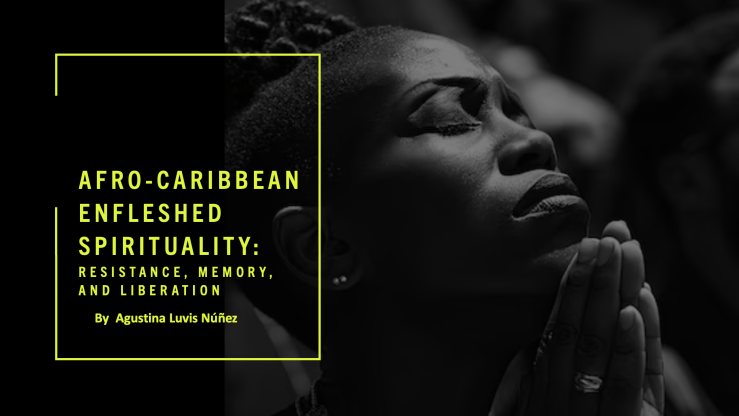
By Agustina Luvis Núñez*
Afro-Caribbean spirituality is not mere popular religiosity, but a historical praxis of resistance that has sustained life since the European and U.S. invasions. It has reconstructed Black subjectivities and generated epistemologies of liberation against the coloniality of being, knowledge, and power in the Caribbean.
To speak of Afro-Caribbean spirituality is to speak of embodied memory, of people who resisted when every political, economic, and religious apparatus attempted to strip them of their humanity. The transatlantic slave trade did not just uproot human beings; it attempted to erase worldviews, languages, and cultures. However, amidst the plantation system, spiritual practices emerged that preserved African memory under new, camouflaged forms. These were not simple religious syncretisms: they were strategies of cultural and spiritual resistance.
Eclecticism (1 Thessalonians 5:21, “test everything; hold fast to what is good”) is not about syncretic theological naivety, but rather a liberating tactic that chooses the fullness of life. Naming the Orishas under Roman Catholic iconography allowed for the preservation of African symbolic systems under colonial surveillance. The ritual consisted of resurrecting wisdom, ancestors, and institutions. The drum spoke to us in the same coded language used by Jesus of Nazareth. It reclaimed our humanity as sacred territory.
In the case of Haiti, spirituality was a space of symbolic and political articulation that contributed to the anti-colonial revolution culminating in 1804. Spirituality was not separate from the struggle for social freedom. Historically, their spirituality was rooted in political emancipation. Enslaved persons turned to this enfleshed spirituality in search of solace and the strength to resist the brutality of their enslavers.
The colonial project constructed the Black being as a “non-being,” as merchandise, as an exploitable entity. Against this, Afro-Caribbean spirituality affirmed a different ontology: that of a relational, communal being open to the pluriverse. If colonialism commodifies, Afro-Caribbean spirituality re-sacralizes. If colonialism turns the Black subject into an object, Afro-Caribbean spirituality reaffirms their intersubjective being where there are no objects, but rather communion with ancestry and nature.
“The drum spoke to us in the same coded language used by Jesus of Nazareth. It reclaimed our humanity as sacred territory.”
— Agustina Luvis Núñez
Afro-Caribbean spirituality affirms that all humanity is sacred, not an instrument or a resource. Ancestry remains alive. Nature is not something inert; it is a living being and our kin. Our spirituality maintains that the divine inhabits concrete history (Luke 17:21, “The Kingdom of God is among you”). Facing the Western dichotomy that tears the soul from the body, a Black spirituality preaches unity. Our being remembers and transmits through intergenerational solidarity what the colonial archive attempted to erase.
In this sense, Afro-Caribbean spirituality resists an exclusionary North Atlantic coloniality of our knowledge, which privileges the written word and discredits orality. Our spirituality confronts the coloniality of being by celebrating parallel ways of being and existing in the world. In Puerto Rico, Afro-Caribbean rituals were systematically stigmatized as superstition and witchcraft. The Spanish colonial project first, and later the U.S. regime, imposed imaginaries of cultural and religious whitening (blanqueamiento).
Sectors of both Roman Catholicism and Protestantism discounted Afro-descendant spirituality through their Eurocentric and white supremacist lenses. Fortunately, within the Afro-Caribbean and U.S. contexts, Pentecostalisms emerged with forms of resistance through their African worldview, their orality, and their enfleshed spirituality expressed through possession, divine healing, rhythmic music, the shout, the dance, and the liberation of the self in worship, dreams, and visions.
These practices, brought by the diaspora of African descent, merged with Protestant religious fervor to recreate a Christianity that experiences the sacred directly in daily life. Although modern Pentecostalism formally emerged at the beginning of the 20th century in the United States, its popular and vibrant expressions are deeply informed by African spirituality.
Today, in a context of economic crisis, mass migration, gender violence, and chronic climate illness, Pentecostalisms re-emerge as spaces for Afro-Boricua identity reassignment and communal healing. We are not dealing with relics of the past but with beings more alive than ever. Black spirituality is not peripheral. It is constitutive of all Christian expression in the Caribbean context.
“Black spirituality preaches unity. Our being remembers and transmits through intergenerational solidarity what the colonial archive attempted to erase.”
— Agustina Luvis Núñez
Having said all of this, let us ask ourselves: What images of the Divine have we inherited? Which (soul-less) bodies do we consider normative? What rituals do we consider “legitimate”? What knowledge have we excluded? Afro-Caribbean spirituality invites a theological reflection that is embodied, holistic, communal, rhythmic, ecological, and anti-colonial. Interreligious dialogue must recognize in Afro-Caribbean spirituality its search for abundant life amidst structures of death.
It is not a matter of romanticizing our Afro-Caribbeanness, but of recognizing that the Holy Spirit of the Christian religion blows beyond our religion, passes through the walls of our temples, and manifests itself also in the ashé of the Yoruba religion.
Afro-Caribbean spirituality is not just resistance; it is proactive. Against extractivist capitalism, it bets on reciprocity with Mother Nature. Against neoliberal individualism, it proposes a life in solidary community. Against structural racism, it opts to cancel the very concept of race, since all humans come from African ancestry. Against the coloniality of power, it chooses service to those who do not know what it is to be served.
In a Caribbean marked by an “eternal” debt, forced displacement, and fatal climate illness, Afro-Caribbean spirituality generates imaginaries of resistance contrary to the kingdoms of this world. This spirituality challenges us to revise colonial burdens, their body/soul binarism, and their sacred/profane dichotomy. This spirituality is resistance, a celebration of ontological equality, political militancy, a matrix of multiple knowledges and flavors, a creator of communal healing theologies, and a source of gestures, symbols, signs, and images of more just worlds and futures.
Note: This piece was originally shared by Dr. Agustina Luvis Núñez as part of the panel ‘Black Spiritualities and a Proposal for a New Humanity’ during the 5th Edition of Cumbre Afro at the University of Puerto Rico, Río Piedras campus. It was originally in Spanish and has been translated by Guesnerth Josue Perea.


 PUBLICA