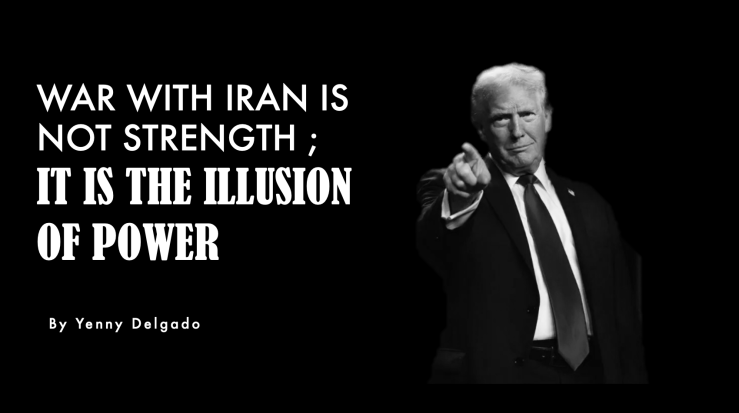
36 days ago Donald Trump decided to bomb Iran in support of Israel, furthering a pattern of expansion in the Middle East. By acting unilaterally and bypassing congressional approval, he has embroiled the nation in a conflict characterized by destruction and control. This approach neglects a fundamental truth: genuine leadership in a democracy is defined not by domination, but by service and the valuing of human life.
The ongoing escalation involving Iran, led by the United States and Israel, raises urgent moral, theological, and political questions. Beyond national security rhetoric, deeper concerns persist, including economic interests, political calculations, and the pursuit of regional influence. Military strength, regardless of its sophistication, does not confer moral legitimacy to endanger entire populations.
When bombs target schools and children, society must confront a painful reality: the erosion of what is sacred. Within the Christian tradition, protecting life, especially that of children, is a core value. When this principle is violated, the failure extends beyond policy; it constitutes a profound failure of conscience.
Each day, global headlines are saturated with fear, threats, and destructive rhetoric. Political figures openly discuss annihilation, treating such language as a strategic tool. However, threatening the eradication of entire nations does not demonstrate strength; it signifies moral collapse. No national interest can justify terror or mass death. Just hearing it should make us tremble!
Meanwhile, those in power remain largely insulated from the consequences of their decisions. Choices about war are made far from the lives they affect, while civilians, families, children, and entire communities bear the burden. In territories like Gaza, Lebanon, and Iran, millions endure uncertainty and struggle to survive. Will the victims get justice for what Israel and the United States are doing?
Simultaneously, unresolved corruption and abuse of power among elites continue to damage public trust. Epstein Files show the monstrous nature of man in power, sexual abuse of minors, among other atrocities, remains covered, and victims are waiting for justice. When truth is obscured and accountability is evaded, a larger moral crisis emerges, influencing foreign policy decisions. A government unable to address injustice domestically cannot credibly advocate for justice internationally.
This situation prompts a necessary question: Are calls to war distracting from deeper issues? If so, the problem is not just political; it is fundamentally ethical. Leadership driven by fear, ego, and deflection conflicts with the democratic values the United States claims to uphold. especially when pastors and evangelical religious leaders like Franklin Graham pray in daylight and on television to support Donald Trump instead of opposing him on his actions.
Threatening the destruction of Iran and the deaths of millions does not constitute a strategy; it represents the rhetoric of catastrophe. No leader possesses the moral authority to determine the fate of entire populations. Such actions do not exemplify leadership; they reflect a dangerous distortion of power.
From a faith perspective, the message is unequivocal: God does not endorse unjust violence. War cannot be justified as an instrument of control. The destruction of human life is never acceptable.
This perspective also challenges communities within the United States that have supported violence under the guise of religious justification. No sincere interpretation of sacred texts supports terror, suffering, or the elimination of others. Invoking God to defend violence is not an act of faith; it is hypocrisy.
It must be acknowledged that bombing does not bring liberation; it is an exercise of control. When power is used at the expense of human life, it loses legitimacy.
It is time to reject leadership motivated by ego, corruption, and fear. Donald Trump must be scrutinized, questioned, and held accountable for his actions.
Across the country, voices are rising: “No Kings,” “No more endless wars,” and “Not in our name.” These statements do not indicate weakness; they represent expressions of democratic responsibility.
True strength is not measured by military force, but by the courage to protect life, uphold justice, and choose restraint over destruction.
 PUBLICA