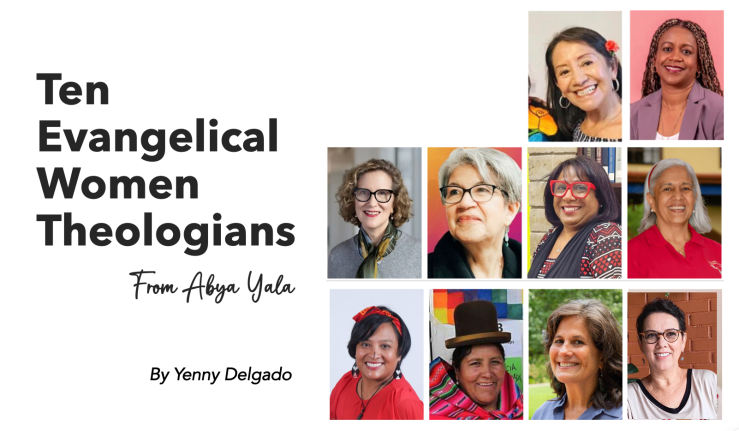
Ten Evangelical Theologians You Should Know and Read
By Yenny Delgado
I grew up in an evangelical family, where faith, Scripture, and church life shaped my earliest understanding of Christianity. Although I was part of the evangelical church only for a period of my life, I have remained deeply interested in it. Over the years, I learned from other Christian traditions, met women theologians, and saw how much women have contributed to theological reflection across Abya Yala.
As an ecumenical theologian today, I still consider my evangelical roots a key part of my story. They sparked my interest in the theological work of women from various evangelical backgrounds. I have learned from several of the women featured here, met some of them, and followed their journeys. My writing draws on these personal experiences and my reading, even though women were often not recognized as theologians per se in the past.
In 2020, I began the series Women Theologians in World Christianity to highlight women theologians who have shared theological reflections and new ways of understanding and believing in God, often without much recognition. While working on this, I saw that evangelical women theologians (Baptist, Pentecostal, or other independent backgrounds) were especially underrepresented in discussions and academic resources. Their work was rarely mentioned, sometimes only briefly in courses about mission or church history. Their contributions deserve much more attention.
In this article, I introduce ten women whose theological work encourages us to broaden our understanding of evangelical theologians from Abya Yala*.
1. Ruth Padilla DeBorst (Colombia)
Ruth Padilla was born in Colombia and raised in Argentina. She is the daughter of the renowned evangelical theologians Catalina and René Padilla and grew up in the misión integral movement, which sees evangelism and social justice as connected parts of Christian faith.
She studied education in Argentina, earned a master’s in interdisciplinary studies at Wheaton College, and completed her PhD in theology at Boston University in the United States. Her work connects biblical reflection, mission, social justice, and care for creation from an evangelical perspective. She has served as president of the Latin American Theological Fellowship (Fraternidad Teológica Latinoamericana) and has worked with CETI and the International Fellowship for Mission as Transformation (INFEMIT).
A good starting point is Reading the Bible Latinamente, which invites readers to approach Scripture from Latin American communities and experiences.
2. Irma Espinoza (Peru)
Irma Espinoza is a Peruvian evangelical theologian who has worked for more than forty years with Indigenous peoples in Amazonian communities in Peru and Brazil. She earned her doctorate at the South African Theological Seminary.
Her missionary and theological work promotes integral, contextual evangelization grounded in intercultural dialogue, justice, and respect for Indigenous spirituality. Through her life and work, she connects Christian faith with ancestral cultures and the dignity of Amazonian peoples. Her experience invites us to rethink how Christian mission relates to the spiritual knowledge and traditions of the communities it encounters.
3. Jocabed Solano (Panama)
Jocabed Solano is a Guna evangelical theologian and missionary from Panama who works with Unidos en Misión. She directs Indigenous Memory, a project that gathers and shares stories of how evangelical churches have grown among the Indigenous peoples of Abya Yala.
Memoria Indígena draws on biographies, testimonies, and community memories to recognize Indigenous Christian leaders as the storytellers of their own histories. Her work matters because it challenges the habit of telling the history of Christianity in the region only through missionary stories. It gives Indigenous Christian communities space to reclaim their memories, affirm their identities, and share their own theological perspectives.
4. Agustina Luvis (Puerto Rico)
Agustina Luvis is an evangelical Pentecostal Puerto Rican theologian. She earned a master’s degree and a doctorate in Systematic Theology from the Lutheran School of Theology in Chicago.
Her work addresses the role of women in pastoral ministry, as well as the contributions of Pentecostal and feminist theologies. She served as dean of the Evangelical Seminary of Puerto Rico, where she fostered the formation and leadership of new generations of women in theological and pastoral roles.
5. Nancy Bedford (Argentina)
Nancy Bedford is an Argentine evangelical theologian. She earned her M.Div. at the University of Texas at Austin and Southwestern Baptist Theological Seminary, and her doctorate in Germany under the supervision of Jürgen Moltmann. She taught theology at Instituto Universitario ISEDET and International Baptist Theological Seminary. In the United States, she is Professor of Theology at Garrett-Evangelical Theological Seminary.
Her research interests include global feminist theories and theologies, theologies of migration and intercultural theologies, and liberating readings of Scripture. Her commentary on Galatians in the Belief theological commentary series is a good place to begin.
6. Nidia Fonseca (Costa Rica)
Nidia Fonseca is a Costa Rican evangelical theologian, a pastor since 1986, and Bishop of the Venezuelan Evangelical Pentecostal Union Church. She studied theology at the Latin American Biblical University and has extensive academic training in theology and pedagogy. She earned a Master’s degree in Critical Pedagogy from the Simón Rodríguez University of Venezuela and a Diploma in the Prevention of Prostitution and Human Trafficking from the Catholic University of Córdoba.
Nidia has dedicated herself to pastoral care and has also written extensively on topics such as women, sexuality, and religion.
7. Elena Vázquez (Cuba)
Elena Vázquez is a Cuban evangelical theologian of African descent, educator, writer, and leading voice in Black theology. She studied theology at the Central American Theological Seminary (SETECA) in Guatemala and earned a Doctor of Ministry from Dallas Theological Seminary.
She teaches history and theology at SETECA, where she currently serves as vice president. She also founded Trasciende, a ministry dedicated to women’s theological and educational development. Her work addresses identity, dignity, justice, and faith from the perspective of Afro-descendant women.
8. Elizabeth Conde- Frazier (United States)
Elizabeth Conde is a United States evangelical Baptist theologian and educator. Her work focuses on theological education, Christian formation, and the experiences of Latino/a communities in the United States.
She co-authored Latina Evangélicas with Loida Martell-Otero and Zaida Maldonado Pérez, helping to open space for Latina women’s theological voices in academic and church conversations. Her work in theological education and community formation is especially significant for those training new church leaders. She shows that education is a place where faith, culture, identity, and social realities meet.
9. Vicenta Mamani (Bolivia)
Vicenta Mamani is an Aymara evangelical theologian. She holds a bachelor’s and a master’s degree from the Latin American Biblical University and a diploma from the Bolivian Catholic University. She has devoted her career to pastoral and educational ministry, working closely with community leaders and the Evangelical Methodist Church in Bolivia, where she served as a national promoter.
Her work reflects on the relationship between faith and Indigenous identity. She holds that Andean peoples, including the Aymara, do not have to stop being Aymara in order to be Christians. For her, many of the values found in the Bible, such as loving our neighbor, visiting the sick, and standing in solidarity with our sisters and brothers, are communal, human values that align with the Gospel. The two complement each other, and the Gospel’s values ultimately strengthen the Aymara way of life.
Her voice reminds us that Christian faith can be lived from within Indigenous cultures rather than apart from them.
10. Regina Fernandes Sanches (Brazil)
Regina Fernandes is a Brazilian evangelical theologian who connects integral mission, theological education, and the realities of Brazilian society. She earned a PhD in theology from the Faculdade Teológica D’Oeste do Brasil, a master’s in missiology from the Faculdade Teológica Sul Americana, and an advanced degree in Afro-Brazilian and Indigenous history and culture from the Universidade Luterana do Brasil.
She served as executive secretary of the Brazilian chapter of the Latin American Theological Fellowship and has taught at several theological schools in Brazil. Her books include Teologia da Missão Integral: História e Método da Teologia Evangélica Latino-Americana (2009) and Como Fazer Teologia da Missão Integral (2015).
Her work brings a Brazilian, Portuguese-speaking perspective to this conversation and shows how integral mission theology continues to develop across the continent.
Why These Voices Matter
These ten women come from different generations, church backgrounds, academic paths, and theological commitments. Their work is rooted in the everyday life of women in the church and society. Some write from universities and seminaries, while others work closely with churches, Native communities, and theological education projects.
They show us that evangelical theology from Abya Yala is not a single way of thinking or a single tradition. It is shaped by the histories and struggles, by women’s experiences, by questions of identity and belonging, and by the search for ways to live out Christian faith in our own lives.
If you teach, consider including one of these women theologians in your next course. If you are a student, explore their articles, books and writings. And if you know other evangelical and women theologians who should be part of this conversation, I would love to hear about them.
Yenny Delgado is an Abya Yala theologian and peruvian psychologist. For two decades, she has worked with social movements, local churches, and regional governments, advocating for decolonial education in Abya Yala. She is the Director of PUBLICA, a public digital square that encourages women theologians to write and reflect on everyday life from the global periphery. She is the founder of the Political Theology and Spiritualities Network, which brings together political and public theologians, and the convener of Women Doing Theology in Abya Yala, an ecumenical, intergenerational space dedicated to amplifying women’s voices in theological education across the continent.
*Abya Yala comes from the Guna language and means “land in full maturity and land of vital blood.” Abya Yala symbolically represents the continent’s interconnectedness. In the 1970s, we adopted Abya Yala as the unified name for our Motherland. We use Abya Yala instead of Latin America, the Americas, Hispanic America, and other names that perpetuate the colonial divisions of our continent.

