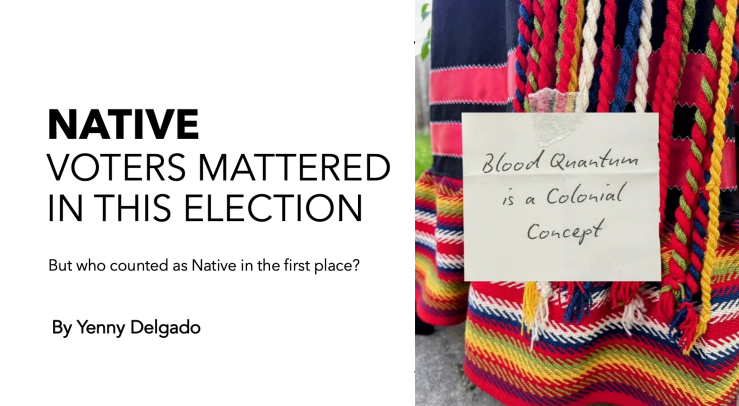
Native voters mattered in this election. But who counted as “Native” in the first place?
In the U.S., Native identity is often measured by blood quantum, a concept created and imposed by the federal government and white settlers to quantify a person’s “degree of Indian blood” in fractions (1/2, 1/4, 1/8). Its purpose was to shrink the number of people legally recognized as Native, and with it, the government’s treaty and land obligations.
It became entrenched in tribal citizenship rules after the Indian reorganization Act of 1934, which pressured or incentivized many Native nations to adopt boilerplate, federal-style constitutions that included blood quantum requirements.
The result: a colonial tool built to erase Native peoples that still shapes who is enrolled, who gets a vote in tribal elections, and whose voices are counted.
Native people were not guaranteed the right to vote in every state until well after they became U.S. citizens in 1924. Their political power has always been contested, criticized, and challenged, which is why it matters to know who Native peoples in the United States actually are.
Now look at this election
On social media, I saw communities celebrate candidates who looked like them, prayed like them, or spoke like them. White voters celebrated white candidates. Black voters celebrated Black candidates. Latinos celebrated Latino candidates, though “Latino” can mean anyone from fully white to deeply mixed, including people with Native ancestors, united by a language that is itself a colonial legacy, now worn with pride.
But that label also hides a group that rarely gets named: people with Native ancestry who may speak an ancestral language, or only Spanish, and whose Indigenous identity was stripped away over generations. Under Spanish colonial rule, Indigenous peoples were sorted into caste categories, pushed to convert, and made to speak Spanish.
After independence, many former Spanish colonies promoted mestizaje, a story of blending that treated Native identity and Indigenous practices as something of the past. Then, in the United States, federal agencies put everyone into the same box as “Hispanic,” a category that, as sociologist Cristina Mora shows in Making Hispanics, was built in the 1970s by activists, bureaucrats, and the media. For many, “Latino” or “Hispanic” became the only option on the form, even when it did not describe where their family came from.
So who celebrated the Native candidates? Is it only those recognized as citizens of a tribal nation, which, because of blood quantum, is a question of paperwork and politics as much as ancestry? Or also the people who know deep down that they carry Native and ancestral memories, but who migrated, live across borders, or can’t get a tribal ID because their ancestors were never listed on the official rolls?
It showed that people look for similarity: shared beliefs, ancestry, language. And it raises a real question about what representation means now that a new Senate and House of Representatives are taking shape in the U.S. They are meant to represent everyone. They will have to set their differences aside and work together for a country that feels like it’s coming apart.

